
A donor’s gift size tells only part of the story. Wealth screening nonprofit tools compare donor information with available financial and philanthropic indicators, helping organizations assess potential giving capacity and guide thoughtful outreach. Used well, wealth screening supports informed decisions, not assumptions about what an individual should give.
It’s reasonable to want a clear view of what these tools can reveal before choosing one. Through comprehensive services provided by Nonprofit Solutions Matter, Inc., this comparison explains the data these tools use, how their capabilities differ, and which considerations matter when selecting the right solution for your organization. You’ll also see how screening can fit into a broader, relationship-centered approach to resource development.
Key Takeaways
- Distinguish capacity, affinity, and propensity indicators to interpret what each signal can tell you about a donor relationship.
- Understand how property, stock ownership, and nonprofit affiliations offer different clues, and why no single data point tells the whole story.
- Compare screening tools by the donor data they provide, record-matching performance, and how well their features fit your team’s workflow.
- Consider a Resource Development Audit when you need to connect screening insights with a broader, sustainable approach to donor engagement.
What Is Wealth Screening Software?
Wealth screening software matches donor records against available financial and philanthropic indicators. It can help teams distinguish estimated financial capacity from a donor’s connection to the mission and history of giving.
Capacity and Affinity Indicators
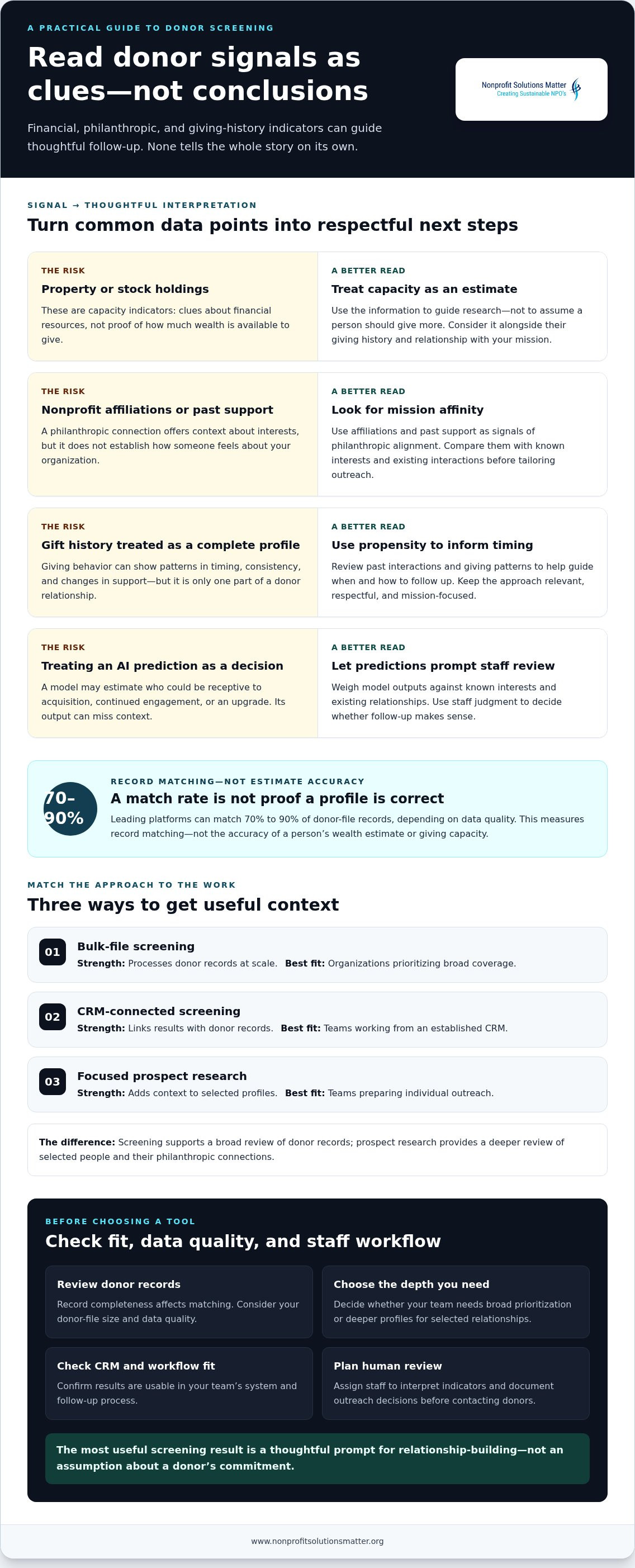
Capacity indicators estimate financial resources, such as property ownership or stock holdings. They do not show how much wealth is available to give. Affinity indicators reflect a donor’s connection to your work, including past support or affiliations with nonprofits. Propensity indicators focus on giving behavior, such as gift history, and can help guide decisions about timing and outreach.
Screening Tools and Prospect Research
Screening tools analyze donor records at scale, grouping indicators to help prioritize follow-up. Prospect research services add a more focused review of an individual’s background and philanthropic connections. How do they compare? Screening supports broad review; prospect research provides deeper context for selected people. For example, a $50 gift made two years earlier may merit attention when other indicators suggest a stronger connection or capacity.
Estimate Accuracy and Ethical Practices
Leading platforms can match 70% to 90% of donor-file records, depending on data quality. That match rate measures record matching, not the accuracy of a person’s wealth estimate or giving capacity. What are the ethical risks? Treating estimates as facts can lead to intrusive outreach or assumptions about a donor. Use indicators as research prompts, consider the person’s giving history, and keep outreach respectful and mission-focused.
| Option | Primary indicator | Best use |
|---|---|---|
| Capacity screening | Financial resources | Estimate potential giving capacity |
| Affinity review | Mission connection | Understand philanthropic alignment |
| Propensity analysis | Giving behavior | Inform outreach timing |
| Prospect research | Individual context | Guide focused relationship-building |
Choose an approach suited to your team’s needs, whether broad prioritization or deeper context for specific donor relationships.
Donor data including real estate, stocks, and nonprofit affiliations
Screening tools can organize financial, philanthropic, and location-related records alongside information in your donor database. Their value depends on how your team interprets the indicators and uses them to guide outreach.
Segmentation by Wealth and Interests
Donor segments may group people by estimated resources, interests, mission affinity, or geography. For example, a record showing real estate ownership offers a different clue from an affiliation with a nonprofit connected to your cause. Stock holdings may provide another financial indicator, while a donor’s location can help organize relationship-building by community. Compare these signals, then tailor relevant communications rather than treating wealth as a measure of commitment.
Some systems use AI-based analysis to estimate which donors may be receptive to acquisition, continued engagement, or an upgrade. These predictions can help prioritize records for review, but consider them alongside known interests and existing relationships. A model’s output should prompt thoughtful follow-up, not replace staff judgment.
Giving History and Philanthropic Activity
Your organization’s giving history can reveal patterns in gift timing, consistency, and changes in support. Philanthropic activity, such as affiliations with other nonprofits, can add context about a donor’s interests. These signals differ from property or stock data: they describe demonstrated engagement, not simply potential resources. Review past interactions before deciding how to approach a donor.
Choose software that fits your budget, donor-file size, and current CRM workflow. A smaller file may need straightforward segmentation, while a larger or more complex database may benefit from stronger matching and integration features. Check that the system returns usable records in a format your team can manage, and assign a staff member to review results before outreach.
Wealth screening tools for nonprofits
For a nonprofit in Pennsylvania, compare tools by match performance, data coverage, CRM fit, and how clearly results support action. Leading platforms can match 70% to 90% of donor-file records, depending on data quality. A match is a record connection, not proof that every profile or estimate is correct.
Consider the privacy obligations that apply to your donor information and how your organization uses screening results. The relevant considerations depend on your organization, the data involved, and the purpose of screening.
This comparison doesn’t identify Pennsylvania-specific vendors or local nonprofit resources. Use the criteria below to assess whether a platform fits your donor file and workflow.
| Tool approach | Strength | Best fit |
|---|---|---|
| Bulk-file screening | Processes donor records at scale | Organizations prioritizing broad coverage |
| CRM-connected screening | Links results with donor records | Teams working from an established CRM |
| Focused prospect research | Adds context to selected profiles | Teams preparing individual outreach |
Before selecting a tool, take these steps:
- Review donor-record completeness, since data quality affects matching.
- Identify whether staff need broad screening or deeper individual profiles.
- Confirm results can fit the team’s CRM and follow-up process.
- Decide how staff will interpret indicators and document outreach decisions.
For a Pennsylvania nonprofit, the strongest choice is the one that turns usable matches into respectful, relevant engagement. A large match rate alone won’t establish fit; donor-file quality, data usefulness, and staff capacity matter too.
Nonprofit Solutions Matter: Resource Development Audits
Nonprofit Solutions Matter, Inc. helps organizations connect screening insights with a broader resource development strategy. A Resource Development Audit is a practical next step when donor data is available but priorities, processes, or follow-up plans need better alignment. The audit can help leaders assess how donor engagement fits the organization’s overall approach to sustainability.
When screening raises questions about donor outreach, the Donor Acquisition Program can support a more structured approach to building donor relationships. Executive Coaching & Leadership Development and Board Engagement & Governance Training can also help organizations strengthen leadership capacity and board participation.
Book a Strategy Call with Nonprofit Solutions Matter, Inc. to discuss how a Resource Development Audit can support your organization’s next steps.
Turn Donor Insights Into a Clear Next Step
Wealth screening nonprofit tools are most useful when they support a deliberate relationship plan, not a standalone ranking. Before acting on a result, decide what your team needs to learn, which donor relationships need attention, and how follow-up will reflect each person’s connection to your mission. This clarity helps turn data into thoughtful engagement while keeping your organization’s priorities in view.
To connect donor insights with a stronger resource development strategy, book a conversation with Nonprofit Solutions Matter, Inc. and identify practical next steps for your organization.
Build a steadier path forward, one considered decision at a time.
Frequently Asked Questions
What is wealth screening for nonprofits and how does it work?
Wealth screening helps a nonprofit organize donor information to guide prospect review and outreach. The process typically matches donor records with external information, then presents indicators for staff assessment. For example, a development team can flag records for further research, correct incomplete contact details, and decide who should receive personalized follow-up rather than relying on gift size alone.
What data sources do nonprofit wealth screening tools use?
Tools may draw on public property records, financial ownership information, philanthropic activity, nonprofit affiliations, and geographic data. Sources vary by platform and donor record. Before interpreting a profile, staff can check whether names and addresses align, distinguish recorded facts from estimates, and note when a record may belong to someone with a similar name.
Which wealth screening platforms are best for nonprofits?
The best platform is one your team can use consistently with its donor records and workflows. Before choosing, test a representative sample of your database. Assess whether the results are understandable, duplicates are manageable, and records can be exported in a useful format. Also decide who will review the findings and how staff will document follow-up decisions.
How much do nonprofit wealth screening services cost?
Costs vary according to the work involved and are provided after a quote request. Factors include the size and condition of the donor file, the breadth of screening, and whether the work includes individual prospect research. Before requesting a service quote, define which records you want reviewed and what level of analysis your team needs.
How can nonprofits use wealth screening to identify major gift prospects?
Use screening to prioritize records for thoughtful qualification, not to assign a gift amount automatically. Review a prospect’s relationship with your organization, confirm relevant details in your own records, and plan an appropriate conversation. For example, a staff member might invite a consistently engaged supporter to discuss their interests before considering a larger giving opportunity.

Article by
Sharon D Jones
Sharon D. Jones, M.Div., is a globally respected fundraising strategist, nonprofit leadership expert, and capacity-building architect with over three decades of experience. As the Founder and CEO of Nonprofit Solutions Matter, Inc., her proprietary growth frameworks have successfully mobilized nearly $957 million in philanthropic capital for local, national, and international organizations.
General Disclaimer & Disclosure
The information provided on this website is for general informational and educational purposes only. While we strive to keep content accurate and up to date, we make no representations or warranties of any kind, express or implied, about the completeness, accuracy, reliability, or suitability of the information contained herein.
Professional Advice
The content on this site does not constitute professional advice (e.g., legal, financial, medical, or tax). You should consult with a qualified professional before making any decisions based on the information provided on this website. Any action you take upon the information found on this site is strictly at your own risk.
Affiliate & Third-Party Links
Some articles on this site may contain affiliate links. If you click on an affiliate link and make a purchase, we may receive a small commission at no additional cost to you. We only recommend products or services we believe add value to our readers. We are not responsible for the content, privacy policies, or practices of any third-party websites linked within our articles.


