
Training alone will not strengthen an NGO if its finances, leadership, and internal systems remain fragile. Global NGO capacity building has lasting impact when it develops managerial, financial, and organizational capacity together, helping local teams turn development goals into sustained work.
It is understandable to focus first on program delivery: communities need practical results, and resources are limited. But lasting progress also depends on the organizations and local governments responsible for sustaining that work. This article explains how capacity building supports global development goals, which organizational needs it can address, and how to approach leadership, financial systems, governance, and organizational development as connected priorities. It also highlights ways to identify the capabilities your organization needs and where professional support can help build a stronger foundation for long-term impact.
Key Takeaways
- Connect capacity-building priorities to development goals so stronger systems can sustain progress beyond individual projects.
- Assess local government and NGO needs before selecting support, keeping institutional context and long-term ownership in view.
- Strengthen managerial, financial, and organizational practices as interdependent foundations for effective implementation and monitoring.
- Use targeted professional support to clarify resource development, leadership, governance, and donor acquisition priorities.
Capacity building and global development goals
Effective global NGO capacity building has evolved from technical training in the 1970s to institutional strengthening in the 1980s. In 2009, international development interventions allocated about $20 billion per year to capacity development, roughly 20% of funding. The World Bank committed more than $1 billion per year through loans or grants as of 2009. OECD-DAC estimated that more than $15 billion a year went to technical cooperation in 2005, most ostensibly aimed at capacity development.
UNDP and UNESCO are among the global organizations providing capacity-building support. UNDP integrated capacity development into work on the Millennium Development Goals, targeted for achievement by 2015. UNESCO’s programs include training and exchange on living heritage, connecting community knowledge with safeguarding and sustainable development.
The GCBC 2026 Accelerator selected five high-impact initiatives working in and for emerging markets and developing economies. A practical sequence for global NGO capacity building is to assess local priorities, align assistance with development goals, strengthen institutions, then monitor whether capabilities endure beyond a project.
Useful tools include a capacity assessment to identify organizational gaps, a stakeholder map to clarify local roles, and a monitoring framework to track implementation and sustainability. UNESCO’s training and exchange formats support shared learning on living heritage. Consultant and training costs depend on scope, delivery format, and local implementation needs; pricing is provided after a quote request. Common risks include short-term training without follow-through, imported approaches that overlook local context, and weak ownership. Sustained participation and clear monitoring help address these challenges.
Capacity support for local governments and NGOs
In Panama, global NGO capacity building should reflect each organization’s mission, operating context, and relationships with public institutions. A consultant can assess where decision-making, service delivery, or coordination needs strengthening before shaping assistance. This keeps the strategy grounded in the country’s priorities rather than applying a standard model.
The GCBC Accelerator selected five high-impact initiatives working in and for emerging markets and developing economies. Its 2026 cohort is a useful example of support organized around selected initiatives. For project teams, a stakeholder map can clarify local roles, while an evaluation framework can track implementation and learning.
When planning global NGO capacity building, provide the organization’s mission, country context, strategy, governance structure, financial processes, program priorities, and evaluation findings. Include staff and partner roles, operational constraints, and the outcomes the organization wants to sustain. This information helps shape practical support around real needs rather than generic training.
Operational support connects internal systems with project delivery. Teams can map how responsibilities, budgets, and reporting move through a project, then identify gaps in handoffs. A process map clarifies ownership, while regular evaluation helps staff adapt implementation and retain organizational knowledge. This makes capacity support part of everyday operations rather than a separate activity that ends after a workshop.
Managerial, financial, and organizational capacity
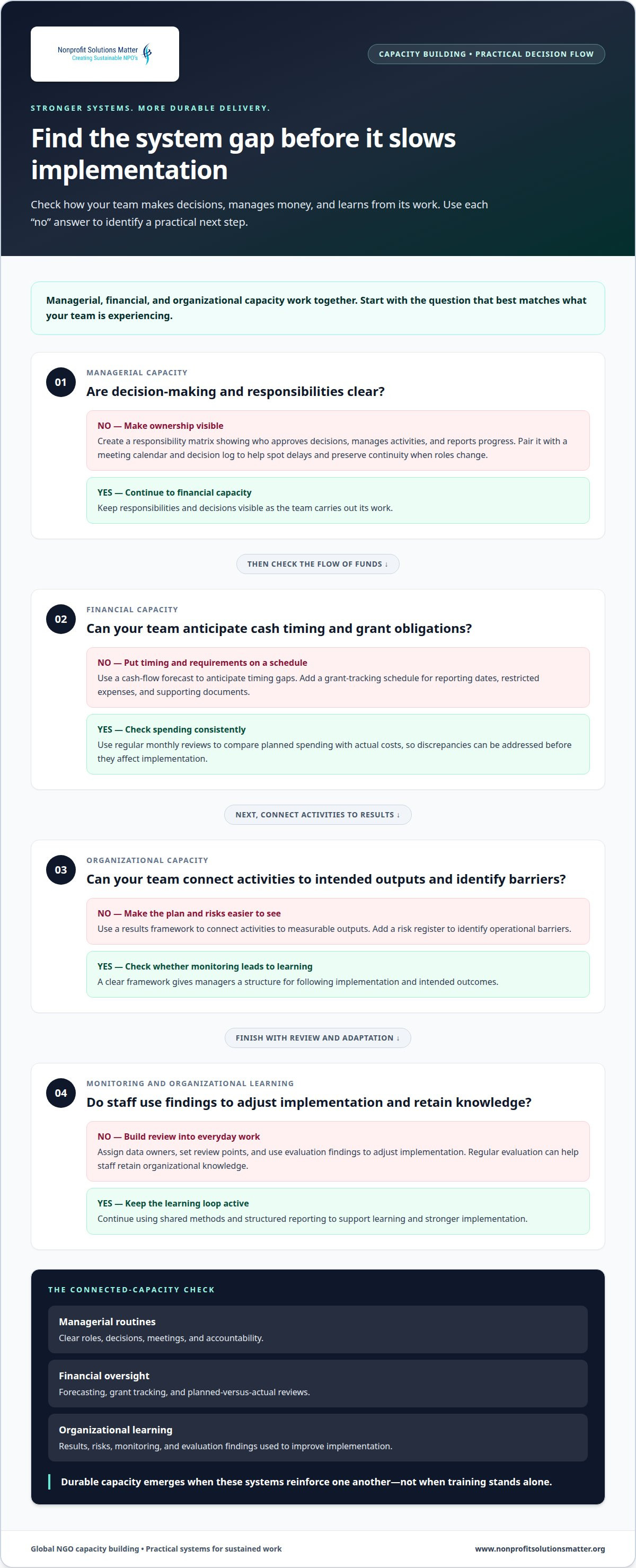
Strong implementation depends on managers who connect sector priorities with clear responsibilities. A responsibility matrix can show who approves decisions, manages activities, and reports progress. Pair it with a meeting calendar and decision log. Together, these tools help leadership teams spot delays, maintain accountability, and preserve continuity when staff roles change.
Financial capacity supports reliable delivery across grants and other revenue sources. A cash-flow forecast helps teams anticipate timing gaps, while a grant-tracking schedule records reporting dates, restricted expenses, and supporting documents. Consistent monthly reviews can compare planned spending with actual costs. This gives managers time to address discrepancies before they affect project implementation.
Consultants select frameworks by assessing an NGO’s mission, sector, operating environment, and existing systems. They then choose an approach that fits local priorities, available staff capacity, grant obligations, and intended outcomes. A results framework can connect activities to measurable outputs, while a risk register helps teams identify operational barriers.
Monitoring turns these systems into learning tools. UNESCO held online training of trainers on periodic reporting under the 2003 Convention on 17-18 September 2026. The example highlights the value of structured reporting and shared methods. An NGO can adapt the principle by assigning data owners, setting review points, and using evaluation findings to adjust implementation. Durable capacity emerges when managerial routines, financial oversight, and organizational learning reinforce one another.
A study on local capacity building observed that revisiting an organization’s aspirations and strategy is often the first step toward improving its capacity. Strategic renewal can therefore complement financial controls and reporting as a foundation for stronger delivery.
A Bangladesh diaspora assessment found that US Bangladeshi diasporas support development by building the capacity of local companies, government, and civil society organizations. The Ukraine Grants for Advocacy on Privatization initiative supported civil society organizations in monitoring privatization and informing citizens about its benefits.
Nonprofit Solutions Matter
Nonprofit Solutions Matter, Inc. helps NGOs turn capacity priorities into stronger internal systems. Its support connects resource development, leadership, governance, and donor engagement with broader sustainability goals. Professional guidance can be useful when your team sees organizational gaps but needs a clear way to decide which priorities to address first.
A Resource Development Audit can clarify whether current resource development practices support the organization’s strategy. It can be useful when revenue sources are concentrated, donor engagement is inconsistent, or leaders need a clearer view of strengths and gaps. Executive Coaching & Leadership Development supports leaders as they manage change, set direction, and align staff around implementation.
Board Engagement & Governance Training can strengthen board participation, oversight, and role clarity. Donor Acquisition can help organizations take a more deliberate approach to engaging prospective donors. Each offering addresses a different capacity need, so the right starting point depends on the barriers affecting the mission, leadership, and financial resilience.
Before work begins, identify the capacity challenge, who will guide decisions, and which outcomes matter most. This context keeps support focused on practical priorities rather than disconnected activities. Durable systems should fit the organization and remain usable by its people. Choosing a clear starting priority gives leaders a practical basis for moving forward.
Frequently Asked Questions
What does capacity building mean for global NGOs?
For global NGOs, capacity building means strengthening the knowledge, practices, and systems needed to deliver their mission over time. It goes beyond a single training session. For example, a team can pair skills development with clearer procedures, local decision-making, and knowledge transfer, helping essential work continue as staff or project priorities change.
What are the core areas of NGO capacity building?
Core areas include leadership, governance, financial management, people and operations, resource development, and learning systems. Priorities vary: a new NGO may need sound internal policies, while an established organization may focus on leadership succession or diversified revenue. Effective capacity building connects these areas to the mission instead of treating each as an isolated improvement.
How can a capacity-building consultant assess an NGO’s organizational capacity and identify gaps?
A consultant can combine document review, interviews with leaders and staff, and facilitated discussions with board members. Reviewing a strategic plan alongside budgets, reporting processes, and staff responsibilities can reveal where stated priorities diverge from daily practice. The consultant can then summarize strengths, barriers, and organizational priorities in a findings-based plan, sequencing actions to fit available resources.
What funding and grants support NGO capacity building worldwide?
Capacity-building support may come through government assistance, multilateral development programs, private foundations, or grants tied to a broader project. Eligible activities depend on each funder’s priorities and grant terms. Organizations can strengthen a request by linking it to specific institutional needs, such as improving financial controls, staff capabilities, governance, or evaluation practices.
How can NGOs and their capacity-building consultants measure the impact of capacity-building initiatives?
Measure progress by establishing a baseline, choosing indicators linked to the initiative, and reviewing results at agreed intervals. For example, a governance project might track board participation and timely decisions, while a financial initiative might monitor reporting consistency. Pair these measures with staff feedback and evidence of continued use, so evaluation captures both operational change and organizational learning.
Article by
Sharon D Jones
Sharon D. Jones, M.Div., is a globally respected fundraising strategist, nonprofit leadership expert, and capacity-building architect with over three decades of experience. As the Founder and CEO of Nonprofit Solutions Matter, Inc., her proprietary growth frameworks have successfully mobilized nearly $957 million in philanthropic capital for local, national, and international organizations.
General Disclaimer & Disclosure
The information provided on this website is for general informational and educational purposes only. While we strive to keep content accurate and up to date, we make no representations or warranties of any kind, express or implied, about the completeness, accuracy, reliability, or suitability of the information contained herein.
Professional Advice
The content on this site does not constitute professional advice (e.g., legal, financial, medical, or tax). You should consult with a qualified professional before making any decisions based on the information provided on this website. Any action you take upon the information found on this site is strictly at your own risk.
Affiliate & Third-Party Links
Some articles on this site may contain affiliate links. If you click on an affiliate link and make a purchase, we may receive a small commission at no additional cost to you. We only recommend products or services we believe add value to our readers. We are not responsible for the content, privacy policies, or practices of any third-party websites linked within our articles.


