
A clear implementation boundary matters as much as the price. For a nonprofit starter pack Quickstart, the listed scope is limited to two person-weeks of consulting. The price depends on the case and is provided after a quote request.
It makes sense to want a defined scope before committing time and resources. This article explains what affects the Quickstart price, what falls outside its scope, and practical steps for putting the pack to work. Thoughtful planning, clear ownership, and focused training can help build a stronger foundation for sustainable operations.
Key Takeaways
- Understand how the Quickstart’s two person-weeks of consulting shape its scope, and what to clarify when reviewing inclusions and exclusions.
- See how reports, dashboards, workflow rules, and user training can support a more organized implementation.
- Learn practical ways to prepare your team, establish clear ownership, and build consistent use of your nonprofit’s systems.
- Explore when Nonprofit Solutions Matter’s Nonprofit Starter Pack may be a useful next step for strengthening organizational capacity.
Best practices for successful implementation
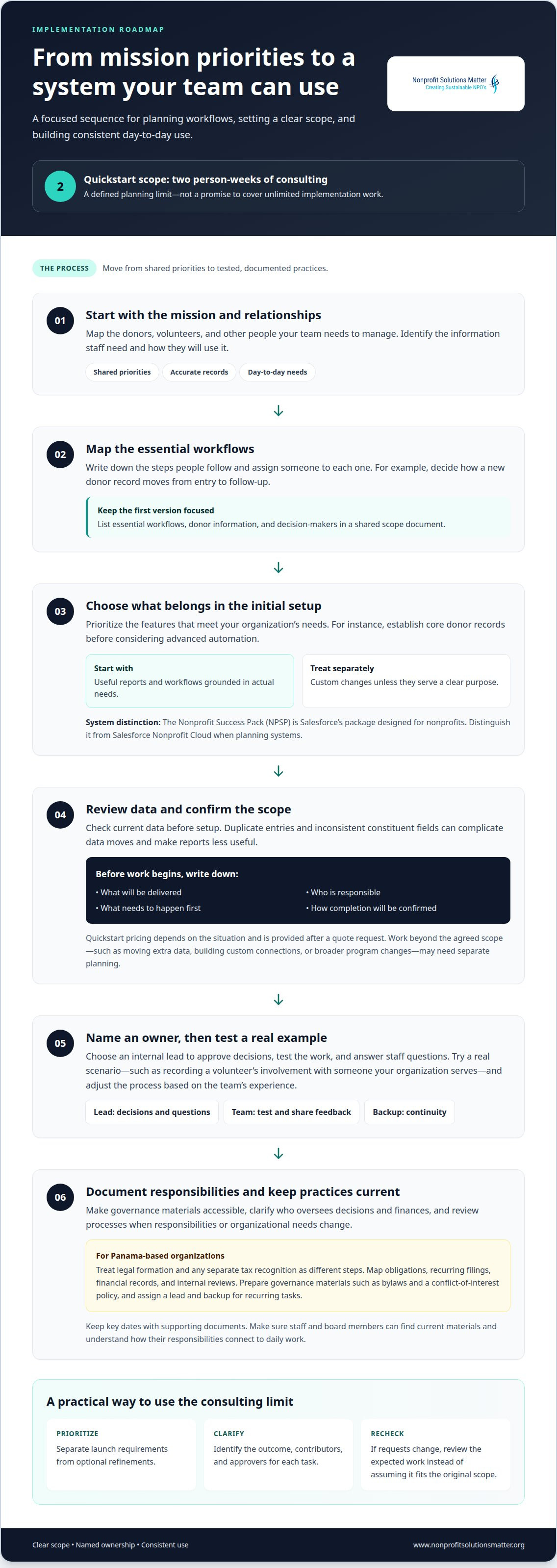
Start with the mission, then map the relationships with donors, volunteers, and others your team needs to manage. Clear steps help staff and volunteers use Salesforce consistently in their daily work. For example, decide how a new donor record moves from entry to follow-up, and assign someone to each step.
The Nonprofit Success Pack (NPSP) is Salesforce’s package designed for nonprofits. Because it’s part of the Salesforce ecosystem, be sure to distinguish NPSP from Salesforce Nonprofit Cloud when planning your systems. Start with features that meet your organization’s needs, and avoid custom changes unless they serve a clear purpose.
A sound implementation starts with shared priorities, accurate records, and a named internal lead. Before setting up a process, write down what information staff need and how they’ll use it. Test a real example, such as recording a volunteer’s involvement with someone your organization serves, then adjust the process based on the team’s experience.
Common startup risks include unclear responsibilities, weak financial planning, and choosing a structure before checking that it fits the mission. Compare operating independently with working under an established organization. Consider how much independence you want, whether you have the capacity to govern, and how much administrative work each option involves.
In Panama, treat legal formation and any separate tax recognition the organization may seek as different steps. The right steps depend on the organization’s structure and activities, so map out what you need before building your operating systems around them.
Document board members’ roles and responsibilities in the organization’s governing documents, and make sure they align with applicable Panama requirements. Set clear expectations for oversight, decision-making, and managing finances so board members understand their roles.
Plan a calendar for recurring filings, financial records, and internal reviews based on the organization’s obligations in Panama. Assign a lead and backup for each task, and keep key dates together with the supporting documents.
Prepare key governance materials before launch, including bylaws and a conflict-of-interest policy. Use them to explain how decisions are made, how conflicts are handled, and how staff, volunteers, and board members contribute to the mission.
Keep legal formation and tax planning as separate areas of work, and record the status of each before setting up related procedures. The Internal Revenue Service says that forming a nonprofit at the state level does not automatically give it federal income tax exemption. Use this as a planning checkpoint: identify what the organization is seeking, who will track it, and what documents support each decision. Don’t assume one step meets every other requirement.
As your systems take shape, make sure staff and board members can find current governance materials and understand how their responsibilities connect to daily work. Review processes when responsibilities or organizational needs change, and update related records so your practices match documented decisions. A clear process lead, a reliable backup, and accessible records help sustain the work without relying on one person’s informal knowledge.
Quickstart price and exclusions
Quickstart pricing depends on the situation and is provided after you request a quote. The agreed scope covers two person-weeks of consulting. Think of that as a planning limit, not a promise to handle unlimited implementation work. The work needed, current setup, data quality, and requested changes affect the project’s setup and planning needs.
Agree on what’s included before deciding which project priorities come first. For example, an organization may need core donor records before advanced automation. Putting those steps in order can help teams get useful reports without building more than they need. List essential workflows, donor information, and decision-makers in a shared scope document so Success Pack discussions stay focused on day-to-day needs rather than wish lists.
Treat work beyond the agreed Quickstart scope as a separate planning decision. Moving extra data, building custom connections, or making broader program changes may need separate planning. Before work begins, write down what will be delivered, who is responsible, what needs to happen first, and how you’ll know the work is complete. This helps staff, volunteers, and leaders avoid confusion as they work together.
Donor records and automation also depend on the quality of your current data. Duplicate entries or inconsistent constituent fields can make moving data more complicated and reports less useful. An early data review helps identify what needs cleaning up before setup begins. Assign an internal owner to approve decisions, test the work, and answer staff questions so the project keeps moving when daily operations compete for attention.
Ask how each proposed change supports donor relationships, resource development, or nonprofit success. Then weigh its value against the consulting time and setup it requires. For Panama-based organizations, write down team responsibilities and operational priorities in clear, shared language. This helps keep implementation focused on the mission and sustainable use. Use the quote process to match project needs with the stated scope and pricing.
The quickstart scope covers 2 person-weeks of consulting, so treat that allowance as limited when deciding what belongs in the initial engagement. Separate the work needed to start using the solution from improvements you can consider later. For each requested task, identify the outcome it supports and the people who need to contribute or approve it. This makes trade-offs clear before consulting time is used and gives the organization a practical way to confirm priorities with the provider. If requests change during planning, review the expected work rather than assuming the original allowance will cover every addition.
A focused kickoff can turn that limit into a useful series of decisions. Confirm which processes need attention first, what information is available, and who can answer questions promptly. Keep optional refinements separate from launch requirements, and note any assumptions that could affect the work. Clear priorities help participants focus on decisions that support agreed outcomes instead of reopening settled questions. The organization can then make informed choices about what to address now, defer, or consider separately.
Nonprofit Solutions Matter: Nonprofit Starter Pack
Nonprofit Solutions Matter, Inc. offers a Nonprofit Starter Pack for leaders building the foundations of a mission-driven organization. It can be relevant during formation when governance, leadership, or resource development priorities also need structure. The pack helps leaders consider how decision-making, revenue planning, and board engagement connect.
Start by identifying the organization’s most immediate capacity gap. If board responsibilities need definition, Board Engagement & Governance Training can strengthen oversight and participation. If leaders need support with direction and decision-making, Executive Coaching & Leadership Development may fit. Each service addresses a distinct need, so the right starting point depends on what is affecting progress.
Resource Development Audits help leaders assess whether current practices support revenue diversification and sustainability. For example, an organization with strong community relationships but inconsistent development planning may need to review its approach before adding activities. The goal is to connect priorities with practical systems, clear ownership, and a manageable path to build capacity.
A Nonprofit Starter Pack may suit a new leader seeking a more integrated foundation or an early-stage organization ready to move beyond informal processes. Clarifying the mission, the board’s role, leadership priorities, and immediate capacity needs can reveal which challenges to address first.
For leaders in Panama, keeping those priorities visible can help the organization stay focused as it develops. A considered discussion of the organization’s needs can clarify which support aligns with its stage and next capacity-building priority.
Frequently Asked Questions
What does a nonprofit starter pack include?
There is no universal set of contents: the term can describe different tools or support. For a new organization, identify whether the immediate need is legal incorporation, stronger board governance, leadership development, or resource development. Nonprofit Solutions Matter, Inc. offers support in these areas through distinct services, helping leaders focus on the capacity gap they need to address rather than assume every pack includes the same components.

Article by
Sharon D Jones
Sharon D. Jones, M.Div., is a globally respected fundraising strategist, nonprofit leadership expert, and capacity-building architect with over three decades of experience. As the Founder and CEO of Nonprofit Solutions Matter, Inc., her proprietary growth frameworks have successfully mobilized nearly $957 million in philanthropic capital for local, national, and international organizations.
General Disclaimer & Disclosure
The information provided on this website is for general informational and educational purposes only. While we strive to keep content accurate and up to date, we make no representations or warranties of any kind, express or implied, about the completeness, accuracy, reliability, or suitability of the information contained herein.
Professional Advice
The content on this site does not constitute professional advice (e.g., legal, financial, medical, or tax). You should consult with a qualified professional before making any decisions based on the information provided on this website. Any action you take upon the information found on this site is strictly at your own risk.
Affiliate & Third-Party Links
Some articles on this site may contain affiliate links. If you click on an affiliate link and make a purchase, we may receive a small commission at no additional cost to you. We only recommend products or services we believe add value to our readers. We are not responsible for the content, privacy policies, or practices of any third-party websites linked within our articles.


