
A useful nonprofit major gifts strategy does not start with a universal dollar figure. Set a threshold by reviewing your nonprofit’s budget, giving history, and donors’ past contributions. Choose a level that flags meaningful gifts without creating an unmanageable prospect list. Major gifts can deepen supporter relationships and help sustain programs and long-term priorities.
A clear threshold helps staff and board members decide where to focus their time. But an amount that works for one organization may be too high or too low for another. Base the figure on your own giving patterns and fundraising capacity.
Use your giving history to set a practical threshold, identify promising donor relationships, and shape an approach your organization can manage. The aim is a clear starting point, not a one-size-fits-all rule.
Key Takeaways
- Build donor relationships through attentive conversations and engagement, not only gift requests.
- Use your largest recent gifts to identify a threshold that reflects your organization’s donor base.
- Review giving patterns over time and adjust the threshold as your nonprofit’s capacity and donor relationships develop.
- Use a Resource Development Audit to assess whether your approach, systems, and team priorities support stronger donor relationships.
Why is major gift fundraising important?
Major gifts can provide a stronger base for a nonprofit’s mission and long-term priorities. An estimated 80% of individual donation revenue comes from the top 20% of donors, making intentional relationship-building an important part of resource development.
Avoid treating wealth screening as proof of intent, overlooking donor restrictions, or losing track of commitments. Record each donor’s stated priorities, restrictions, and agreed next steps. Acknowledge gifts and report on their impact.
For nonprofits operating in Panama, build compliance procedures around the organization’s registration, tax status, gift restrictions, and reporting responsibilities. Requirements depend on the entity and its activities, so establish procedures with qualified local legal and accounting guidance.
- Define “major” relative to your donor base. Review recent giving patterns and identify a level that represents a meaningful contribution for your organization, rather than adopting another nonprofit’s threshold.
- Qualify people through several signals. Consider giving history, demonstrated philanthropy, mission affinity, engagement, timing, and access to a relationship. Prioritize donors who have given frequently or increased gifts over the previous 2-3 years.
- Build cultivation around donor interests. Ask open questions, listen for the outcomes they value, and record priorities and timing. A volunteer or board member may help open a personal conversation when they already have a genuine connection.
- Use moves management to guide each relationship. Record a purposeful next action, assign an owner, and review progress with staff and board members. Major gifts can take months or sometimes years, so match the pace to donor readiness.
- Make a specific, mission-connected request, then steward the donation. Explain its intended outcome, honor restrictions, acknowledge the gift, and share impact updates. This sequence supports a successful major gift and continued engagement.
Defining a major gift threshold
- Use your organization’s giving history to choose a working threshold. Some nonprofits use $500; others set it at $10,000. These examples illustrate the range, not a standard. Consider your budget, donor base, and which gifts warrant individualized engagement.
- Set a revenue goal by connecting donor prospects to actual program needs. Count donors whose past gifts meet the threshold, review their giving patterns, and distinguish confirmed commitments from possible future contributions. Update the forecast as conversations develop, rather than treating every prospect as guaranteed income.
- Clarify how a dedicated major-gift program fits broader resource development. General outreach can engage a wide community, while a focused approach gives staff or board members responsibility for tailored donor relationships, proposals, and stewardship. Set clear owners so these efforts complement rather than compete.
- Plan the resources needed to sustain the work. Assign responsibility for donor conversations, data upkeep, proposal preparation, and follow-up. Use a CRM or organized spreadsheet to track commitments and next actions. Account for staff time, technology, prospect research, and donor engagement when assessing program costs.
- Prepare for each donor meeting by reviewing the person’s history, interests, and connection to the mission. Set a clear purpose, decide who will lead, and prepare open questions. Afterward, record agreed next steps and any preferences the donor shared.
- Personalize each proposal around the donor’s values and a defined outcome. Explain the requested support, its intended use, and the impact it can enable. A clear, tailored proposal helps the donor make an informed decision and gives the organization a basis for responsible stewardship.
Defining major gifts based on organizational size and past giving
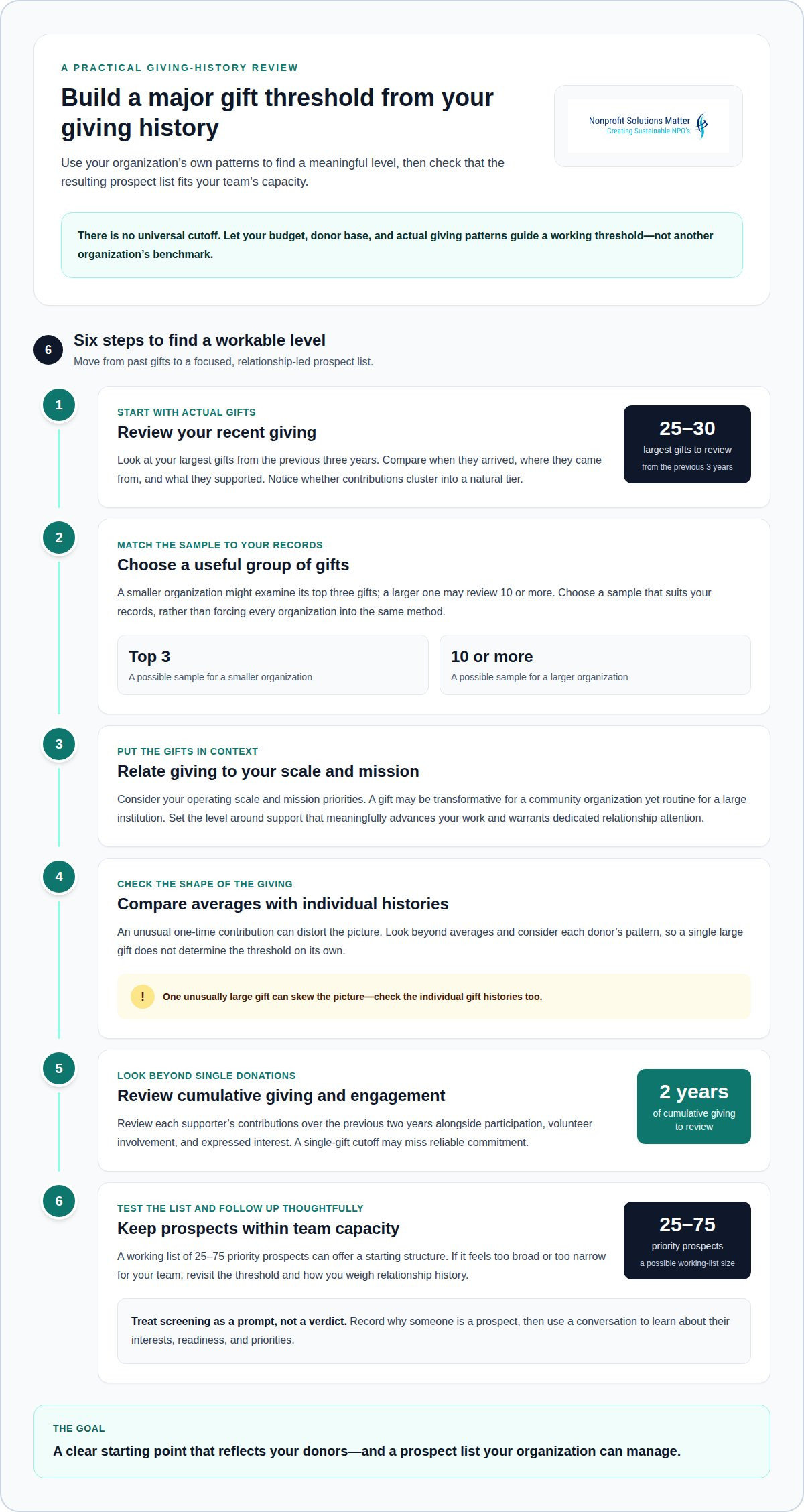
- Review your largest 25-30 gifts from the previous three years. Compare their timing, source, and purpose to see whether contributions cluster into a natural tier. A nonprofit major gifts strategy should begin with actual giving patterns, not an imported benchmark.
- Relate those patterns to your operating scale and mission priorities. A gift can be transformative for a community organization yet routine for a large institution. Consider what level of support meaningfully advances your work and warrants dedicated relationship attention.
- Choose a sample suited to your records. A smaller organization might examine its top three gifts, while a larger one may review 10 or more. Compare averages with individual gift histories, since an unusual one-time contribution can distort the picture.
- Assess cumulative giving, not only single donations. Review each supporter’s contributions over the previous two years alongside participation, volunteer involvement, and expressed interest. This can reveal reliable commitment that a single-gift cutoff would miss.
- Check whether the resulting prospect group fits your team’s capacity. A working list of 25-75 priority prospects can offer a starting structure. If the list is too broad or too narrow, revisit the threshold and how you weigh relationship history.
- Use screening as a prompt for thoughtful follow-up, not a decision about a person’s intentions. A nonprofit major gifts strategy becomes more grounded when staff record why someone is a prospect and use a meeting to learn about their interests, readiness, and priorities.
Nonprofit Solutions Matter, Inc.: Resource Development Audits
Nonprofit Solutions Matter, Inc. can assess whether your resource development systems support the donor relationships and priorities you have identified. A Resource Development Audit is a practical next step if your giving history is difficult to interpret, your threshold does not fit your donor base, or staff and board members need clearer roles.
The audit identifies strengths and gaps in your current approach, giving you a stronger basis for refining donor engagement and revenue priorities. If you also need to build leadership capacity or increase board participation, Executive Coaching & Leadership Development and Board Engagement & Governance Training can support that work.
Turn Your Threshold into a Lasting Practice
A threshold is useful when it guides consistent decisions, not when it sits unused in a policy document. Use it to structure prospect reviews, clarify who owns each relationship, and connect donor conversations to your mission. As your giving patterns change, revisit the approach and help your team apply it thoughtfully.
A durable nonprofit major gifts strategy also depends on organizational alignment. Nonprofit Solutions Matter offers Resource Development Audits, Executive Coaching & Leadership Development, and Board Engagement & Governance Training to strengthen the systems and leadership practices that support donor engagement.
If you are ready to clarify your next step, a conversation can help you consider the structure that best supports your work.
Build steadily, keeping your mission and donor relationships at the center.
Frequently Asked Questions
What are major gifts?
Major gifts are contributions that represent significant support for a particular nonprofit, relative to its resources and donor community. They may be one-time donations or commitments over time, and can support a specific project or broader mission priorities. For example, a gift for a new community program may qualify as major if it meaningfully advances the organization’s work.
How long does cultivation take?
Cultivation has no fixed timeline. It depends on the donor’s interest, readiness, and preferred pace of engagement. Someone who already knows the organization may be ready for a focused conversation sooner; a new supporter may need time to learn about its work. Let the donor’s questions and responses guide follow-up rather than treating a date on the calendar as a signal to ask.
What exactly should you say when you ask?
Be direct and specific, and connect the request to the donor’s interests. You might say, “Your interest in youth education aligns with our plans for this program. Would you consider a gift to help make it possible?” Then pause and listen. Explain what the contribution would support, invite questions, and give the donor room to consider the request without pressure.
What’s the difference between major giving and individual giving?
Individual giving includes donations from people across a range of amounts and giving patterns. Major giving is a focused part of that work, involving personalized engagement around a donor’s interests and a contribution’s potential impact. An annual appeal may invite broad participation, while a major-gift conversation explores whether a supporter wants to advance a particular organizational priority.
Who are major donors?
Major donors are supporters whose giving, engagement, and connection to the mission make a deeper relationship appropriate. Wealth alone does not establish readiness or intent. Consider a donor’s past support, expressed interests, participation, and willingness to discuss the organization’s work. A volunteer who gives consistently and champions a program may be a stronger prospect than someone with apparent capacity but little connection.
Article by
Sharon D Jones
Sharon D. Jones, M.Div., is a globally respected fundraising strategist, nonprofit leadership expert, and capacity-building architect with over three decades of experience. As the Founder and CEO of Nonprofit Solutions Matter, Inc., her proprietary growth frameworks have successfully mobilized nearly $957 million in philanthropic capital for local, national, and international organizations.
General Disclaimer & Disclosure
The information provided on this website is for general informational and educational purposes only. While we strive to keep content accurate and up to date, we make no representations or warranties of any kind, express or implied, about the completeness, accuracy, reliability, or suitability of the information contained herein.
Professional Advice
The content on this site does not constitute professional advice (e.g., legal, financial, medical, or tax). You should consult with a qualified professional before making any decisions based on the information provided on this website. Any action you take upon the information found on this site is strictly at your own risk.
Affiliate & Third-Party Links
Some articles on this site may contain affiliate links. If you click on an affiliate link and make a purchase, we may receive a small commission at no additional cost to you. We only recommend products or services we believe add value to our readers. We are not responsible for the content, privacy policies, or practices of any third-party websites linked within our articles.


