
A wealth score is not a major-gift strategy. Nonprofit prospect research services help organizations assess a potential donor’s capacity, interests, giving history, and connection to the mission, then use those insights to guide thoughtful relationship-building. Wealth screening is one input; prospect research adds context.
It’s understandable to begin with a donor’s apparent ability to give, but capacity alone doesn’t show whether an approach is relevant or well timed. This guide explains what prospect research includes, which tools nonprofits can use in Panama, how research supports major gifts, and how to distinguish a screening result from a fuller research process. You’ll also see how to turn useful information into a practical next step for resource development.
Key Takeaways
- Assess donor capacity, affinity, and giving propensity together to identify prospects whose interests align with your mission.
- Use your CRM, public records, nonprofit databases, corporate giving resources, and social networks to build a more useful picture of potential supporters.
- Distinguish a wealth screening, which flags possible capacity, from prospect research that adds context for relationship-building.
- Turn research into a focused major-gift plan, with thoughtful outreach shaped by each prospect’s connection to your work.
What are the most popular tools for researching donors?
Useful donor research combines internal records with external sources, then assesses capacity, affinity, and giving propensity. Nonprofits can use their CRM or donor database, nonprofit databases, public records, corporate philanthropy databases, and social networks. In Panama, prospect research should respect applicable privacy requirements and ethical practices, including protecting records and limiting access to staff with a work-related need.
Capacity, Affinity, and Propensity Assessment
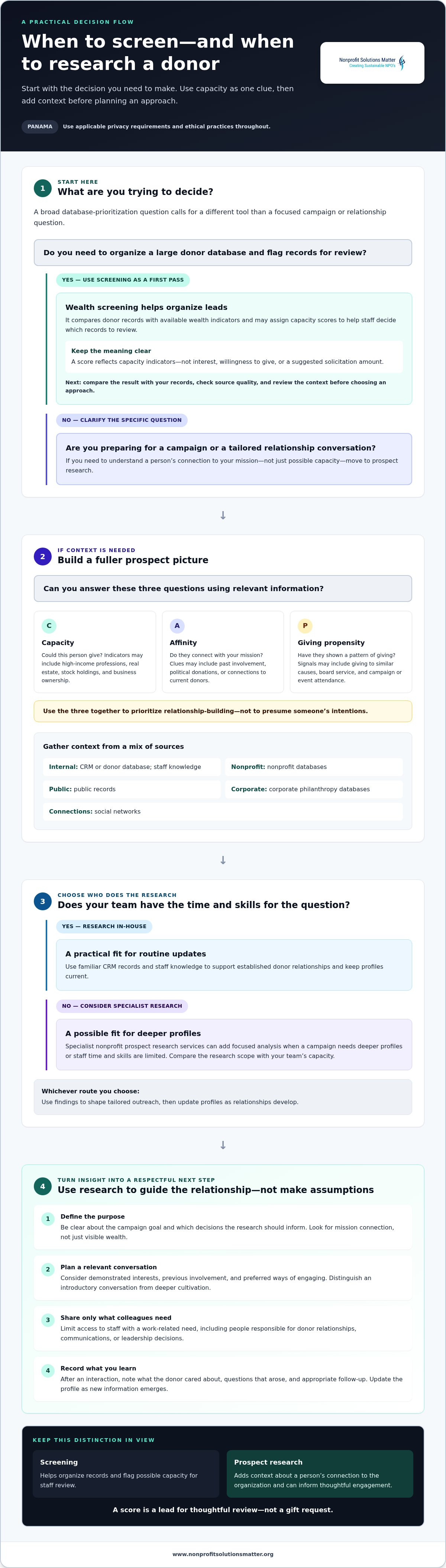
Build each profile around three questions: could this person give, do they connect with your mission, and have they shown a pattern of giving? Capacity indicators can include high-income professions, real estate, stock holdings, and business ownership. Affinity may be reflected in past involvement, political donations, or connections to current donors. Propensity signals include giving to similar causes, board service, and campaign or event attendance. Together, these indicators help prioritize relationship-building, not presume a donor’s intentions.
Wealth Screening and Capacity Scoring
Wealth screening compares donor records with available wealth indicators and may assign capacity scores to help organize prospects. Treat a score as a starting point, not a solicitation amount: it reflects capacity indicators, not necessarily interest or willingness to give. Combine it with CRM history, nonprofit databases, public records, corporate philanthropy databases, and social networks. Then review the context before choosing an appropriate major-gift approach.
Service-Based and In-House Research
In-house research draws on staff knowledge and familiar CRM records; it can support routine updates and established donor relationships. Specialist nonprofit prospect research services can add focused analysis when a campaign requires deeper profiles or staff time and skills are limited. Yes, consultants and firms serve nonprofits in Panama through organizations like Nonprofit Solutions Matter, Inc. Compare the scope of their research with your team’s capacity, then use the findings to shape tailored outreach and update profiles as relationships develop.
How research supports major-gift resource development
Prospect research supports major gifts by helping a team decide where personal engagement can advance its mission. Use findings to distinguish an introductory conversation from deeper cultivation, and shape each step around the supporter’s demonstrated interests. This gives major-gift work a clearer purpose without treating every donor interaction alike.
Before research begins, define the campaign’s purpose and the decisions the findings should inform. For example, a campaign seeking support for a new community program may need to identify donors connected to that issue, not simply people with visible wealth. Agree on how staff will use the findings, who will lead donor conversations, and how research priorities fit the organization’s broader resource development goals.
Translate relevant insights into respectful, individualized engagement. A solicitation plan can guide the sequence of conversations while accounting for staff time and communication constraints. Consider the donor’s interests, previous involvement, and preferred ways of engaging before deciding what to share or request. A suitable ask and a focused explanation of the mission can support a more durable relationship than a generic appeal.
Research can also help colleagues work together. Share only the insights needed by the people responsible for donor relationships, communications, or leadership decisions. After an interaction, record what the donor cared about, what questions arose, and what follow-up is appropriate. That learning helps the organization refine future conversations and recognize supporters’ skills and experience, not just their potential contribution.
Prospect research versus wealth screening
Wealth screening and prospect research serve different purposes. Screening helps organize records for review; research adds context that can inform how an organization engages a potential supporter. Use screening to generate leads, then decide whether further research can answer a specific campaign or relationship question.
Research and Screening Distinctions
A screening tool compares donor records with available wealth indicators and may flag prospects for staff attention. Research examines a person’s broader connection to the organization, drawing on internal records and relevant sources. For example, a screening result may prompt staff to review a prospect, while research can help them understand whether the person’s interests align with the organization’s work. Capacity indicators alone don’t show intent.
Wealth Screening Risks and Limitations
Screening results can be incomplete, outdated, or associated with the wrong person. Wealth indicators may also overlook less visible assets, while a high capacity score cannot show whether someone wants to support a particular mission. Before acting, compare a result with the organization’s records, assess the source quality, and update the profile when new information emerges. A score is a lead for thoughtful review, not a gift request.
Choose the method based on the decision at hand. Broad screening can help organize a large database; focused research can help prepare a tailored engagement plan for selected prospects. Keeping those purposes distinct helps teams use their time well and approach major donors with relevant context rather than assumptions.
Nonprofit Solutions Matter: Resource Development Audits
Nonprofit Solutions Matter, Inc. helps organizations connect prospect insights with a stronger resource development system through Resource Development Audits. Consider an audit when donor information is available but priorities, responsibilities, or follow-up practices remain unclear. It can help identify where research fits within donor engagement and revenue diversification, and where the organization’s current approach needs greater alignment.
Research creates more value when leadership, staff, and board members can act on it consistently. Executive Coaching & Leadership Development and Board Engagement & Governance Training support the people responsible for carrying that work forward. The Donor Acquisition Program can also help organizations build their donor base. Together, these services help turn prospect information into a more coordinated approach to long-term sustainability.
Contact Nonprofit Solutions Matter, Inc. to discuss how a Resource Development Audit could support your organization’s priorities.
Build a Stronger Path from Insight to Action
Research earns its place in a resource development plan when your team can turn insight into consistent decisions. Identify who will interpret findings, how those insights inform donor engagement, and where leadership needs to strengthen shared priorities. This helps nonprofit prospect research services contribute to a durable system rather than a collection of disconnected profiles.
Nonprofit Solutions Matter’s Resource Development Audits, Executive Coaching & Leadership Development, and Board Engagement & Governance Training support different parts of that organizational work. Consider which area most needs attention, then set a practical priority your team can carry forward.
Your mission can move forward with greater clarity, thoughtful leadership, and a stronger foundation for lasting impact.
Frequently Asked Questions
What is prospect research?
Prospect research is a structured way to gather and assess information that helps an organization plan donor engagement. For example, a team might combine its CRM notes with public information about a supporter’s community involvement, then record what needs follow-up. The aim is informed, relevant outreach, not surveillance or assumptions about someone’s personal willingness to contribute.
What is the difference between major donor research and wealth screening?
Major donor research investigates a specific person or group in greater depth to inform a relationship plan. Wealth screening generally reviews a larger donor database to flag possible capacity indicators. For example, screening can surface records for later attention, while targeted research can help staff prepare a more personal conversation. Neither method alone establishes a donor’s intentions.
What do nonprofit prospect research services include?
Nonprofit prospect research services may include reviewing donor records, conducting wealth screening, compiling prospect profiles, and organizing findings for resource development decisions. The work can also help teams identify data gaps, prioritize follow-up, and align research with a campaign or donor acquisition effort. Before beginning, define the decision the research must support, such as whom to engage first.
What are the best prospect research services for nonprofits?
The most useful option depends on your organization’s research goal and internal capacity. A team with reliable CRM records and staff time may handle routine updates in-house; a focused campaign may benefit from specialized analysis. In Pennsylvania, define the donor population, information needed, and intended use first. That scope helps keep the work relevant and actionable.
How do prospect research services identify donor wealth and giving capacity?
Researchers look for indicators such as professional roles, real estate, business affiliations, and publicly visible philanthropic activity. They compare those signals with the organization’s giving records and engagement history to develop a more complete picture. For instance, a business connection may indicate resources, while prior charitable support can add context about giving behavior. These indicators guide review, not conclusions.
Article by
Sharon D Jones
Sharon D. Jones, M.Div., is a globally respected fundraising strategist, nonprofit leadership expert, and capacity-building architect with over three decades of experience. As the Founder and CEO of Nonprofit Solutions Matter, Inc., her proprietary growth frameworks have successfully mobilized nearly $957 million in philanthropic capital for local, national, and international organizations.
General Disclaimer & Disclosure
The information provided on this website is for general informational and educational purposes only. While we strive to keep content accurate and up to date, we make no representations or warranties of any kind, express or implied, about the completeness, accuracy, reliability, or suitability of the information contained herein.
Professional Advice
The content on this site does not constitute professional advice (e.g., legal, financial, medical, or tax). You should consult with a qualified professional before making any decisions based on the information provided on this website. Any action you take upon the information found on this site is strictly at your own risk.
Affiliate & Third-Party Links
Some articles on this site may contain affiliate links. If you click on an affiliate link and make a purchase, we may receive a small commission at no additional cost to you. We only recommend products or services we believe add value to our readers. We are not responsible for the content, privacy policies, or practices of any third-party websites linked within our articles.


