
A nonprofit’s resilience depends on more than the strength of its programs. Nonprofit infrastructure development builds the systems, skills, financial practices, and leadership capacity that help an organization deliver its mission through change. Capacity building is the practical work of strengthening those foundations so the organization can operate effectively and adapt over time.
This work can be difficult to prioritize when resources and attention are focused on immediate community needs. Yet sound infrastructure supports the people and programs at the heart of your mission.
This article explains what capacity building means, how nonprofit infrastructure contributes to resilience in Panama, and why investing in essential systems and organizational capabilities matters. You’ll also see how leadership, governance, technology, and resource development connect to a more durable organization.
Key Takeaways
- Match capacity-building priorities to your organization’s stage, strengthening the roles, skills, and systems needed for its next phase.
- Connect sound governance, capable staff, and practical technology to improve continuity when circumstances change.
- Make the case for investing in the operational foundations behind programs, not only the programs themselves.
- Use a resource development audit to identify gaps and clarify where focused support can strengthen organizational sustainability.
What is Capacity Building?
Capacity building strengthens the people, systems, and practices that help organizations deliver on their missions. Nonprofit infrastructure development connects these foundations to reliable services and prepares an organization for its next stage.
Capacity at Different Stages
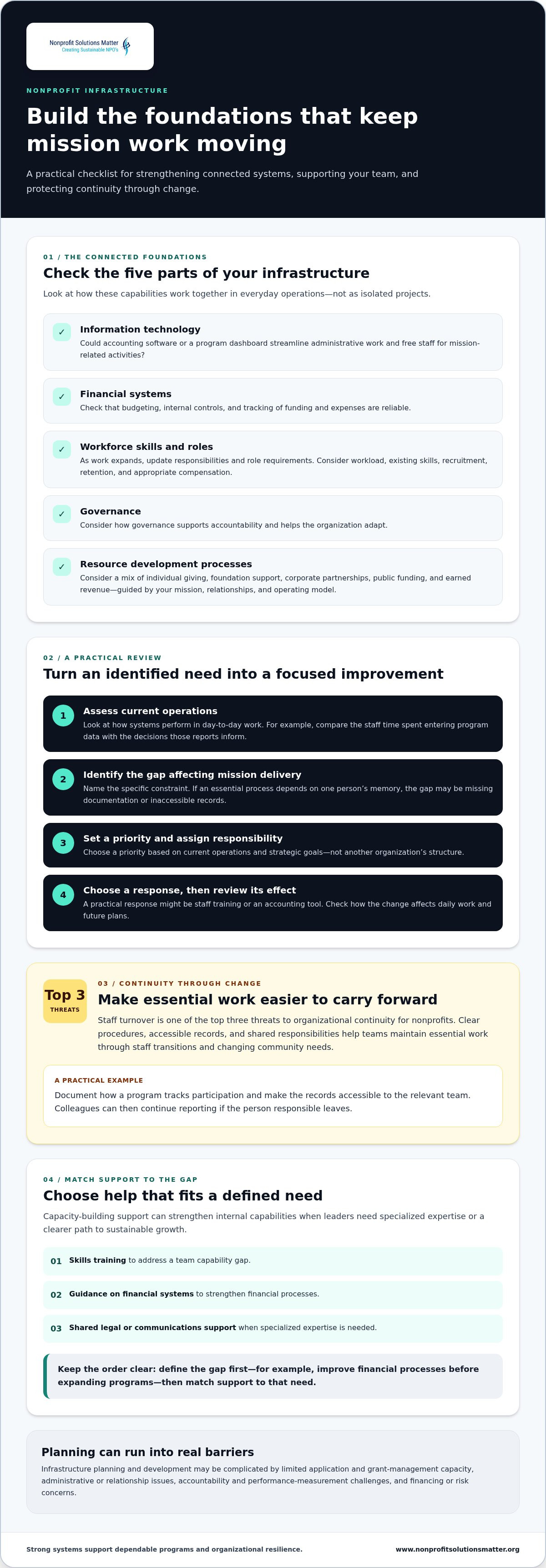
A grassroots organization may first need clear roles, basic bookkeeping, and consistent program records. As its work expands, responsibilities and role requirements should evolve too. A team coordinating several community initiatives, for example, may need defined supervision and regular reporting. Set priorities based on current operations and strategic goals, not another organization’s structure.
Financial capacity includes budgeting, internal controls, and reliable tracking of funding and expenses. Workforce capacity depends on recruiting and retaining skilled staff, with appropriate compensation supporting program quality. Compare technology, staffing, and operational support by considering workload, existing skills, and mission priorities. Accounting software may help manage recurring records; staff development may address a skills gap.
Capacity-Building Support
Capacity-building support strengthens an organization’s internal capabilities. It may include skills training, guidance on financial systems, or shared legal and communications support. This can help when leaders need specialized expertise or a clearer path to sustainable growth. Match support to a defined gap, such as improving financial processes before expanding programs.
Steps for Developing Infrastructure
Infrastructure development is a deliberate process for strengthening the systems an organization needs. Assess current operations, identify the gap affecting mission delivery, then set a priority and assign responsibility. Choose a practical response, such as staff training or an accounting tool. Review how the change affects daily work and future plans. This keeps nonprofit infrastructure development focused on demonstrated needs.
Nonprofit infrastructure and resilience
For organizations operating in Panama, infrastructure decisions should reflect their mission, activities, and operating context. Nonprofit infrastructure development links internal systems with the ability to sustain programs and adapt when circumstances change.
Infrastructure and Organizational Resilience
Organizational resilience is the ability to maintain essential work while responding to disruption. Clear procedures, accessible records, and shared responsibilities help teams preserve continuity through staff transitions or changing community needs. For example, documenting how a program tracks participation lets colleagues continue the work if the person responsible for reporting leaves. Staff turnover is one of the top three threats to organizational continuity for nonprofits. Regular learning and practical documentation help protect institutional knowledge and support sound decisions.
Organizational Infrastructure Components
Organizational infrastructure comprises the connected capabilities that support mission delivery: information technology, financial systems, workforce skills, governance, and resource development processes. Together, these elements form a foundation for accountability and adaptation across the nonprofit sector. Nonprofit infrastructure development is most useful when leaders consider how these components work together, rather than treating each as an isolated project.
Assess how systems perform in day-to-day operations. For instance, compare the staff time spent entering program data with the decisions those reports inform. If essential processes depend on one person’s memory, document the steps and make records accessible to the relevant team. Accounting software or a program dashboard can also streamline administrative work, giving staff more time for mission-related activities.
Nonprofit infrastructure organizations are also commonly called infrastructure bodies, intermediaries, umbrella bodies, and peak bodies; terminology can vary across contexts and may carry slightly different meanings. These organizations support other nonprofit entities by connecting and brokering relationships, while representing and promoting the interests of the nonprofit sector. The Nonprofit Infrastructure Coalition includes about 50 national, regional, and local nonprofits and foundations.
Barriers to nonprofit participation in infrastructure planning and development can include limited application and grant-management capacity, administrative and relationship issues, challenges with accountability and performance measurement, and financing and risk concerns.
Nonprofit infrastructure investment
For nonprofits in Panama, infrastructure investment can be supported through a mix of individual charitable giving, foundation support, corporate partnerships, public funding, and earned revenue. The appropriate mix depends on the organization’s mission, relationships, and operating model. Treat these sources as part of a considered resource development strategy, rather than relying on one source for every operational need.
Investment should cover the systems that make charitable programs dependable, not just direct program activity. A community health initiative, for example, can budget for the financial controls, staff learning, and data tools needed to deliver and assess services. Leaders can explain how these costs support outcomes, accountability, and community trust. That connects infrastructure to mission instead of presenting it as disconnected overhead.
Expectations of low overhead can discourage organizations from budgeting adequately for essential operations. Repeatedly delaying software updates or staff development to protect program spending can weaken capacity over time. Leaders can explain the operational requirements behind each program and show how those investments support results. This makes a stronger case for durable support, rather than treating infrastructure as a secondary expense.
To prioritize investment, identify the constraint affecting delivery, estimate the resources and staff time required, then connect the need to a clear outcome. If inconsistent donor records limit revenue diversification, better data practices can strengthen relationship management. If board oversight needs attention, governance development can support financial stewardship. A justice-focused organization can use the same approach, aligning its mission priorities with the systems needed to sustain its work. Discuss these priorities with funders as part of a broader plan.
Independent Sector and KABOOM! formed the Nonprofit Infrastructure Coalition in 2020 to advocate for federal investments in nonprofit infrastructure. MacArthur says shared research led it to increase indirect cost rates and provide more general operating support.
Nonprofit Solutions Matter: Resource Development Audits
Nonprofit Solutions Matter, Inc. helps organizations assess their resource development approach through Resource Development Audits. Consider an audit when revenue sources feel concentrated, donor engagement lacks direction, or leaders need a clearer view of development priorities. The findings can help your team identify areas to strengthen and align resource development with your organization’s mission and capacity, while supporting long-term nonprofit infrastructure development.
If your next challenge involves leadership or governance, Executive Coaching & Leadership Development and Board Engagement & Governance Training offer relevant support. For organizations focused on reaching new donors, the Donor Acquisition Program may be a good fit. The right starting point depends on the gap your organization needs to address.
Build the Capacity for What Comes Next
Resilience is strengthened through deliberate choices about what your organization needs to sustain its mission. In Panama, nonprofit infrastructure development can be treated as an ongoing leadership priority, shaped by changing community needs and the organization’s direction. Choose one operational gap to address, then connect that work to the outcomes your team intends to support.
When resource development needs clearer direction, a Resource Development Audit can help identify priorities. Executive Coaching & Leadership Development and Board Engagement & Governance Training can support leadership and governance needs. Focus on the area that will help your organization move forward with greater clarity and purpose.
Your mission has room to grow. Build its foundations with care, and keep moving toward the impact your community needs.
Frequently Asked Questions
What does nonprofit infrastructure development include?
Nonprofit infrastructure includes the operational foundations that help an organization manage its work and sustain its mission. Beyond accounting and technology, organizations may need clear data practices, secure access to records, documented decision-making, and reliable donor information. For example, assigning responsibility for keeping contact records current can help staff coordinate outreach and maintain consistent relationships as team members change.
How can nonprofits assess their infrastructure needs and gaps?
Assess needs by comparing current practices with the demands of your mission and planned activities. Review a recent program cycle: Could staff find accurate participant and donor records, track spending, and explain who approves key decisions? Ask staff and board members where delays or repeated work occur. Prioritize gaps that create the greatest operational friction or limit informed decisions.
How much does nonprofit infrastructure development typically cost?
There is no single typical cost: scope depends on an organization’s existing systems, staffing needs, training requirements, and implementation support. Updating an existing process differs from building a new one. For a tailored engagement, fees depend on the specific work and are provided after a quote request. A practical starting point is to define the capacity gap and intended outcome.

Article by
Sharon D Jones
Sharon D. Jones, M.Div., is a globally respected fundraising strategist, nonprofit leadership expert, and capacity-building architect with over three decades of experience. As the Founder and CEO of Nonprofit Solutions Matter, Inc., her proprietary growth frameworks have successfully mobilized nearly $957 million in philanthropic capital for local, national, and international organizations.
General Disclaimer & Disclosure
The information provided on this website is for general informational and educational purposes only. While we strive to keep content accurate and up to date, we make no representations or warranties of any kind, express or implied, about the completeness, accuracy, reliability, or suitability of the information contained herein.
Professional Advice
The content on this site does not constitute professional advice (e.g., legal, financial, medical, or tax). You should consult with a qualified professional before making any decisions based on the information provided on this website. Any action you take upon the information found on this site is strictly at your own risk.
Affiliate & Third-Party Links
Some articles on this site may contain affiliate links. If you click on an affiliate link and make a purchase, we may receive a small commission at no additional cost to you. We only recommend products or services we believe add value to our readers. We are not responsible for the content, privacy policies, or practices of any third-party websites linked within our articles.


