
A low hourly rate can still lead to a larger overall commitment. Across the industry, nonprofit consulting fees don’t follow one standard rate: consultants may bill by the hour, set a flat fee for defined work, or use a recurring retainer. The right comparison is the total cost of the work, including how scope and billable time affect it.
It’s reasonable to want a clear budget before committing organizational resources. At Nonprofit Solutions Matter, Inc., this guide explains how to compare billing methods, what affects consulting costs, and how billable hours influence your budget. You’ll also learn how resource development fees are structured and what to look for in an agreement, so you can make a considered decision that supports your organization’s priorities.
Key Takeaways
- Compare consultant quotes by deliverables, project complexity, and experience, not by the hourly rate alone.
- Choose a billing structure that fits the work: a defined project, ongoing support, or limited hourly assistance.
- Estimate how billable time will affect your budget, and clarify how scope changes and project expenses are handled.
- A Resource Development Audit can help identify where your organization’s revenue strategy and systems need strengthening.
How much do nonprofit consultants cost?
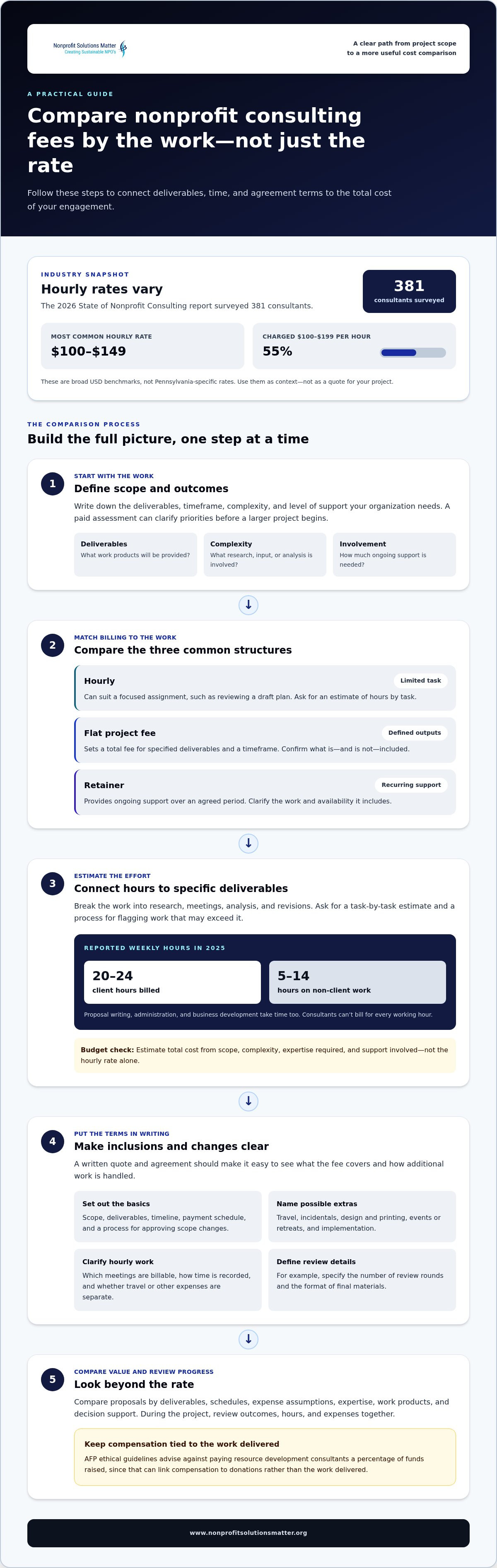
The 2026 State of Nonprofit Consulting report surveyed 381 consultants. Its most common hourly rate was $100 to $149, while 55% charged $100 to $199 per hour. These are broad USD benchmarks, not Pennsylvania-specific rates.
Consultants commonly bill hourly, by project, or through a retainer. Hourly billing can suit a limited task, such as reviewing a draft plan. A project fee sets a total for defined deliverables and a timeframe. A retainer provides recurring support over an agreed period, so clarify what work and availability it includes. The right structure depends on scope, complexity, experience, and level of involvement.
To compare proposals, align deliverables, schedules, and expense assumptions. Assess value based on the expertise, work products, and decision support included, not just the hourly rate. AFP ethical guidelines advise against paying resource development consultants a percentage of funds raised, since that can link compensation to donations rather than the work delivered.
In Pennsylvania, whether consulting expenses are deductible or subject to sales tax depends on applicable tax rules and transaction details. Don’t infer tax treatment from the consultant’s billing method.
Strategic planning and board development costs depend on the assessment, facilitation, governance training, and follow-through involved. Compare proposals by their defined outcomes and deliverables rather than expecting one standard rate.
To budget, estimate the total cost based on the project scope, complexity, expertise required, and support involved. A written quote should detail the work and billing method for your engagement.
Broad nonprofit consulting benchmarks put the most common hourly rate at $100-$149, with 55% of consultants charging $100-$199. Strategic planning and board development fees vary with the assessment, facilitation, training, and follow-through involved.
How are resource development consulting fees structured?
An organization’s scope shapes both the work and how a consultant charges. A paid assessment can clarify priorities and deliverables before a larger project begins. A flat project fee can suit defined outputs, such as a resource development plan, while a retainer supports recurring strategic work. Compare proposals by what they include, not just by payment structure.
Project size and ongoing support affect the effort required. A focused review may involve limited research and recommendations; a campaign plan may require assessment, stakeholder input, messaging, and implementation guidance. The agreement should distinguish included tasks from additional work. Scope changes can add fees, so define how both parties approve them before work expands.
For grant-writing work, agree on payment for defined services, such as proposal development, research, or revisions. AFP ethical guidelines advise against paying consultants a percentage of funds raised, since that can link compensation to donations rather than the work delivered.
Campaign and capital campaign costs depend on scope, duration, research, planning, and organizational needs. A focused assignment differs from a broad initiative with multiple stages and deliverables. Compare proposals based on their specific tasks and outputs rather than assuming one standard fee applies.
Put the key terms in writing: scope, deliverables, timeline, payment schedule, expenses, and a process for approving changes. Specify whether travel, incidentals, design and printing, events or retreats, and implementation are included or billed separately. For example, define the number of review rounds and the format of the final materials.
To budget, consider the scope, complexity, duration, and expenses involved. The quote should set out the deliverables and payment terms for your engagement.
Consultants’ billable hours
A consultant’s weekly schedule includes client work and essential non-client work. In 2025, nonprofit consultants reported billing 20-24 client hours per week. They spent another 5-14 hours weekly on non-client work. Proposal writing, administration, and business development can affect how many hours remain available for projects.
That distinction matters when assessing an hourly rate. A consultant can’t bill for every working hour, so the rate must account for expenses and time spent outside client engagements.
For your budget, estimate the total hours required and connect them to specific deliverables. For example, separate research, meetings, analysis, and revisions in the project plan. Ask for a clear estimate by task and a process for flagging work that may exceed it. This makes costs easier to track.
Build expectations into the contract. Define which meetings are billable, how time is recorded, and whether travel or other expenses are separate. Set a review point before approving additional hours. A simple monthly time summary can help your organization compare planned work with completed deliverables.
Billable hours alone don’t measure success. A focused consultant may complete the agreed work in fewer hours, while a complex project may require more collaboration. Review progress against outcomes, hours, and expenses together. This gives leaders a practical basis for adjusting scope while protecting the work’s strategic purpose.
Nonprofit Solutions Matter: Resource Development Audits
Nonprofit Solutions Matter, Inc. offers Resource Development Audits to assess how an organization’s current approach supports revenue diversification and long-term sustainability. Consider an audit when funding efforts feel disconnected, responsibilities are unclear, or leaders need a stronger basis for setting priorities. The assessment helps identify where current practices and organizational capacity need attention before you commit resources to broader changes.
A Resource Development Audit is a practical next step when your team needs an informed view of its resource development structure, rather than another isolated tactic. If leadership alignment or board participation is also a challenge, Executive Coaching & Leadership Development or Board Engagement & Governance Training can address those needs.
Discuss your organization’s priorities and next steps with Nonprofit Solutions Matter, Inc.
Build a Stronger Foundation for What Comes Next
Use your consulting budget to strengthen long-term organizational capacity, not simply complete a short-term task. Identify the internal challenge that needs attention, then shape the support around that priority. A deliberate approach connects nonprofit consulting fees to the outcomes your organization wants to sustain.
Nonprofit Solutions Matter, Inc. offers Resource Development Audits, Executive Coaching & Leadership Development, and Board Engagement & Governance Training. These services help organizations assess resource development practices, strengthen leadership, and deepen board engagement.
Start with the challenge most closely tied to your mission. A focused next step can help your organization move forward with greater clarity and purpose.
Frequently Asked Questions
How do you calculate consulting rates?
Consultants commonly calculate an hourly rate by dividing the income they need, including business expenses, by their expected billable hours. For a project quote, estimate each task and account for research, meetings, revisions, and delivery. Ask how the estimate could change if decisions or materials arrive late, since delays can affect the work plan.
What additional fees can arise when working with a consultant?
Additional charges may cover travel, incidentals, design and printing, events, retreats, or implementation work. A scope change can also add fees if it requires new research or deliverables. For clearer budget control, separate necessary expenses from optional work in the agreement, and establish how proposed additions will be described and approved before they begin.
What goes into the costs of hiring a resource development consultant?
The cost reflects the expertise and time needed to address your organization’s priorities. A project may include reviewing current systems, analyzing donor information, facilitating leadership discussions, and developing recommendations. Implementation support involves different work from an assessment alone. Map each desired outcome to a task, then use that list to assess whether a proposal addresses your actual needs.
What are typical nonprofit consulting fees in 2026?
The 2026 State of Nonprofit Consulting report found that $100 to $149 per hour was the most common rate among surveyed consultants; 55% charged $100 to $199 per hour. These are broad USD benchmarks, not Panama-specific rates or a quote for a particular engagement. In Panama, compare proposals by scope, deliverables, and expenses as well as the hourly figure.
What factors affect nonprofit consulting fees, such as experience, scope, and organization size?
Experience, project complexity, location, and the organization’s budget and ability to pay can all shape fees. A focused review requires a different level of effort than work involving several teams, extensive research, or continued implementation. When comparing proposals, describe your organization’s capacity and priorities clearly, then assess how each proposed scope fits the resources available.

Article by
Sharon D Jones
Sharon D. Jones, M.Div., is a globally respected fundraising strategist, nonprofit leadership expert, and capacity-building architect with over three decades of experience. As the Founder and CEO of Nonprofit Solutions Matter, Inc., her proprietary growth frameworks have successfully mobilized nearly $957 million in philanthropic capital for local, national, and international organizations.
General Disclaimer & Disclosure
The information provided on this website is for general informational and educational purposes only. While we strive to keep content accurate and up to date, we make no representations or warranties of any kind, express or implied, about the completeness, accuracy, reliability, or suitability of the information contained herein.
Professional Advice
The content on this site does not constitute professional advice (e.g., legal, financial, medical, or tax). You should consult with a qualified professional before making any decisions based on the information provided on this website. Any action you take upon the information found on this site is strictly at your own risk.
Affiliate & Third-Party Links
Some articles on this site may contain affiliate links. If you click on an affiliate link and make a purchase, we may receive a small commission at no additional cost to you. We only recommend products or services we believe add value to our readers. We are not responsible for the content, privacy policies, or practices of any third-party websites linked within our articles.


