
What if stagnant revenue reflects a gap in your organization’s systems, not a lack of commitment? When income depends heavily on a few sources, it’s reasonable to ask whether your current approach can support the mission over time. A fundraising audit checklist helps leaders examine the conditions behind revenue, rather than focusing only on financial records.
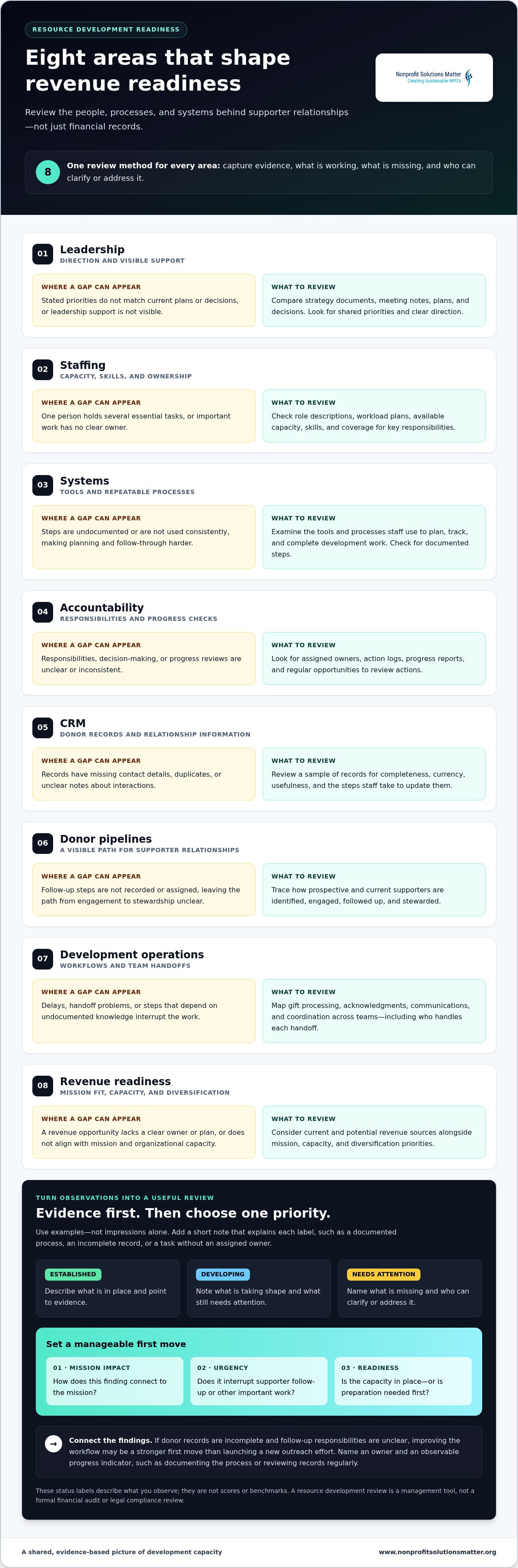
Use this practical guide to review leadership, staffing, systems, accountability, CRM, donor pipelines, development operations, and revenue readiness. For each area, gather evidence, note what’s working, identify a gap, and name a next step. This is a structured resource development assessment, not a formal financial audit or legal compliance review. The goal is a shared, evidence-based picture of readiness and a manageable path toward stronger revenue diversification.
Key Takeaways
- A fundraising audit checklist helps you assess the people, processes, and systems that support revenue, not just financial records.
- Review readiness across eight connected dimensions to see where your organization is strong and where capacity may be limited.
- Capture evidence, gaps, and an owner for each review area to build a shared, practical picture of development capacity.
- Use mission impact, urgency, and readiness to choose a manageable first priority and define how progress will be observed.
What a Fundraising Audit Checklist Should Assess Beyond Financial Records
A resource development audit looks at the people, processes, and systems that help an organization build relationships and generate revenue. It asks whether leaders share a clear direction, staff have the capacity to carry out the work, information is usable, and donor relationships have a thoughtful path forward. A fundraising audit checklist makes these conditions visible instead of treating revenue as the result of one campaign or tactic.
This broader view is especially useful when revenue has stalled or relies heavily on a small number of sources. An organization may have a clear case for support but no defined owner for donor follow-up. Or its database may contain useful information that staff don’t consistently record or use. These issues affect one another: gaps in staffing or systems can weaken stewardship, limit pipeline development, and make revenue diversification harder to plan. Reviewing resource development principles and practices can also help frame the importance of ethical, relationship-centered work.
How is a resource development audit different from a financial audit?
A financial audit examines whether financial statements are fairly presented; a resource development audit assesses whether the organization’s people and systems are ready to support revenue. The first focuses on financial records and reporting. The second considers leadership, staffing, systems, accountability, and donor pipelines, among other connected areas.
This checklist is a management tool for identifying strengths, questions, and improvement opportunities. It doesn’t provide an independent audit opinion or determine compliance, and it doesn’t replace a financial statement or compliance audit. Gather relevant evidence, such as role descriptions, planning documents, database practices, and donor communication processes. Then discuss what that evidence shows with the people responsible for the work.
A Nonprofit Resource Development Audit Checklist Across Eight Readiness Dimensions
Use the same review method in every area: record the evidence you can point to, what’s working, what’s missing, and who can clarify or address it. A fundraising audit checklist is most useful when it captures examples rather than impressions alone.
- Leadership: Look for shared priorities, clear direction, and visible leadership support. Compare the organization’s stated priorities with current plans and decisions.
- Staffing: Review role descriptions, available capacity, skills, and coverage for key responsibilities. Note where one person holds several essential tasks or work has no clear owner.
- Systems: Examine the tools and repeatable processes staff use to plan, track, and follow through on development work. Check whether steps are documented and consistently used.
- Accountability: Check whether responsibilities, decision-making, and progress reviews are clear and consistent. Look for assigned owners and regular opportunities to review actions.
- CRM: Review whether donor records are complete, current, and useful for relationship management. Check for missing contact details, duplicate records, and clear notes about interactions.
- Donor Pipelines: Look for visibility into how prospective and current supporters are identified, engaged, and stewarded. Trace whether follow-up steps are recorded and assigned.
- Development Operations: Examine workflows such as gift processing, acknowledgments, communications, and coordination across teams. Identify delays, handoff points, or steps that rely on undocumented knowledge.
- Revenue Readiness: Consider whether current and potential revenue sources align with mission, organizational capacity, and diversification priorities. Note which opportunities have a clear owner and plan.
What evidence should each checklist area examine?
Use practical records: strategy documents and meeting notes for leadership alignment, role descriptions and workload plans for staffing, and action logs or progress reports for accountability. For CRM and pipelines, review a sample of records and the steps staff use to update them. For operations, map how a supporter interaction moves from initial contact to follow-up, including who handles each handoff.
Then label each area as established, developing, or needs attention. These are descriptive labels, not scores or benchmarks. Add a short example to explain each label, such as a documented process, an incomplete record, or a task without an assigned owner. Evidence makes gaps easier to prioritize by showing what is working, what is missing, and who is best placed to act.
Turn Audit Findings into a Focused Resource Development Action Plan
A completed fundraising audit checklist may surface more gaps than your team can address at once. Sort findings by mission impact, urgency, and organizational readiness. A gap that interrupts supporter follow-up may need attention before a longer-term improvement. If a priority requires capacity you don’t yet have, identify the preparation needed before committing to it.
Look for connections between findings. If donor records are incomplete and follow-up responsibilities are unclear, improving the workflow may be a stronger first move than launching a new outreach effort. Choose one manageable priority, name an owner, and agree on an observable indicator of progress, such as documenting the process or reviewing records regularly. The indicator should show whether the work is advancing, not promise a specific revenue result.
When can outside capacity-building support help?
An outside perspective can help leaders see how governance, staffing, systems, and revenue priorities affect one another, especially when teams hold different views of organizational readiness. Nonprofit Solutions Matter, Inc. conducts Resource Development Audits to clarify strengths, gaps, and practical next steps. The findings can inform a tailored plan that reflects the organization’s needs rather than assuming every organization requires the same intervention.
Keep the plan focused: document the priority, owner, first action, and date to review progress. Once the team has learned from that step, decide what to address next. This creates steady movement without turning the assessment into an overwhelming list of demands.
Next Steps
Bring the findings to your next leadership discussion. Agree on who will own the first priority, what action they will take, and when the team will review progress.
Build the Capacity for What Comes Next
A review is valuable when it changes how your organization makes decisions. Use the fundraising audit checklist as a starting point for regular, honest conversations about what the mission needs and what your team can sustain. As priorities evolve, revisit assumptions, share learning across leadership and staff, and adjust the plan when the evidence points in a new direction.
Progress doesn’t require solving every challenge at once. A clear next step, supported by shared ownership, can turn assessment into lasting organizational practice. With a thoughtful approach, your organization can build a stronger foundation for mission-aligned, sustainable growth.
Frequently Asked Questions
Can a small nonprofit use a resource development audit checklist without a dedicated development department?
Yes. A small organization can use a fundraising audit checklist to clarify what’s working and where support or process changes may be needed. Document who handles each function, such as donor follow-up, gift recording, or board engagement, even if several people share those duties. Assess the work against your actual capacity and mission, not an assumed staffing model.
How often should a nonprofit review its resource development readiness?
There’s no universal review schedule. Revisit the assessment when strategy, staffing, systems, or revenue conditions materially change, such as after a leadership transition or a shift in how the organization engages supporters. Using the same review dimensions each time can help leaders compare evidence, note what has changed, and distinguish new needs from longstanding gaps.
Does completing a resource development audit guarantee increased revenue?
No. An assessment can’t guarantee revenue growth. It can help leaders understand organizational strengths and constraints, choose informed priorities, and monitor whether planned actions are being completed. For example, a team might track whether it has adopted a consistent donor follow-up process. Revenue outcomes still depend on implementation and broader circumstances beyond the assessment itself.
Can a resource development audit replace a nonprofit financial statement audit?
No. They serve different purposes. A resource development review considers whether the organization’s development capacity and systems support its plans; a financial statement audit examines financial reporting within its applicable scope. Treat them as separate activities, and clarify which questions each review is meant to address so leaders use the findings appropriately.
Ready to discuss your organization’s resource development priorities? Book a 30-minute strategy call.

Article by
Sharon D Jones
Sharon D. Jones, M.Div., is a globally respected fundraising strategist, nonprofit leadership expert, and capacity-building architect with over three decades of experience. As the Founder and CEO of Nonprofit Solutions Matter, Inc., her proprietary growth frameworks have successfully mobilized nearly $957 million in philanthropic capital for local, national, and international organizations.
General Disclaimer & Disclosure
The information provided on this website is for general informational and educational purposes only. While we strive to keep content accurate and up to date, we make no representations or warranties of any kind, express or implied, about the completeness, accuracy, reliability, or suitability of the information contained herein.
Professional Advice
The content on this site does not constitute professional advice (e.g., legal, financial, medical, or tax). You should consult with a qualified professional before making any decisions based on the information provided on this website. Any action you take upon the information found on this site is strictly at your own risk.
Affiliate & Third-Party Links
Some articles on this site may contain affiliate links. If you click on an affiliate link and make a purchase, we may receive a small commission at no additional cost to you. We only recommend products or services we believe add value to our readers. We are not responsible for the content, privacy policies, or practices of any third-party websites linked within our articles.


