
What if attracting new donors depends less on reaching more people and more on building the trust and systems that help the right people connect with your mission? A donor acquisition strategy for nonprofits can be hard to shape when prospective donors are difficult to prioritize, outreach feels disconnected from the work, and staff have limited time or inconsistent data. Sustainable growth starts with a clear, mission-aligned approach, not more activity for its own sake.
This guide explains how to identify promising prospects, communicate your impact clearly, and invite support in ways your organization can sustain. It also covers what to measure so you can assess whether outreach is building relationships, not just generating first gifts. Leadership, donor data, and development operations all play a part in making acquisition a durable part of resource development.
Key Takeaways
- Build a donor acquisition strategy for nonprofits around mission alignment and organizational readiness, not outreach volume alone.
- Use a clear pipeline to define prospective donors, shape your case for support, choose suitable channels, and record follow-up.
- Match outreach methods to your organization’s capacity. Compare relationship-based introductions, community engagement, online giving, and pilot campaigns.
- Track first-time donors, channel sources, responses, and acquisition effort consistently. Use the results to refine your approach before expanding.
What Is a Donor Acquisition Strategy for Nonprofits, and Why Does Readiness Matter?
Donor acquisition is the process of identifying prospective supporters, engaging them with the organization’s work, and inviting them to make an initial gift. It sits within the broader practice of Fundraising, but has a distinct focus: helping a new supporter take that first step. Retention begins after the gift, with acknowledgment, communication, and relationship-building that encourage continued involvement.
Effective donor acquisition connects mission clarity and trust with the organizational readiness to make a meaningful invitation and respond well when someone gives. Without that foundation, more outreach can create activity without building a sustainable resource development system.
What should an organization clarify before seeking new donors?
Start with fit, not volume. Identify the people or communities most likely to care about your mission and the change your organization seeks to create. Consider who already encounters your work, who shares its values, and which audiences your team can realistically reach. Broad outreach can dilute a strong case for support if it is not aimed at people with a plausible connection to the mission.
Before choosing channels, clarify three things: the need being addressed, the intended impact of support, and the specific invitation you’re making. For example, a message about expanding access to a community program should explain what the program does and how a first gift can contribute. Avoid implying a result your organization cannot substantiate.
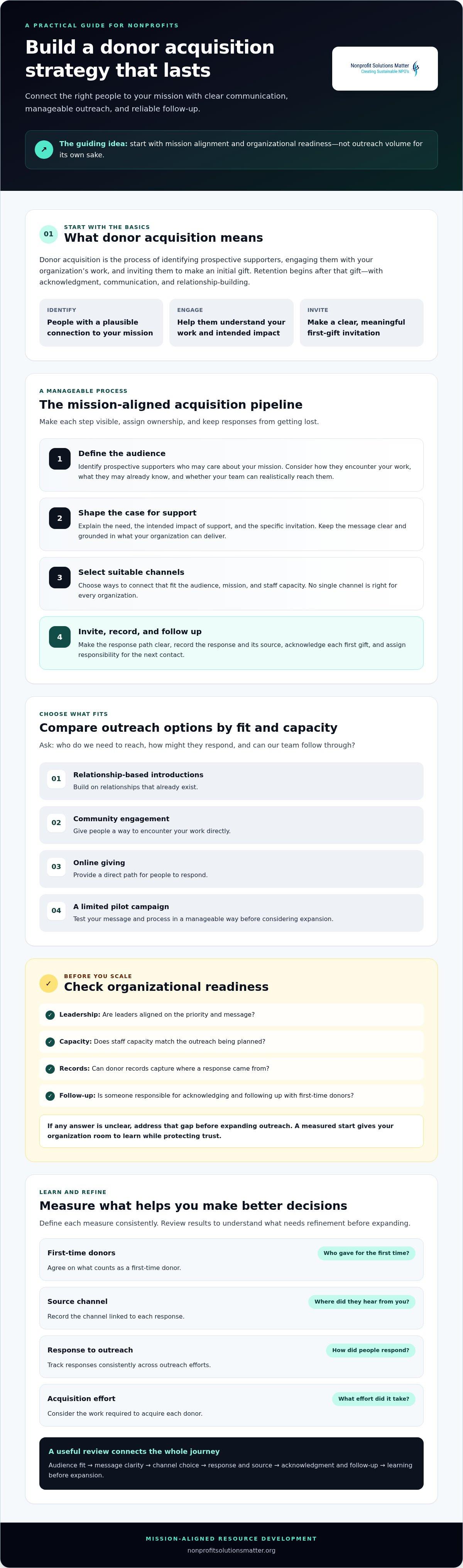
Then check readiness. Are leaders aligned on the fundraising priority and message? Does staff capacity match the outreach planned? Can donor records capture where a response came from? Is someone responsible for acknowledging and following up with a first-time donor? If any answer is unclear, address that gap before scaling the donor acquisition strategy for nonprofits. A measured start gives the organization room to learn while protecting the trust behind each invitation.
How Can Nonprofits Build a Donor Acquisition Pipeline That Fits Their Mission?
A practical pipeline makes each step visible, from deciding whom to reach to ensuring no response is lost. For a donor acquisition strategy for nonprofits, use a sequence your team can manage and improve:
- Define the audience: Identify prospective supporters with a plausible connection to the mission. Note how your organization can reach them and what they may already know about your work.
- Shape the case: Explain the need, intended impact, and specific invitation in clear language. Make sure the message reflects what your organization can deliver.
- Select channels: Compare relationship-based introductions, community engagement, online giving, and a limited pilot campaign. Choose options that fit the audience and your team’s capacity.
- Invite, record, and follow up: Make the next step clear, capture responses and their source, and assign someone to acknowledge each first gift.
Choose channels according to audience access, mission fit, and staff capacity, rather than treating any one method as universally effective. Personal introductions can build on relationships that already exist. Community engagement helps people encounter the work directly. Online giving provides a direct response path, while a pilot campaign gives a team a manageable way to test its message and process. Decide what to try by asking which audience you need to reach, how they are most likely to respond, and whether your team can follow through.
How do you turn prospective supporters into first-time donors?
Make the invitation specific and accessible. Explain the mission outcome a gift supports, then provide a clear way to respond. Before outreach begins, assign responsibility for recording the source and response, acknowledging the first gift, and managing the next contact. Use your CRM or online-giving system to record useful interaction details, including channel and communication preferences, in a way that respects consent. DonorSearch also offers guidance to measure acquisition and build a sustainable next step.
If your team is shaping its approach, you can discuss your donor acquisition priorities as part of planning a mission-aligned pipeline.
How Should Nonprofits Measure Acquisition and Build a Sustainable Next Step?
Measurement helps distinguish a channel that needs refinement from a plan the organization is ready to expand. Define each measure consistently, then review first-time donors, source channel, response to outreach, and the effort required to acquire each donor. For example, agree on what counts as a first-time donor and how staff will record whether that person came through a community event, an introduction, or online giving. The Building Your Donor Pipeline resource offers additional perspective on cultivating donor relationships and involving the board.
Interpret results as signals, not verdicts. Few responses may point to an audience that is not well matched or an invitation that lacks clarity. Responses that are not recorded suggest a process or data gap. If staff cannot acknowledge gifts and manage next steps consistently, capacity may be the constraint. Increasing outreach alone will not fix these underlying issues.
When should an organization strengthen its systems before expanding outreach?
Pause before scaling if leadership ownership is unclear, staff lack time, CRM records are incomplete, or no one is responsible for moving prospects through the pipeline. Review the Fundraising Performance Diagnostic™, which assesses eight dimensions of revenue readiness, as a framework for identifying where organizational systems may need attention.
After the first gift, make a clear handoff to stewardship: acknowledge the donor and begin an appropriate relationship-building plan. Retention is the next stage, not a substitute for measuring acquisition.
A sound donor acquisition strategy for nonprofits develops through review and adjustment. If you’re ready to assess your organization’s priorities, book a strategy call to discuss a practical next step.
Build a More Sustainable Path to New Support
A strong donor acquisition strategy for nonprofits begins with mission-aligned prospects, a clear invitation, and channels the organization can manage. Consistent records and practical measures help leaders understand what is working, while a thoughtful handoff gives a first gift the opportunity to become the start of a lasting relationship.
Nonprofit Solutions Matter, Inc. helps nonprofits strengthen resource development through audits, board engagement and governance training, donor data support, and executive coaching. These services can help leaders identify gaps in readiness, improve the systems behind outreach, and build a practical plan for revenue diversification.
Start with a clear view of your priorities and capacity. A consultation with Nonprofit Solutions Matter, Inc. can help you consider which service package fits the next step for your organization.
Frequently Asked Questions
What is a donor acquisition strategy for a nonprofit?
A donor acquisition strategy for a nonprofit is a plan for identifying prospective supporters, explaining why the mission matters, and inviting an initial gift. It should define the intended audience, case for support, outreach channels, follow-up responsibilities, and measures of progress. The approach works best when it fits the organization’s capacity rather than relying on isolated appeals.
How can a small nonprofit attract new donors?
A small nonprofit can begin with a clear explanation of its mission and the need a gift can address. Identify audiences the organization can reach through existing relationships or suitable channels, then test a manageable outreach effort. Record responses and assign follow-up responsibility. Expand only when the team can acknowledge gifts and maintain accurate donor information.
What should nonprofits measure in donor acquisition?
Track first-time donors, how they found the organization, responses to outreach, and the effort involved in acquiring them. Define each measure consistently so leaders can compare results over time. Review the audience, message, channel, and internal process together. A single metric rarely explains performance on its own, so use the pattern of results to guide practical adjustments.
How is donor acquisition different from donor retention?
Acquisition focuses on inviting someone to make a first gift; retention focuses on continuing the relationship afterward through communication, stewardship, and further engagement. The stages are connected: a thoughtful handoff after the initial gift helps the organization maintain contact and build trust. For guidance on the work that follows a first contribution, consult a dedicated donor retention resource.
Article by
Sharon D Jones
Sharon D. Jones, M.Div., is a globally respected fundraising strategist, nonprofit leadership expert, and capacity-building architect with over three decades of experience. As the Founder and CEO of Nonprofit Solutions Matter, Inc., her proprietary growth frameworks have successfully mobilized nearly $957 million in philanthropic capital for local, national, and international organizations.
General Disclaimer & Disclosure
The information provided on this website is for general informational and educational purposes only. While we strive to keep content accurate and up to date, we make no representations or warranties of any kind, express or implied, about the completeness, accuracy, reliability, or suitability of the information contained herein.
Professional Advice
The content on this site does not constitute professional advice (e.g., legal, financial, medical, or tax). You should consult with a qualified professional before making any decisions based on the information provided on this website. Any action you take upon the information found on this site is strictly at your own risk.
Affiliate & Third-Party Links
Some articles on this site may contain affiliate links. If you click on an affiliate link and make a purchase, we may receive a small commission at no additional cost to you. We only recommend products or services we believe add value to our readers. We are not responsible for the content, privacy policies, or practices of any third-party websites linked within our articles.


