
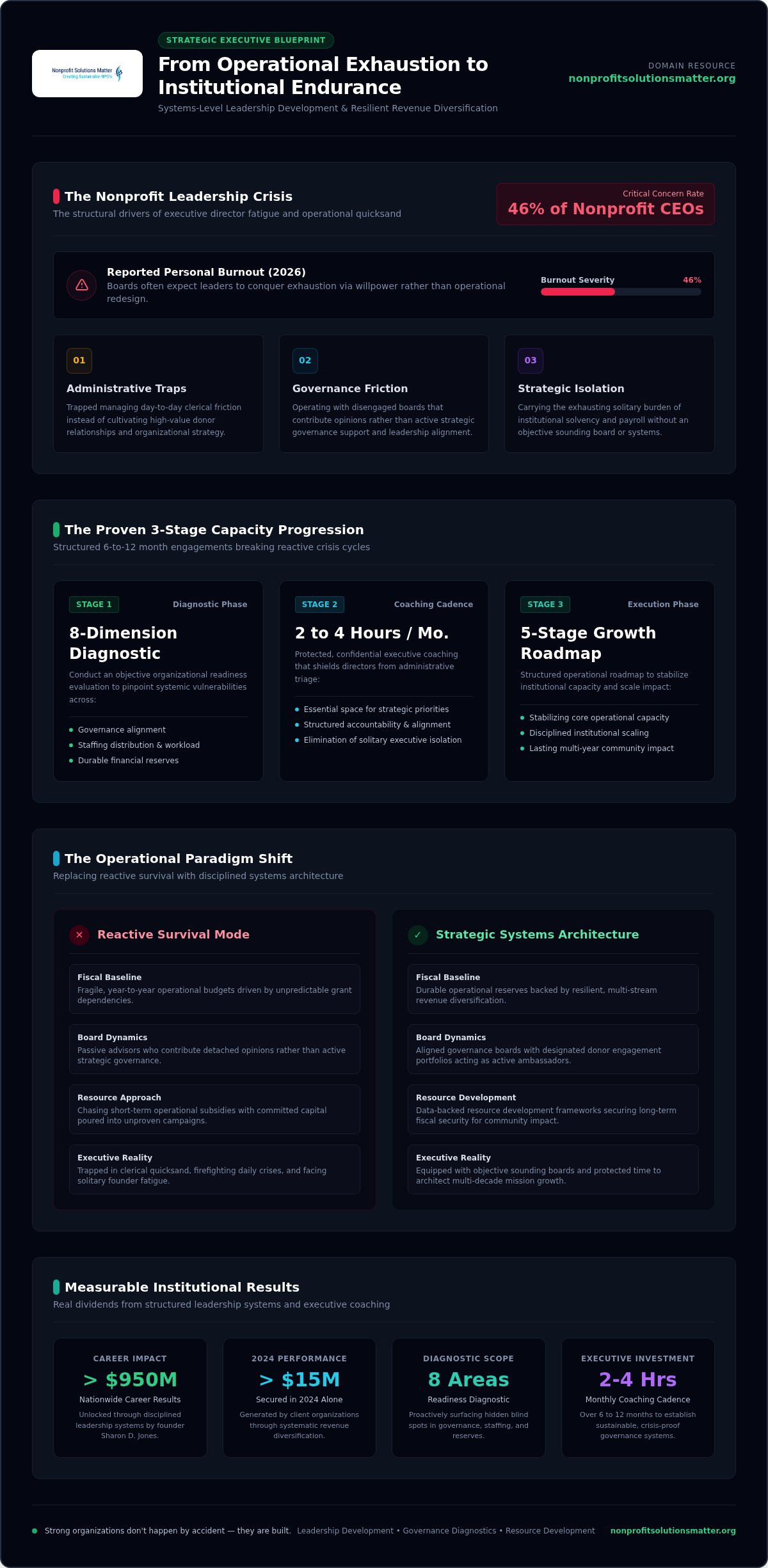
In 2026, 46% of nonprofit CEOs reported that personal burnout is a critical concern, yet many boards still expect executive directors to overcome operational exhaustion through sheer willpower. You know this reality intimately. When your week is consumed by daily firefighting, founder fatigue, and the stress of unpredictable grant cycles, strategic capacity building quickly falls by the wayside. True institutional resilience doesn't come from working longer hours; it requires structured nonprofit leadership development that re-architects your core foundation.
Discover how targeted executive coaching and systems-level development transform operational exhaustion into multi-million dollar revenue diversification. In this case study, we'll examine how practical governance diagnostics and reliable resource development frameworks transition leadership teams away from crisis-driven survival and toward lasting, measurable financial sustainability for the communities they serve.
Key Takeaways
- Discover how structured nonprofit leadership development elevates executive directors from reactive administrative firefighting into high-level strategic architecture.
- Learn how an objective eight-dimension diagnostic pinpoints systemic operational bottlenecks before they jeopardize your mission.
- See why an intentional coaching commitment of just two to four hours per month creates the momentum needed to align governance boards.
- Explore the practical frameworks that turn unpredictable grant dependencies into resilient revenue diversification backed by over $950 million in career results.
The Leadership Crisis: Moving from Daily Survival to Strategic Architecture
Many executives confuse leadership development with corporate seminars or detached academic theory. Genuine nonprofit leadership development is systematic capacity building. It directly reshapes how an institution governs, allocates resources, and delivers impact. Too often, executive directors remain trapped in administrative quicksand, resolving basic operational glitches and chasing short-term fixes rather than guiding institutional vision.
When internal systems are fragile, leadership degrades into reactive firefighting. Effective nonprofit organization management requires that executive directors and boards operate as unified strategic partners. True organizational resilience begins when leaders step back from daily chaos, establishing aligned governance and disciplined operational architecture that protect the mission over decades.
Diagnosing the Structural Roots of Executive Exhaustion
Operational exhaustion rarely stems from a lack of passion. It happens when absent systems force skilled directors to oversee clerical minutiae instead of strategy. Without clear operational guardrails, leaders experience intense fatigue and solitary pressure:
- Administrative traps: Managing day-to-day clerical friction rather than cultivating high-value donor relationships.
- Governance friction: Operating with disengaged boards that offer opinions rather than strategic governance support.
- Strategic isolation: Carrying the heavy burden of institutional solvency without an objective sounding board.
Structured 6-to-12 month nonprofit leadership development engagements break this exhausting cycle. By combining confidential executive coaching with structured accountability, leaders shed the isolation of daily crisis management, building systems that support sustainable revenue diversification.
Inside the Engagement: Applying Proven Frameworks for Executive Growth
Effective nonprofit leadership development transforms executive exhaustion into institutional endurance through a deliberate, three-stage progression that anchors daily operations in sound systems:
- Diagnostic Assessment: Conduct an objective evaluation using an eight-dimension organizational readiness diagnostic. This framework pinpoints systemic vulnerabilities across governance, staffing, and financial reserves before they cause institutional strain.
- Strategic Cadence: Establish a confidential coaching cadence requiring just two to four hours monthly. This protected time shields executives from administrative triage, creating the essential space needed to focus on long-term institutional priorities.
- Roadmap Implementation: Implement structured tools, such as a five-stage growth roadmap, to stabilize organizational capacity and guide disciplined scaling.
Connecting Leadership Capacity to Sustainable Resource Development
Financial instability and volatile grant environments consistently rank among the primary concerns for nonprofit leaders. Grounded nonprofit leadership development directly counters this vulnerability. Instead of chasing short-term operational subsidies, executives learn how to design diversified revenue streams that provide lasting fiscal security.
Objective diagnostic tools reveal hidden operational blind spots before leadership teams commit precious capital to unproven campaigns. Armed with clear organizational data, executives don't have to carry the burden of resource development in isolation. They can utilize structured governance templates to align board members around specific donor engagement portfolios, turning passive advisors into active ambassadors for institutional growth.
Measuring the Return: Tangible Outcomes of Dedicated Leadership Coaching
Investing in nonprofit leadership development delivers measurable institutional returns rather than ambiguous professional enrichment. When executives step into structured coaching engagements, organizations replace fragile, year-to-year budgets with durable operational reserves. This strategic shift transforms leadership teams from exhausted crisis managers into confident architects who build enduring community impact.
The financial dividends of structured capacity building are clear. Across the career of founder Sharon D. Jones, implementing disciplined leadership systems has unlocked more than $950 million in career results nationwide. These rigorous methodologies translate directly into fiscal strength; in 2024 alone, client organizations secured over $15 million through systematic revenue diversification and strategic planning.
Evaluating Long-Term Governance and Revenue Impact
Dedicated executive coaching aligns internal leadership with governing boards. This transition moves trustees from passive observers into active stewards of the mission. You can evaluate your readiness for structured coaching using several clear operational indicators:
- Board Participation: Trustees transition from rubber-stamping agendas to executing clear development portfolios.
- Revenue Balance: Income expands beyond volatile grant awards into dependable individual and institutional support.
- Operational Clarity: Senior leaders protect weekly time for strategy instead of reacting to operational fires.
When leadership capacity expands, institutional stability naturally follows. Executive directors gain the objective frameworks needed to lead their boards confidently, turning precarious annual targets into predictable, multi-year community investments.
Architecting Your Path to Long-Term Mission Resilience
Sustainable organizations don't emerge by chance; they're intentionally engineered from the inside out. Transitioning away from constant operational triage demands structured nonprofit leadership development, an engaged governance partnership, and objective diagnostics that safeguard your team's energy. Under the proven guidance of Sharon D. Jones, CNE, CDE, CNC, these battle-tested frameworks help executives replace administrative fatigue with durable revenue diversification and predictable growth across every season.
You don't have to navigate the solitary burden of institutional solvency in isolation. By putting proven operational architecture in place today, your leadership team gains the breathing room, board alignment, and strategic clarity needed to secure lasting mission stability for years ahead.
Frequently Asked Questions
How does nonprofit leadership development differ from standard corporate management training?
Nonprofit leadership development differs fundamentally by targeting mission-driven governance, resource development, and multi-stakeholder accountability rather than corporate market share. While corporate training concentrates on executive presence or commercial team dynamics, social sector development equips leaders to navigate dual structures of community impact and volunteer boards. It focuses directly on building durable systems that convert unpredictable funding cycles into sustainable institutional growth.
What time commitment is typically required from an executive director during coaching?
Executive coaching typically requires a disciplined commitment of just two to four hours each month, accompanied by strategic action items. This protected cadence fits within an executive director's demanding schedule through flexible weekly, bi-weekly, or monthly sessions. The goal isn't to add administrative burdens to your calendar, but to create intentional breathing room that eliminates daily operational friction.
Can leadership development programs assist with passive boards and governance challenges?
Yes, structured nonprofit leadership development directly tackles board disengagement by redefining governance roles and expectations. Executive leaders learn how to establish clear communication routines, implement customized board portfolios, and transform passive committees into active champions for resource development. By giving trustees tangible, mission-aligned responsibilities, leadership teams cultivate an aligned governing body that actively shares the responsibility of long-term sustainability.
How do organizations measure the return on investment for executive leadership coaching?
Organizations measure return through tangible financial and operational milestones rather than subjective feelings. Key performance indicators include measurable progress in revenue diversification, expanded individual donor bases, reduced executive burnout, and improved leadership retention rates. Over time, the investment proves its value when leaders transition away from crisis survival toward predictable multi-year budgets backed by objective operational diagnostics.

Article by
Sharon D Jones
Sharon D. Jones, M.Div., is a globally respected fundraising strategist, nonprofit leadership expert, and capacity-building architect with over three decades of experience. As the Founder and CEO of Nonprofit Solutions Matter, Inc., her proprietary growth frameworks have successfully mobilized nearly $957 million in philanthropic capital for local, national, and international organizations.
General Disclaimer & Disclosure
The information provided on this website is for general informational and educational purposes only. While we strive to keep content accurate and up to date, we make no representations or warranties of any kind, express or implied, about the completeness, accuracy, reliability, or suitability of the information contained herein.
Professional Advice
The content on this site does not constitute professional advice (e.g., legal, financial, medical, or tax). You should consult with a qualified professional before making any decisions based on the information provided on this website. Any action you take upon the information found on this site is strictly at your own risk.
Affiliate & Third-Party Links
Some articles on this site may contain affiliate links. If you click on an affiliate link and make a purchase, we may receive a small commission at no additional cost to you. We only recommend products or services we believe add value to our readers. We are not responsible for the content, privacy policies, or practices of any third-party websites linked within our articles.


