

What if your donor retention rate looks healthy only because your team counted the wrong people? Knowing how to calculate donor retention rate starts with consistent decisions: which donors belong in the baseline total, what counts as a return gift, and how duplicate records are handled. If those rules shift from one report to the next, the percentage can mislead.
Use a clear, repeatable method to calculate the rate, interpret what it does and doesn’t reveal, and turn the result into practical stewardship priorities. This guide explains the formula, shows how to prepare donor records, and covers common reporting mistakes. The goal isn’t simply to report a percentage. It’s to use that signal to strengthen donor relationships and build a more durable resource development system.
Key Takeaways
- Learn how to calculate donor retention rate using a consistent donor cohort and a repeatable formula.
- Separate donor retention from gift frequency and gift value so the percentage answers the right question.
- Use an illustrative calculation to check your method, not as a benchmark.
- Compare similar reporting periods and donor segments to identify where stewardship can strengthen long-term relationships.
What donor retention rate measures, and what the number cannot tell you
Donor retention rate is the percentage of unique donors from a defined earlier period who also made a gift during a later comparison period.
It measures whether donors returned, not how many gifts they made or how much they gave. A donor who gives once and a donor who gives several times each count as one retained donor if both gave in the comparison period. The rate is one useful signal about donor relationships, but it doesn’t explain why someone gave again or show changes in gift value. For wider context on donor relations and stewardship, consider how consistent relationship-building supports continued engagement.
Which donors belong in a retention calculation?
Start with the unique donors who gave in your baseline period. Then identify which of those same people gave again in the comparison period. The baseline cohort is the denominator; the donors who returned are the numerator.
Keep first-time and repeat donors distinct when reviewing results. Someone who gave for the first time during the baseline period belongs in that cohort, and you can assess whether they gave again. A donor whose first gift came during the comparison period wasn’t part of the earlier cohort, so they don’t count as retained in that calculation. These groups reflect different stages of the donor relationship.
Reliable comparisons depend on reliable records. Use consistent donor identifiers to recognize the same person across gifts, and apply the same reporting-period boundaries each time. Check for duplicate profiles, name variations, and gifts recorded under different accounts. If one donor appears as several people, or reporting dates shift between calculations, the rate may reflect recordkeeping changes rather than donor behavior. Set your rules once, document them, and apply them consistently.
How to calculate donor retention rate step by step
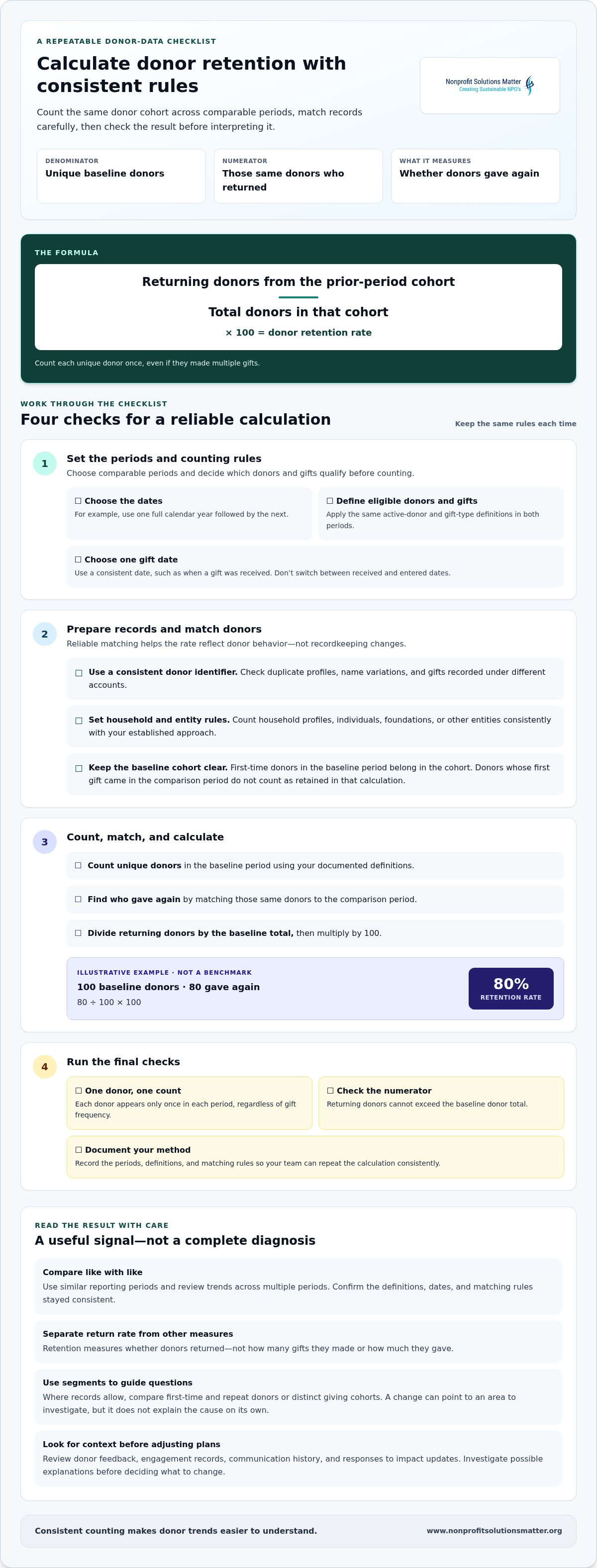
To calculate donor retention rate consistently, use the same donor cohort and reporting rules each time. The formula is: Donor retention rate = returning donors from the prior-period cohort ÷ total donors in that cohort × 100. The denominator is the number of unique donors in the baseline period. The numerator is how many of those same donors gave again in the comparison period.
Illustrative example, not a benchmark: If 100 unique donors gave in one year and 80 of them gave again the next year, the calculation is 80 ÷ 100 × 100 = 80%. Count each donor once, even if they made multiple gifts.
Prepare donor records before applying the formula
First, choose comparable periods, such as one full calendar year followed by the next. Decide what your organization counts as an active donor and which gift types qualify. Apply the same definition in both periods. Also use a consistent gift date, such as the date the gift was received, rather than switching between received and entered dates. That makes comparisons easier to interpret.
Next, review records for duplicate profiles and use a consistent identifier to match each donor across periods. Decide how your organization counts households, foundations, or other entities. If gifts are recorded under one household profile, count that profile consistently; if individuals have separate records, keep them separate. Follow your established reporting rules rather than switching approaches between calculations.
- Set the baseline and comparison dates.
- Count unique baseline-period donors using your documented gift and donor definitions.
- Match records to find which donors gave again.
- Divide returning donors by the baseline total, then multiply by 100.
Before sharing the result, check that the numerator cannot exceed the baseline donor total and that each donor appears only once in each period. Documenting the steps gives your team a repeatable calculation and a clearer foundation for reviewing donor trends.
How to interpret donor retention rate and strengthen resource development
A retention rate is a signal, not a complete diagnosis. Compare like-for-like reporting periods, then review the trend across multiple periods instead of drawing conclusions from one result. A change may reflect donor behavior, a shift in recordkeeping, or both. First confirm that your definitions, dates, and matching rules stayed consistent.
Where your records allow, segment the results. Compare first-time donors with repeat donors, or review distinct giving cohorts. If the overall rate is steady but one group’s result has changed, that pattern can help focus your attention. It doesn’t explain the cause on its own. Treat the data as a prompt to investigate stewardship, communication, and the donor experience, not as proof that any one factor is responsible.
Turn the result into a practical improvement plan
Look for context in donor feedback and engagement records. Review communication history, responses to impact updates, and feedback shared by donors. Ask what changed in the relationship or in your organization’s approach, then test possible explanations before deciding what to adjust.
Translate what you learn into a resource development plan with clear ownership and follow-up measures. For example, assign someone to review outreach to a specific donor segment, then track whether the planned follow-up happened and what the next retention review shows. This creates a useful cycle: observe, investigate, act, and assess.
Retention is one part of a broader system. Nonprofit Solutions Matter, Inc. offers Resource Development Audits that examine organizational systems and inform tailored action plans. This helps leaders connect donor data to wider priorities and responsibilities. The aim isn’t to chase a single percentage. It’s to build a steadier understanding of donor relationships and use that insight to guide thoughtful improvement.
Turn donor data into stronger relationships
A consistent approach to how to calculate donor retention rate gives your team a clearer view of whether donors are returning. Define the donor cohort, apply the same periods and recordkeeping rules, then compare trends and segments over time. Treat the result as a signal to investigate, not a complete explanation of donor behavior.
Use donor feedback and engagement records to guide practical stewardship improvements, and assign clear responsibility for follow-up. A Resource Development Audit can help assess the systems behind your results and identify tailored next steps. Founder Sharon D. Jones brings over 30 years of resource development experience to this work.
With consistent measurement and thoughtful action, your organization can build stronger donor relationships and a more durable resource development system.
Frequently Asked Questions
How do you calculate donor retention rate?
Divide the number of donors from a baseline period who gave again in the comparison period by the total number of unique donors in the baseline period, then multiply by 100. This is how to calculate donor retention rate consistently. For example, if 80 of 100 baseline donors gave again, the rate is 80%. Count people, not gifts.
What is a good donor retention rate for a nonprofit?
There isn’t one rate that defines success for every nonprofit. Results can vary with an organization’s size, donor mix, and reporting methods, so a sector-wide figure may not be a suitable target. Compare like-for-like periods and review your own trend over time. If the rate changes, investigate which donor groups shifted and what their experience may reveal.
Do new donors count in the donor retention rate?
Include new donors in the baseline cohort, then count them as retained only if they give again during the comparison period. A donor whose first gift occurs in the comparison period wasn’t in the earlier cohort, so they don’t count as retained for that calculation. Review first-time donor retention separately from repeat donor retention to understand each group’s pattern.
What is the difference between donor retention rate and donor renewal rate?
Donor retention rate measures the share of a prior-period donor cohort that gave again in a later period. Donor renewal rate often refers to donors who renewed their support, such as making another annual gift, but organizations may define these terms differently. Document your definition and use it consistently so reports remain clear and comparable across periods.
Next Steps: Talk with Nonprofit Solutions Matter, Inc. about building a stronger resource development system.

Article by
Sharon D Jones
Sharon D. Jones, M.Div., is a globally respected fundraising strategist, nonprofit leadership expert, and capacity-building architect with over three decades of experience. As the Founder and CEO of Nonprofit Solutions Matter, Inc., her proprietary growth frameworks have successfully mobilized nearly $957 million in philanthropic capital for local, national, and international organizations.
General Disclaimer & Disclosure
The information provided on this website is for general informational and educational purposes only. While we strive to keep content accurate and up to date, we make no representations or warranties of any kind, express or implied, about the completeness, accuracy, reliability, or suitability of the information contained herein.
Professional Advice
The content on this site does not constitute professional advice (e.g., legal, financial, medical, or tax). You should consult with a qualified professional before making any decisions based on the information provided on this website. Any action you take upon the information found on this site is strictly at your own risk.
Affiliate & Third-Party Links
Some articles on this site may contain affiliate links. If you click on an affiliate link and make a purchase, we may receive a small commission at no additional cost to you. We only recommend products or services we believe add value to our readers. We are not responsible for the content, privacy policies, or practices of any third-party websites linked within our articles.


