
A clear mission doesn’t automatically give an organization the systems and support to deliver it well. A nonprofit capacity building consultant helps strengthen the people, operations, governance, data, and resources a nonprofit needs to carry out its mission sustainably. The work starts by identifying what’s helping the organization and where practical improvements could make its efforts more durable.
It’s understandable to think first about strategic planning when an organization needs to move forward. Planning sets direction; capacity building strengthens the organization’s ability to act on it. This article explains what capacity building can strengthen, how it differs from strategic planning, and what a consultant does, so you can better understand the support that fits your nonprofit’s needs in Panama.
Key Takeaways
- Distinguish strategic planning, which sets direction, from capacity building, which strengthens the organization’s ability to carry it out.
- Look beyond individual skills to the systems, relationships, culture, and resources that support sustainable mission delivery.
- Use organizational analysis to identify where practical support, such as stronger supervision or clearer processes, can help teams adapt and work effectively.
- Explore how targeted support in resource development, leadership, governance, and donor acquisition can address specific organizational priorities.
Is capacity building the same as strategic planning?
Strategic planning defines an organization’s direction: its mission priorities, intended outcomes, and measures. A theory of change connects a program’s activities to those outcomes and identifies indicators of progress. For example, a youth organization might connect mentoring sessions to school engagement and track attendance.
Capacity building strengthens an organization’s ability to deliver its strategy. A nonprofit capacity building consultant can help leaders diagnose constraints, prioritize investments, improve workflows, and put systems into practice. The work may include management consultation, training, or technical assistance. For example, if staff struggle to use program data consistently, support might focus on clearer data processes and staff training.
Strategy, culture, and systems must work together. A plan may call for community partnerships, while internal approval processes slow decisions. Capacity-building consulting can examine that gap, clarify roles, and strengthen staff and board ownership. Consultants may also provide coaching and peer learning, helping leaders practice new approaches instead of simply receiving recommendations.
What services do nonprofit capacity-building consultants offer? They commonly provide consulting, coaching, training, and technical assistance tailored to an organization’s needs and community context. What risks should nonprofits consider when hiring one? Define the scope, decision-making roles, and how recommendations will be implemented. A plan that overlooks staff capacity or organizational culture may not lead to lasting change. A practical first step is to connect each proposed activity to a strategic priority, a responsible role, and a progress indicator.
What does nonprofit capacity building actually strengthen?
Capacity building connects internal capability to reliable mission delivery. It addresses gaps that can weaken program quality, staff engagement, or resource development.
Grant Readiness and Organizational Analysis
A grant-readiness review maps funder priorities against program outcomes and evidence of impact. It also examines governance records and budget processes. Organizational analysis identifies whether staff roles, finances, or data systems support proposed work. For nonprofits operating in Panama, potential funding depends on eligibility, funder priorities, and whether proposed budgets can support capacity-building activities. An organization might document staff training needs and how stronger systems would improve program delivery.
People and Organizational Change
During a program launch or leadership transition, change support can clarify responsibilities and communication. Contract training can build specific skills, while supervision creates regular opportunities to discuss performance, workload, and learning. A consulting contract should define the scope, deliverables, schedule, responsibilities, confidentiality, payment terms, and progress reviews. For example, a training agreement can specify who will participate and how the learning will be applied at work.
Organizational Power and Mission Delivery
Capacity also depends on who shapes decisions. A review can examine whose expertise is heard, who approves changes, and whether frontline staff can raise service concerns. For example, recurring barriers reported by staff need a clear route into program decisions. This connection helps align leadership choices with community experience and mission delivery, while making decision-making roles more visible across the organization.
Definition of a nonprofit capacity building consultant
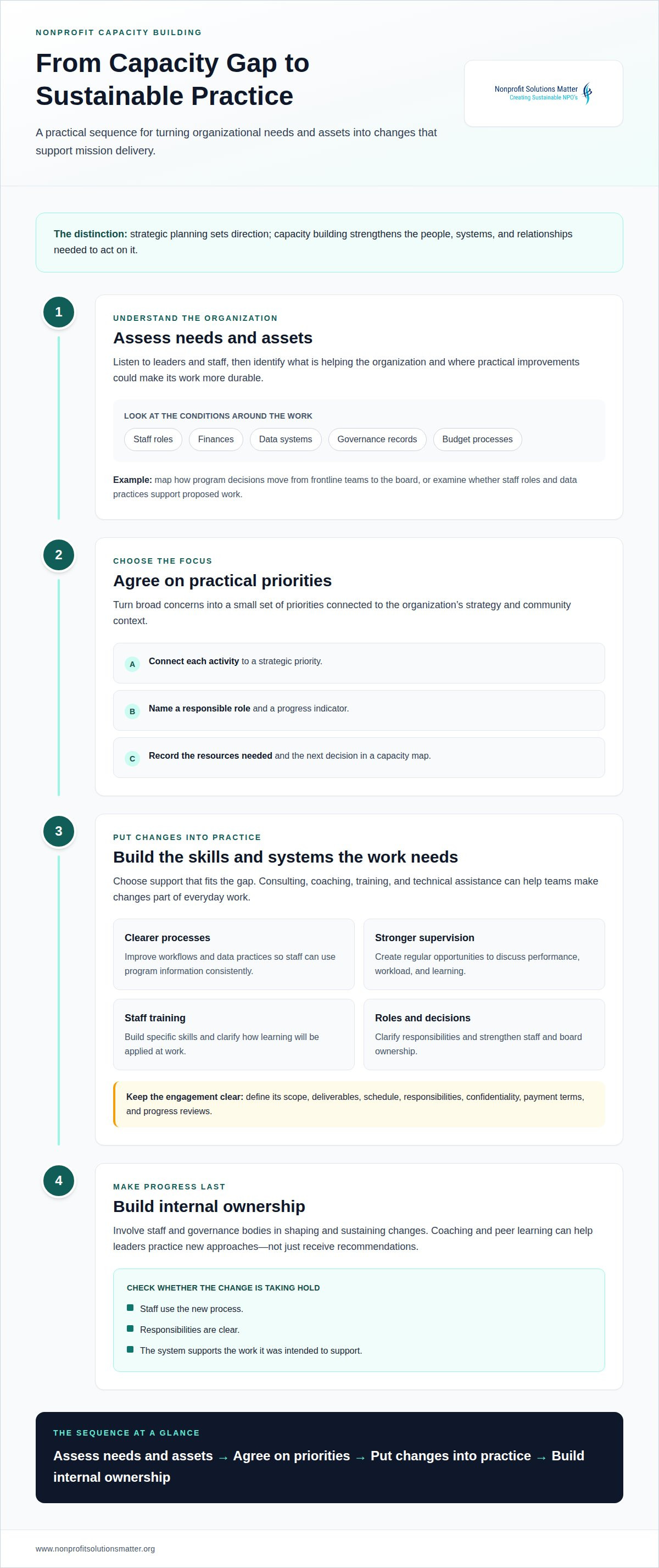
A nonprofit capacity building consultant is a professional partner who helps organizations strengthen the capabilities, structures, systems, and relationships needed to advance their missions. The consultant listens to leaders and staff, then analyzes organizational needs and assets. For example, they might map how program decisions move from frontline teams to the board.
Analysis turns broad concerns into practical priorities. If a community organization struggles to track service outcomes, a consultant can examine data practices, staff roles, and decision-making workflows. Support may include management consultation, training, or technical assistance, with staff and governance bodies involved in shaping and sustaining changes.
Across the nonprofit sector, organizations differ in mission, community context, and stage of development. A consultant tailors recommendations rather than applying a single template. A growing organization may need clearer supervision practices, while an established group may need stronger financial processes. The aim is to build sustainable capabilities that support mission delivery beyond the engagement.
A useful engagement follows a clear sequence: assess needs and assets, agree on priorities, put changes into practice, and build internal ownership. Leaders can judge progress by whether staff use the new process, responsibilities are clear, and the system supports its intended work. A capacity map can record each priority, its owner, the resources needed, and the next decision.
Nonprofit Solutions Matter
Nonprofit Solutions Matter, Inc. can help when your organization has identified a capacity gap and needs practical support. The right focus depends on whether the challenge concerns resource development, leadership, governance, or donor engagement. Matching the work to the need keeps capacity-building efforts connected to mission priorities.
A Resource Development Audit can clarify current resource development practices and identify areas for attention. The Donor Acquisition Program addresses donor acquisition as a distinct organizational priority. These services can help leaders strengthen resource development and donor engagement in support of their mission.
Executive Coaching & Leadership Development supports leaders as they work through organizational decisions and responsibilities. Board Engagement & Governance Training focuses on board participation and governance practices. Together, these services address leadership and governance, two areas that shape how organizations set priorities, make decisions, and sustain their work.
Start by identifying the organizational challenge you want to address, such as resource development, leadership, board engagement, or donor acquisition. That focus can frame a useful conversation about support that fits your priorities. Contact Nonprofit Solutions Matter, Inc. to discuss what your organization is building.
Build the Next Step Into Your Organization’s Work
Choose one organizational priority that would make your mission easier to deliver, then identify the decision or work process it affects. A nonprofit capacity building consultant can help turn that priority into a focused effort, with clear ownership and a way to recognize progress. The aim isn’t to add another plan to an already full calendar. It’s to strengthen how the organization works so its people can carry important work forward.
Nonprofit Solutions Matter can partner with you to shape that next step. Bring the challenge you’re working through and the change you hope to make. A focused conversation can help clarify where to begin and what support fits your organization’s needs.
Steady, intentional capacity building can help your organization create a stronger foundation for its mission. Begin with one clear priority.
Frequently Asked Questions
How does it work?
An engagement usually begins by agreeing on the issue to address, who needs to participate, and what progress should look like. For example, if staff enter donor information inconsistently, the consultant can observe the workflow, identify where entries break down, and support a revised process. Leaders and staff then review whether the change works in daily practice.
The options: who can deliver the support?
Support can come from an independent consultant, a consulting team, or skilled facilitators who provide training and technical assistance. Internal leaders and staff should also participate because they understand how decisions and daily work happen. Peer mentoring and information sharing can add practical insight, especially when organizations face similar governance or management challenges.
What does a nonprofit capacity-building consultant do?
A nonprofit capacity-building consultant helps an organization turn a stated need into changes people can use. The work might include facilitating a leadership discussion, clarifying responsibilities, or helping staff adopt a shared process. A useful engagement also establishes how knowledge will be transferred, so the organization can maintain the practice without relying on the consultant for routine decisions.
How do nonprofits in Panama find and evaluate capacity-building consultants?
Nonprofits in Panama can begin by describing the organizational challenge and the result they need, then assess proposals against that scope. Look for a clear approach, relevant nonprofit experience, defined responsibilities, and a way to review progress. Consider whether the consultant understands the organization’s mission and community context, and whether staff and governance leaders will have meaningful roles in the work.
What qualifications and experience should a nonprofit capacity-building consultant have?
Look for demonstrated experience in the relevant area, such as governance, leadership development, or organizational analysis. A strong consultant can explain their process in plain language, facilitate participation across roles, and show how recommendations become practical. Relevant experience includes adapting methods to an organization’s mission and community, rather than applying the same template to every engagement.
Article by
Sharon D Jones
Sharon D. Jones, M.Div., is a globally respected fundraising strategist, nonprofit leadership expert, and capacity-building architect with over three decades of experience. As the Founder and CEO of Nonprofit Solutions Matter, Inc., her proprietary growth frameworks have successfully mobilized nearly $957 million in philanthropic capital for local, national, and international organizations.
General Disclaimer & Disclosure
The information provided on this website is for general informational and educational purposes only. While we strive to keep content accurate and up to date, we make no representations or warranties of any kind, express or implied, about the completeness, accuracy, reliability, or suitability of the information contained herein.
Professional Advice
The content on this site does not constitute professional advice (e.g., legal, financial, medical, or tax). You should consult with a qualified professional before making any decisions based on the information provided on this website. Any action you take upon the information found on this site is strictly at your own risk.
Affiliate & Third-Party Links
Some articles on this site may contain affiliate links. If you click on an affiliate link and make a purchase, we may receive a small commission at no additional cost to you. We only recommend products or services we believe add value to our readers. We are not responsible for the content, privacy policies, or practices of any third-party websites linked within our articles.


