
Growth doesn’t begin with a bigger program; it begins with a funding plan that can sustain it. To understand how to scale a nonprofit, connect revenue development to the people, systems, and ongoing costs required to deliver more services. A short-term funding boost can open a door, but durable growth depends on planning for what comes next.
Expanding your mission takes more than a strong idea. Funding, team alignment, and growing program needs all shape your ability to scale. Build a deliberate path forward by diversifying revenue, preparing staff and board members for change, and assessing whether a program is ready to reach more people or communities.
Key Takeaways
- Build revenue diversity and plan how programs will continue after initial support ends.
- Align staff, volunteers, and board members around clear roles, practical training, and sustainable workloads.
- Choose an expansion approach that fits community needs and your organization’s capacity to deliver consistently.
- Use resource development and leadership support to strengthen the systems behind long-term growth.
How does financial sustainability impact the scaling of a nonprofit?
Financial sustainability turns a promising launch into a dependable service. Before expanding a program, assess its full operating model: staffing, delivery, administration, and revenue after initial support ends. A grant can establish a pilot, but continued delivery needs a separate funding plan. Map ongoing program costs to reliable income instead of treating a one-time award as permanent support.
Pennsylvania nonprofits can explore eligible state and local grant programs, community foundations, and corporate partnerships. The right opportunities depend on the organization’s mission, location, and program needs. For multi-year general operating support, prepare a clear budget, a defined program model, and outcome data showing how flexible funding sustains core work.
Diversification reduces reliance on a single source. Build a funding calendar that combines individual and monthly giving, major gifts, foundations, corporate partnerships, events, planned giving, and government support. Match each opportunity to the mission and the team’s capacity. For example, an organization can strengthen individual giving while developing foundation relationships instead of pursuing every channel at once.
Readiness also depends on internal systems. Track restricted and unrestricted income separately, review cash flow, and assign clear ownership for each revenue opportunity. Assess whether new commitments can support their related work over time. These steps connect growth plans to practical resources and help leaders decide which programs to sustain, adapt, or expand.
Aligning staff, volunteers, and board members
Before scaling, map the work behind each program and assign clear ownership. Staff need defined responsibilities, volunteers need practical orientation, and board members need shared priorities and decision-making roles. A recruitment plan should describe the skills each role requires, while training connects those skills to program standards. This structure helps leaders determine whether existing capacity can support expansion or hiring is necessary.
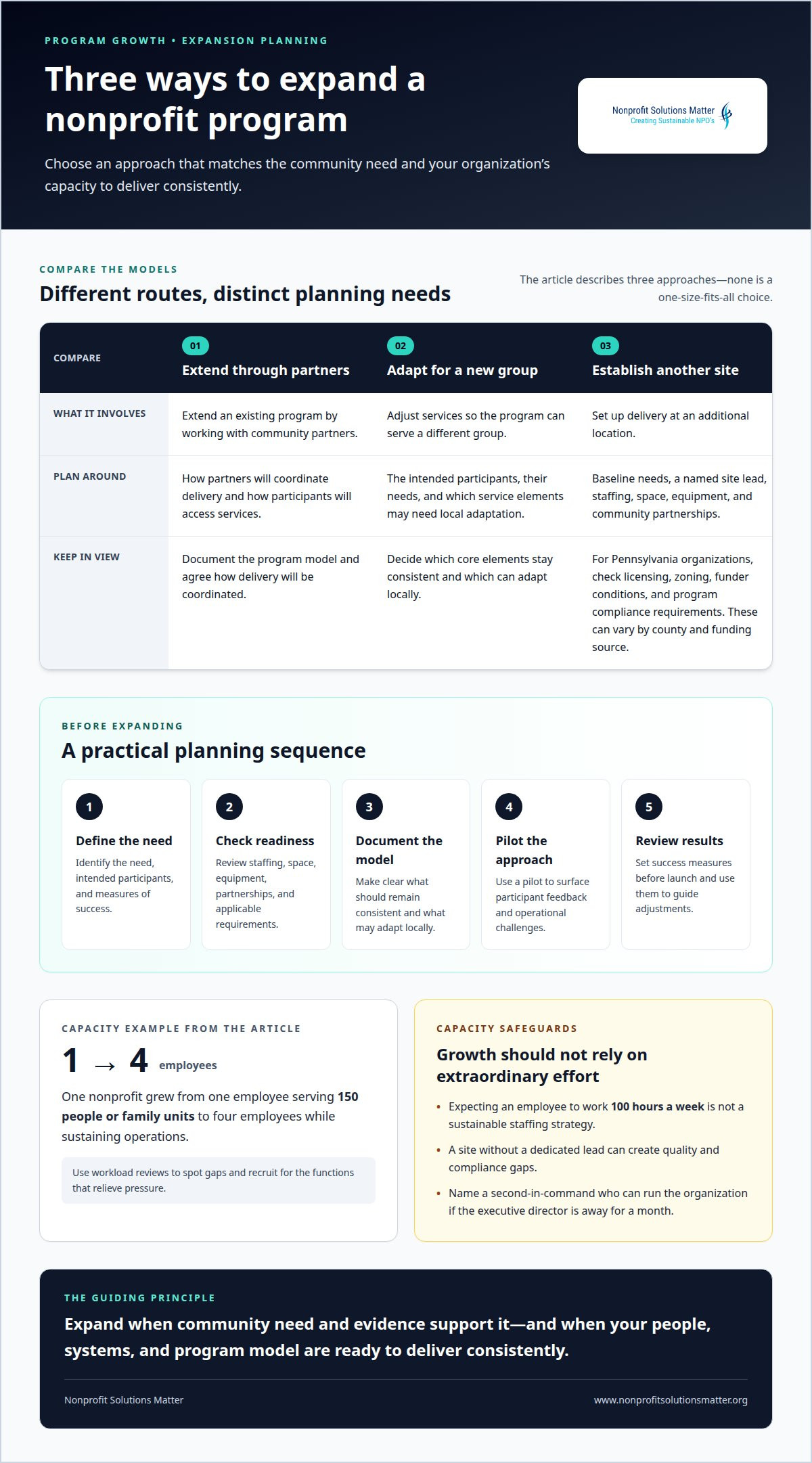
Growth should match staffing capacity, not depend on extraordinary effort. One nonprofit example expanded from one employee serving 150 people or family units to four employees while sustaining operations. Use workload reviews to identify gaps, then recruit for the functions that relieve pressure. Pair new team members with experienced colleagues, provide regular feedback, and discuss retention before turnover disrupts services.
The common risks are unclear accountability, weak supervision, and burnout. Expecting an employee to work 100 hours a week is not a sustainable staffing strategy; launching a site without a dedicated lead can create quality and compliance gaps. Name a second-in-command who can run the organization if the executive director is away for a month.
For alignment, schedule regular staff and board check-ins, share progress against agreed priorities, and offer volunteers role-specific training. Give each leader responsibility for a defined outcome, then review capacity as services grow. Record decisions and follow up on agreed actions so staff, volunteers, and directors can see how their contributions support shared priorities.
What prompts a nonprofit to expand its services and programs?
Organizations expand when community needs exceed a program’s current reach or evidence suggests its model can serve more people. Growth may address access barriers, respond to partner requests, or deepen mission impact. Before choosing a location, define the need, intended participants, and measures of success. A clear purpose keeps expansion aligned with the mission and gives staff a basis for evaluating results.
For Pennsylvania organizations, expansion requirements depend on the program, location, and funding source. Licensing, zoning, funder conditions, and program compliance obligations can vary by county and funding source. Include these considerations in early planning, alongside staffing, space, equipment, and community partnerships, so the proposed model reflects the intended site.
Choose an expansion model that fits the organization’s capacity. A nonprofit might extend an existing program through community partners, adapt services for a new group, or establish another site. GreenLight Fund, founded in 2004 to help bring nonprofit solutions into communities, illustrates a community-focused approach. Document the program model before expanding, then identify which core elements should remain consistent and which can adapt locally.
For a new site, define baseline needs and name a site lead. A pilot can surface participant feedback and operational challenges before wider expansion. Set success measures before launch, then use them to guide adjustments. Consider how participants will access services, how partners will coordinate delivery, and how the organization will gather feedback after launch. These decisions help leaders assess whether the expansion model is working as intended.
Nonprofit Solutions Matter
Scaling requires more than a promising program. It calls for a clear view of resource development, leadership capacity, board engagement, and donor relationships. Nonprofit Solutions Matter, Inc. helps mission-driven organizations strengthen these foundations so growth plans are supported by the systems needed to carry them forward. The right next step depends on where your organization feels the greatest pressure.
A Resource Development Audit can assess current resource development practices and systems, identify gaps, and clarify opportunities for a more durable revenue strategy. The Donor Acquisition Program supports organizations in strengthening how they develop donor relationships. Together, these services can help leaders broaden their resource base while keeping funding priorities connected to mission needs.
Growth also changes how people lead and make decisions. Executive Coaching & Leadership Development supports leaders as they navigate organizational demands and build leadership capacity. Board Engagement & Governance Training helps board members understand their roles in governance, resource development, and strategic leadership. Each offering addresses a different part of the organization that must evolve alongside its programs.
Nonprofit Solutions Matter, Inc. can help identify a practical starting point, whether your priority is assessing resource development, strengthening leadership, engaging the board, or improving donor acquisition. Sustainable growth comes from connected decisions, not expansion alone. Name the organizational question that needs attention first, then contact Nonprofit Solutions Matter, Inc. to discuss your goals and support needs.
Build the Next Stage with Intention
The next stage of growth is not simply about reaching more people. It’s a deliberate choice about what your organization can sustain, what it should strengthen first, and how success can serve the mission over time. Name the decision that feels most consequential, then bring the right leaders and board members into a focused conversation. That’s how to scale a nonprofit without allowing expansion to outrun its purpose.
Nonprofit Solutions Matter supports this work through Resource Development Audits, Executive Coaching & Leadership Development, and Board Engagement & Governance Training. These offerings address distinct aspects of organizational readiness, from resource development to leadership capacity and board engagement. Choose the area that best matches the decision in front of you, then use that clarity to move from intention to action.
Your mission can grow through disciplined choices and shared direction. Take the next step with confidence.
Frequently Asked Questions
How Do You Fund Growth Itself?
Fund growth by matching each new commitment to a realistic source of continuing revenue. Separate startup needs, such as launching a service, from recurring expenses like staff time and delivery. Then phase spending against confirmed income and review progress before adding further commitments. This approach helps leaders avoid building ongoing obligations around support that may not continue.
What Does It Mean to Scale a Nonprofit?
Scaling means increasing an organization’s reach or impact while preserving the quality and purpose of its work. It isn’t simply adding staff, locations, or services. A practical test is whether the organization can reproduce its core approach and track comparable outcomes as it grows. If delivery depends on one person’s informal knowledge, document the process before extending it.
Where Should You Start?
Start with one specific growth decision, such as extending a service or serving a new community. Identify who will benefit, what success would look like, and which current responsibilities could be affected. Bring the executive leader and board into the decision early, then agree on a point to review progress. Clear boundaries make it easier to adjust the plan as experience accumulates.

Article by
Sharon D Jones
Sharon D. Jones, M.Div., is a globally respected fundraising strategist, nonprofit leadership expert, and capacity-building architect with over three decades of experience. As the Founder and CEO of Nonprofit Solutions Matter, Inc., her proprietary growth frameworks have successfully mobilized nearly $957 million in philanthropic capital for local, national, and international organizations.
General Disclaimer & Disclosure
The information provided on this website is for general informational and educational purposes only. While we strive to keep content accurate and up to date, we make no representations or warranties of any kind, express or implied, about the completeness, accuracy, reliability, or suitability of the information contained herein.
Professional Advice
The content on this site does not constitute professional advice (e.g., legal, financial, medical, or tax). You should consult with a qualified professional before making any decisions based on the information provided on this website. Any action you take upon the information found on this site is strictly at your own risk.
Affiliate & Third-Party Links
Some articles on this site may contain affiliate links. If you click on an affiliate link and make a purchase, we may receive a small commission at no additional cost to you. We only recommend products or services we believe add value to our readers. We are not responsible for the content, privacy policies, or practices of any third-party websites linked within our articles.


