
A credential can signal preparation, but it cannot show whether a consultant understands your board’s particular challenges. If you’re searching for a board source certified governance consultant, the terminology can add another layer of uncertainty: the former Certified Governance Consultant credential is now a legacy designation, while BoardSource’s current pathway separates course training from directory membership.
It’s reasonable to want clear evidence of expertise. It’s just as important to understand how that expertise could help your board participate more effectively and strengthen organizational capacity. This article explains what BoardSource’s certificate and membership signify, then offers practical criteria for evaluating a consultant’s experience, approach, and fit. Use the guidance to connect board education with meaningful engagement, resource development, and long-term sustainability.
Key Takeaways
- Distinguish BoardSource course certificates from Governance Consultant Membership and directory listing when assessing a board source certified governance consultant.
- Evaluate practical fit by connecting your board’s specific challenge with the consultant’s relevant experience, working approach, and intended outcomes.
- Before work begins, clarify deliverables, who needs to participate, confidentiality, and how progress will be reviewed.
- Turn governance learning into sustained capacity by identifying a gap, connecting board education to the mission, and agreeing on next actions linked to strategy and resource development.
What Does a BoardSource Governance Consultant Credential Actually Mean?
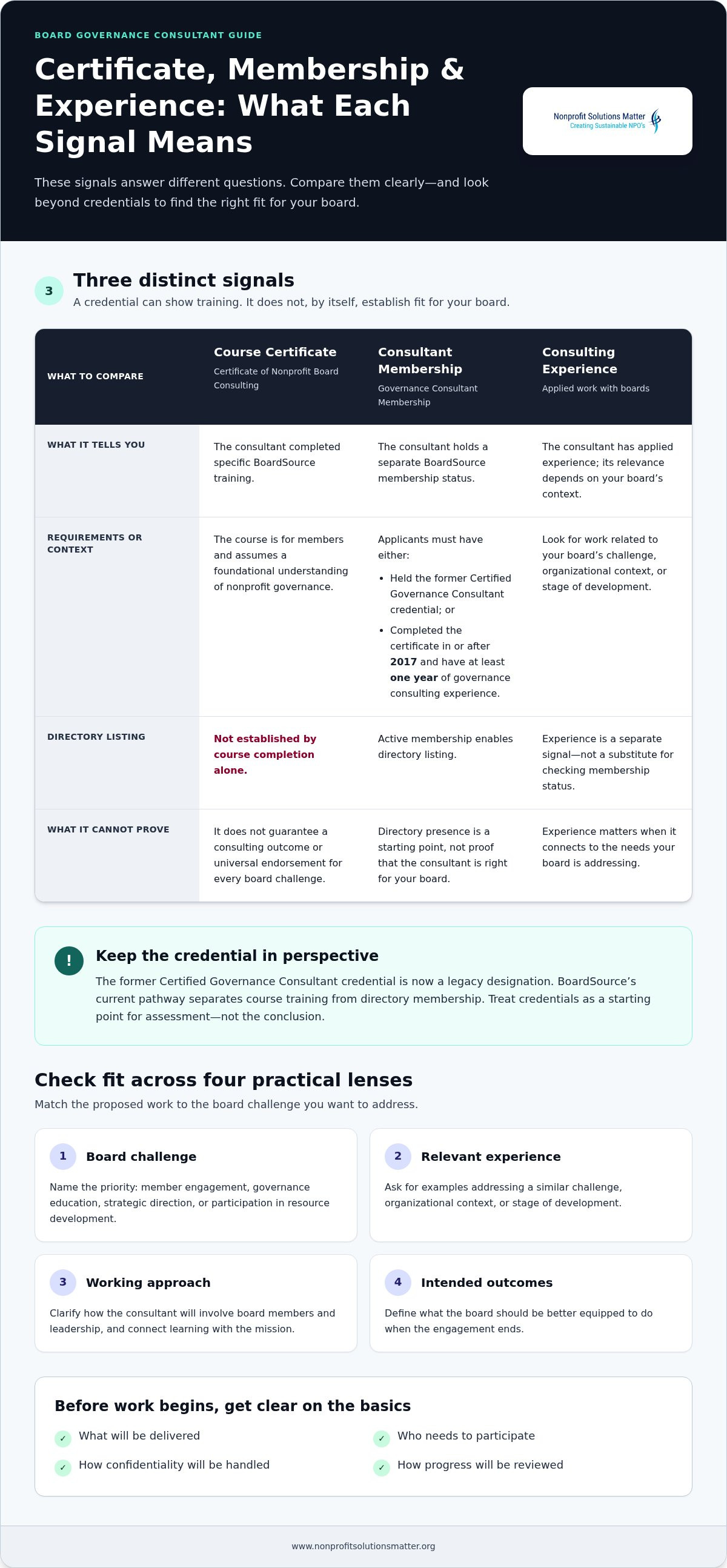
A BoardSource course certificate documents completion of specific training. Governance Consultant Membership is a separate status that can make an eligible consultant visible in BoardSource’s directory. Consulting experience is another signal. Keeping these distinctions clear helps you interpret the phrase board source certified governance consultant without treating a credential as proof of fit for your organization.
Certificate, membership, and consulting experience are different signals
BoardSource’s current training is the Certificate of Nonprofit Board Consulting. The course is for members and assumes a foundational understanding of nonprofit governance. Completing it indicates participation in this training, not a guaranteed consulting outcome or a universal endorsement for every board challenge. For background on the organization, see the BoardSource Wikipedia page.
A certificate can establish that a consultant completed BoardSource’s named training. It cannot establish that the consultant’s approach or experience is right for your board.
BoardSource describes training, membership, and experience as distinct parts of its consultant pathway. To qualify for Governance Consultant Membership, applicants must either have held the former Certified Governance Consultant credential or have completed the Certificate of Nonprofit Board Consulting in or after 2017 and have at least one year of governance consulting experience. Active membership enables directory listing; course completion alone does not establish that listing.
Use each signal for what it tells you. Training suggests exposure to a structured body of governance learning. Membership and directory listing indicate a separate relationship with BoardSource under its stated requirements. Experience can show applied work, but its relevance depends on your board’s context. For example, a board working on role clarity, member participation, or resource-development strategy should look for experience that relates to those needs. The credential is a starting point for assessment, not its conclusion.
How to Assess a Governance Consultant Beyond the Credential
Credentials and project alignment answer different questions: one signals formal learning, while the other helps show whether a consultant’s experience and methods fit your board’s needs. Assess that fit through four lenses:
- Board challenge: Name the priority. Is the board working on member engagement, governance education, strategic direction, or participation in resource development?
- Relevant experience: Look for examples of work addressing a similar challenge, organizational context, or stage of development.
- Working approach: Ask how the consultant will involve board members and leadership, and how learning will connect with the mission.
- Intended outcomes: Define what the board should be better equipped to do when the engagement ends.
The BoardSource Consultant Directory can help you learn about listed consultants, but directory presence is only a starting point. A board facing uneven participation may need guided learning and clear role expectations. A board focused on sustainability may need help connecting strategy with resource-development participation and revenue diversification. Match the proposed work to the problem you want to address.
Match the consultant’s approach to the board’s actual challenge
Nonprofit Solutions Matter’s Board Empowerment work combines workshops, custom board manuals, and practical strategy training to support meaningful participation. Workshops are available in half-day or full-day formats, on-site or virtually. Choose an approach that responds to the board’s specific gap instead of applying a standard session without regard to its mission or goals.
Before work begins, agree on what will be delivered, who needs to participate, how confidentiality will be handled, and how you will review progress. It can also help to identify the decision or behavior the board should be ready to address after the training. These steps give leadership and board members a clear structure for preparing and applying what they learn. For a board seeking nonprofit board governance training, the key question is how learning will translate into decisions and sustained participation, not simply which topics appear on the agenda.
Turn Board Governance Support into Stronger Organizational Capacity
Governance support creates lasting value when it strengthens how the board contributes to the organization’s mission, not just what members know about governance. Keep the work connected to organizational priorities with a practical sequence:
- Identify the gap: Pinpoint where the board needs stronger understanding, engagement, or participation. Use specific examples, such as inconsistent attendance, unclear responsibilities, or limited involvement in planning.
- Align learning with the mission: Connect board education to strategic priorities and the organization’s current capacity needs.
- Establish next actions: Decide how members will apply what they learn, contribute to strategic planning, and support resource development. Assign owners to agreed actions so follow-through is clear.
For example, board members may understand their roles but not actively contribute to revenue diversification. Training can connect their governance responsibilities with meaningful resource-development participation, such as identifying how their skills and relationships can support the organization’s strategy. The aim is a clearer bridge between board engagement and organizational sustainability.
What a practical board-empowerment engagement can include
Nonprofit Solutions Matter’s Board Empowerment work brings together workshops, custom board manuals, and resource-development strategy training. Workshops are available in half-day or full-day formats and can be delivered on-site or virtually. These elements help translate governance concepts into practical understanding and connect board participation with strategic planning and the organization’s mission.
A board source certified governance consultant may bring relevant training, but the enduring value of governance support lies in how learning informs action. Agree on next steps that fit the board’s priorities. These might include applying a shared understanding of roles to planning discussions or clarifying how members can participate in resource development.
The strategy-call page provides a starting point for discussing board priorities and how engagement could connect with organizational capacity.
Build the Board Capacity Your Mission Needs
Turn governance insight into a deliberate practice: choose one board contribution that would strengthen your organization’s future, then give members a clear opportunity to develop it together. For example, the board might focus on connecting its strategic priorities with member participation in resource development. A specific focus keeps board development tied to the mission rather than treating it as a one-time exercise.
Choosing a board source certified governance consultant is ultimately about finding support that helps your board move from intention to sustained participation. Consider what meaningful progress would look like for your organization, then bring that priority into a conversation about next steps. Clear direction can help build momentum for stronger engagement and lasting capacity.
Your board’s potential is a foundation for the organization’s future. Discuss your priorities and identify a practical next step with Nonprofit Solutions Matter.
Frequently Asked Questions
Is the BoardSource Certificate of Nonprofit Board Consulting the same as consultant certification?
No. The Certificate of Nonprofit Board Consulting indicates completion of a BoardSource training course. It is not automatically equivalent to the former Certified Governance Consultant credential or to Governance Consultant Membership. These terms describe different statuses. A certificate documents course completion, not a guarantee of consulting capability or results for a particular board.
What does a BoardSource governance consultant membership indicate?
Membership indicates that a consultant has met BoardSource’s stated eligibility requirements and agreed to its professional expectations. BoardSource’s information describes eligibility, education, experience, and professional agreements as parts of the membership pathway. Treat membership as one qualification signal, not a measure of fit for every nonprofit. Assess whether the consultant’s experience speaks to your board’s stage, dynamics, and priorities.
Can a nonprofit work with a governance consultant who does not hold a BoardSource credential?
Organizations should assess a consultant’s relevant experience, working approach, and alignment with the support they need; don’t assume one credential is universally required. If you’re seeking a board source certified governance consultant, distinguish credential status from the practical scope of the engagement. A consultant may be suited to facilitate role clarification, while your organization may need support with board education or strategic participation.
How can a nonprofit tell whether governance consulting is working?
Agree in advance on observable signs of progress that match the engagement’s purpose. These might include board members completing agreed learning goals, participating more consistently in a strategic discussion, or recording owners and timelines for next actions. Review those indicators with leadership and board participants at agreed points. Measures should reflect the organization’s context and guide adjustments, not imply a predetermined result.
Article by
Sharon D Jones
Sharon D. Jones, M.Div., is a globally respected fundraising strategist, nonprofit leadership expert, and capacity-building architect with over three decades of experience. As the Founder and CEO of Nonprofit Solutions Matter, Inc., her proprietary growth frameworks have successfully mobilized nearly $957 million in philanthropic capital for local, national, and international organizations.
General Disclaimer & Disclosure
The information provided on this website is for general informational and educational purposes only. While we strive to keep content accurate and up to date, we make no representations or warranties of any kind, express or implied, about the completeness, accuracy, reliability, or suitability of the information contained herein.
Professional Advice
The content on this site does not constitute professional advice (e.g., legal, financial, medical, or tax). You should consult with a qualified professional before making any decisions based on the information provided on this website. Any action you take upon the information found on this site is strictly at your own risk.
Affiliate & Third-Party Links
Some articles on this site may contain affiliate links. If you click on an affiliate link and make a purchase, we may receive a small commission at no additional cost to you. We only recommend products or services we believe add value to our readers. We are not responsible for the content, privacy policies, or practices of any third-party websites linked within our articles.


