
What if the strongest case for bringing in a nonprofit consultant isn’t a promise of more revenue, but a clearer, more durable way to deliver your mission? Building a business case for nonprofit consultant support starts with a practical question: what organizational constraint is keeping good work from becoming sustainable?
Leaders and board members may see the same challenge differently. Revenue diversification can take substantial staff time, while the systems needed for long-term progress remain unfinished. That tension doesn’t signal failure. It may point to a capacity gap that focused, collaborative support can address.
This article offers a practical framework for assessing your organization’s need and readiness for consulting, connecting the work to mission-aligned outcomes, and defining success without relying on promised revenue results. You’ll also see how to take a responsible next step, with leadership firmly in the driver’s seat.
Key Takeaways
- Separate temporary workload pressure from persistent gaps in strategy, governance, data, or resource development before deciding whether consulting is needed.
- Build a credible business case for nonprofit consultant support by linking a specific organizational gap to its effect on mission delivery and the expertise needed to address it.
- Set observable measures in advance, such as clearer leadership roles, more usable development processes, or stronger data practices.
- Match the support to the diagnosed need, then align leadership, governance, data, and resource development around implementation.
When Does the Business Case for a Nonprofit Consultant Make Sense?
The business case for a nonprofit consultant connects a defined organizational need to the value of specialized support. It isn’t simply a request for extra hands. It explains what is getting in the way, how that gap affects the mission, and why focused expertise could help the organization address it.
A nonprofit organization exists to advance a purpose, so the case for support should show how stronger systems can protect or extend that purpose. A short-term workload spike may call for reprioritizing tasks. A persistent gap in strategy, governance, data, or resource development may require a more structural response. If the same problem returns after staff put in extra effort, the issue may be the system, not the effort.
Which organizational signals justify outside expertise?
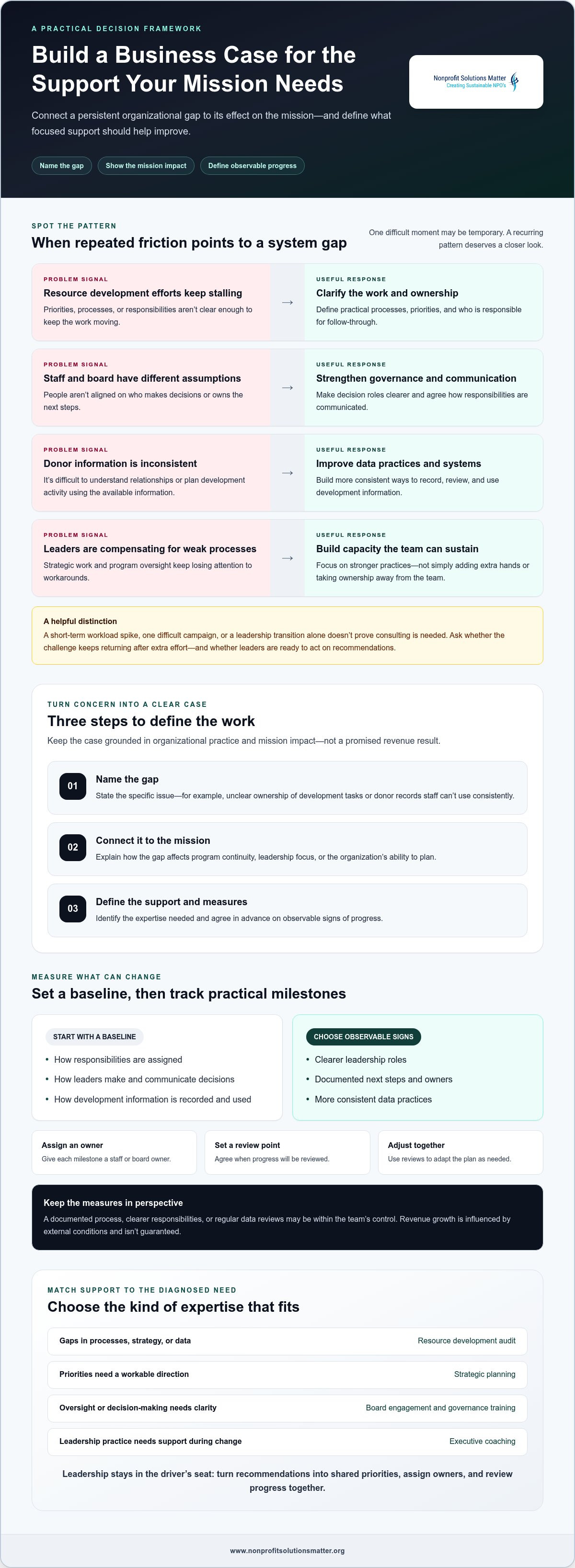
Look for patterns that constrain decisions or make essential work difficult to sustain:
- Revenue diversification efforts keep stalling because priorities, processes, or responsibilities aren’t clear.
- Staff and board members have different assumptions about who makes decisions or owns follow-through.
- Donor information is inconsistent, making it hard to understand relationships or plan development activity.
- Leaders spend so much time compensating for weak processes that strategic work and program oversight lose attention.
One difficult campaign or leadership transition, on its own, doesn’t prove consulting is needed. Ask whether the challenge is temporary or recurring, what root cause is within the organization’s influence, and whether leaders are ready to act on recommendations. If unresolved gaps are diverting capacity from programs or leaving key decisions dependent on individual memory, they can weaken mission delivery and resilience over time.
Start with shared priorities. Name the gap, identify its effect on the mission, and decide whether the organization can commit the leadership attention needed to put improvements into practice. Specialized support is most useful when it strengthens the team’s capacity rather than taking ownership away from it.
How to Build a Credible Business Case for a Nonprofit Consultant
A persuasive business case turns a concern into a defined piece of work. It helps leaders and the board agree on what needs attention, why it matters to the mission, and what expertise or capacity can address it. Focus on a path to stronger organizational practice, not a promise of a particular revenue result.
- Name the gap. State the specific issue, such as unclear ownership of development tasks or donor records that staff can’t use consistently.
- Connect it to the mission. Explain how the gap affects program continuity, leadership focus, or the organization’s ability to plan.
- Define the support and measures. Identify the expertise needed and agree on observable signs of progress before work begins.
Separate what the engagement can directly produce from outcomes influenced by external conditions. A documented process, clearer responsibilities, or a regular data-review practice may be within the team’s control. Revenue growth isn’t guaranteed. The Association of Consultants to Nonprofits offers a broader reference point for understanding the profession, while your case should stay grounded in your organization’s needs and intended work.
What should leaders measure before and during an engagement?
Start with a baseline: how responsibilities are assigned, how leaders make and communicate decisions, and how development information is recorded and used. Then select a small set of milestones tied to the diagnosed need. Give each milestone an owner and review date so the board and staff can assess progress and adjust course together.
For example, the Fundraising Performance Diagnostic™ assesses eight dimensions of revenue readiness, including leadership, staffing, systems, accountability, CRM, donor pipelines, development operations, and overall readiness. Its findings can help leaders pinpoint where support is useful and set practical measures, such as documented next steps or more consistent data practices.
Use those measures as working tools, not as a scorecard detached from the mission. Regular reviews help leaders see where implementation is gaining traction and where the plan needs to adapt.
What a Mission-Aligned Nonprofit Consultant Can Help Build
The right support depends on the need. A resource development audit can identify gaps in processes, strategy, or data. Strategic planning can help leaders turn priorities into a workable direction. Board engagement and governance training can clarify oversight and decision-making, while executive coaching can strengthen leadership practice during change. Nonprofit Solutions Matter, Inc. provides these services to build organizational capacity while keeping decisions and implementation with the nonprofit.
Lasting progress often depends on how the pieces fit together. Leadership sets priorities, governance supports clear decisions, data informs choices, and resource development processes help put plans into action. Nonprofit Solutions Matter, Inc. brings more than 30 years of resource development experience across six continents. Its Resource Development Audits, board training, executive coaching, and technical assistance with CRM optimization can help organizations assess gaps and build more consistent practices. A sound business case for nonprofit consultant support focuses on systems and habits the organization can sustain, not a guaranteed financial result.
How to move from a consultant’s recommendations to lasting capacity
Recommendations matter only when they become shared work. Translate findings into a short set of priorities, assign each action to a staff or board owner, and establish checkpoints to review progress. If a resource development review identifies inconsistent follow-up, for example, the team can define a consistent process, name who maintains it, and schedule regular reviews of whether it’s being used.
Coaching and technical guidance can help reinforce new leadership habits and accountability over time. Executive coaching typically requires 2-4 hours monthly, plus action-item work. The nonprofit remains responsible for decisions and implementation; the consultant helps the team build confidence and routines that continue beyond the engagement.
Next Steps
Bring your diagnosed need, desired organizational change, and questions about readiness into a leadership discussion. Identify a practical, mission-aligned path forward and the people who will own the work.
Build the Next Stage with Intention
Your next step doesn’t need to be a full-scale change. Choose one priority leaders can own, identify who will champion the work internally, and decide how progress will be reviewed. This gives consulting a clear starting point while keeping responsibility and learning within the organization. A sound business case for nonprofit consultant support is a commitment to strengthen the conditions that let mission work endure, not a wager on promised revenue.
For eligible nonprofits with limited resources, sliding-scale and qualifying pro-bono options can help make capacity-building support more accessible. Begin with a shared priority and a realistic commitment to act on what the work reveals.
With a thoughtful first step, your organization can build stronger foundations for the work ahead.
Frequently Asked Questions
How do you make the case to a nonprofit board for hiring a consultant?
Present a business case for nonprofit consultant support as a focused decision, not a general request for help. Give the board a concise memo describing the issue, its effect on programs or organizational priorities, the proposed scope, and what staff will contribute. For example, if donor records are difficult to use, explain how that limits planning and what improved data practices would enable.
How can a nonprofit measure whether a consultant is helping?
Compare the organization’s starting point with agreed indicators, then review them at planned intervals. A board engagement project might track whether members understand their roles and complete agreed actions; a data project might track whether staff consistently enter and use key information. Record barriers as well as progress, so leaders can adjust implementation rather than judge the work by a single outcome.
Can a small nonprofit work with a consultant if its budget is limited?
Yes. Begin with one priority that can be addressed within the organization’s available resources, such as clarifying a decision process or improving a single development workflow. Define a manageable scope and the staff time available to participate before setting the work in motion. Sliding-scale and qualifying pro-bono options can help eligible nonprofits access capacity-building support. A focused engagement can help the team make progress without trying to solve every organizational challenge at once.
Does a nonprofit consultant guarantee that revenue will increase?
No. A consultant can help strengthen resource development strategy, systems, and leadership practices, but revenue depends on factors beyond the consultant’s control, including donor decisions and changing conditions. Ask what work will be completed and how progress will be assessed. Clear deliverables and stronger organizational practices are more responsible measures than a promised financial result.
Article by
Sharon D Jones
Sharon D. Jones, M.Div., is a globally respected fundraising strategist, nonprofit leadership expert, and capacity-building architect with over three decades of experience. As the Founder and CEO of Nonprofit Solutions Matter, Inc., her proprietary growth frameworks have successfully mobilized nearly $957 million in philanthropic capital for local, national, and international organizations.
General Disclaimer & Disclosure
The information provided on this website is for general informational and educational purposes only. While we strive to keep content accurate and up to date, we make no representations or warranties of any kind, express or implied, about the completeness, accuracy, reliability, or suitability of the information contained herein.
Professional Advice
The content on this site does not constitute professional advice (e.g., legal, financial, medical, or tax). You should consult with a qualified professional before making any decisions based on the information provided on this website. Any action you take upon the information found on this site is strictly at your own risk.
Affiliate & Third-Party Links
Some articles on this site may contain affiliate links. If you click on an affiliate link and make a purchase, we may receive a small commission at no additional cost to you. We only recommend products or services we believe add value to our readers. We are not responsible for the content, privacy policies, or practices of any third-party websites linked within our articles.


