
What if keeping donors engaged depended less on sending more messages and more on making every interaction feel purposeful? Strong donor retention strategies connect gratitude, relevant updates, and thoughtful follow-through, so supporters hear from your organization for more than an ask.
If donor communication feels inconsistent, stewardship lacks clear ownership, or signs of disengagement are easy to miss, you’re not alone. These challenges often point to a need for a manageable system, not more activity from an already stretched team.
This practical checklist will help your nonprofit build a steady stewardship rhythm, tailor communications to donor interests, and track engagement patterns so you can respond thoughtfully. You’ll find steps for turning each gift into the beginning of a stronger relationship, while connecting donor care to a more sustainable resource development system.
Key Takeaways
- Shape donor communications around gratitude, trust, and meaningful updates, not just the next contribution.
- Use donor retention strategies that include prompt acknowledgment, impact reporting, feedback, and relevant follow-up.
- Tailor outreach to each donor’s interests and engagement history, rather than relying on gift size alone.
- Review retention alongside engagement patterns to spot where stewardship can become more consistent and responsive.
Why donor retention strategies begin with the donor experience
Donor retention is an organization’s ability to sustain relationships and continued support over time. It isn’t secured by a single thank-you or campaign. It grows through repeated experiences that show donors their contribution is valued, their interests are understood, and the organization follows through on its mission.
Timely gratitude acknowledges a gift while the decision is still fresh. Meaningful updates then help donors understand what their support made possible, without making every message another request. Together, these actions build trust beyond the next contribution. They also depend on clear internal ownership: leaders, program staff, board members, and resource development teams all shape whether the donor experience feels consistent.
What causes donors to disengage, and what can teams notice?
Delayed thanks, generic updates, unclear explanations of impact, and repeated asks without relationship-building can leave supporters feeling overlooked. These are experience gaps a team can review and address. For example, if a donor supports a particular program but receives no update about its work, they may be missing the follow-through that connects giving to the mission.
Notice observable changes, such as fewer responses, unopened communications where that data is available, or a pause in giving. Don’t treat these signals as proof of a donor’s reason. They might reflect changed circumstances, message preferences, or something else entirely. Use them as a prompt to review the communication history, listen where appropriate, and adjust thoughtfully.
Donor retention is the practice of caring for relationships consistently, so supporters can stay connected to the mission over time. Practical donor retention strategies make that care a shared organizational responsibility. Agree on who acknowledges gifts, records donor preferences, shares program updates, and follows up, rather than leaving each task to memory.
Donor retention strategies your nonprofit can put into practice
A dependable stewardship process doesn’t need to be complex. It needs clear steps, realistic timing, and an owner for each follow-up. Use this sequence as a starting point, then adapt it to your team’s capacity. The Urban Institute’s research on donor retention offers further context on why sustaining donor relationships matters.
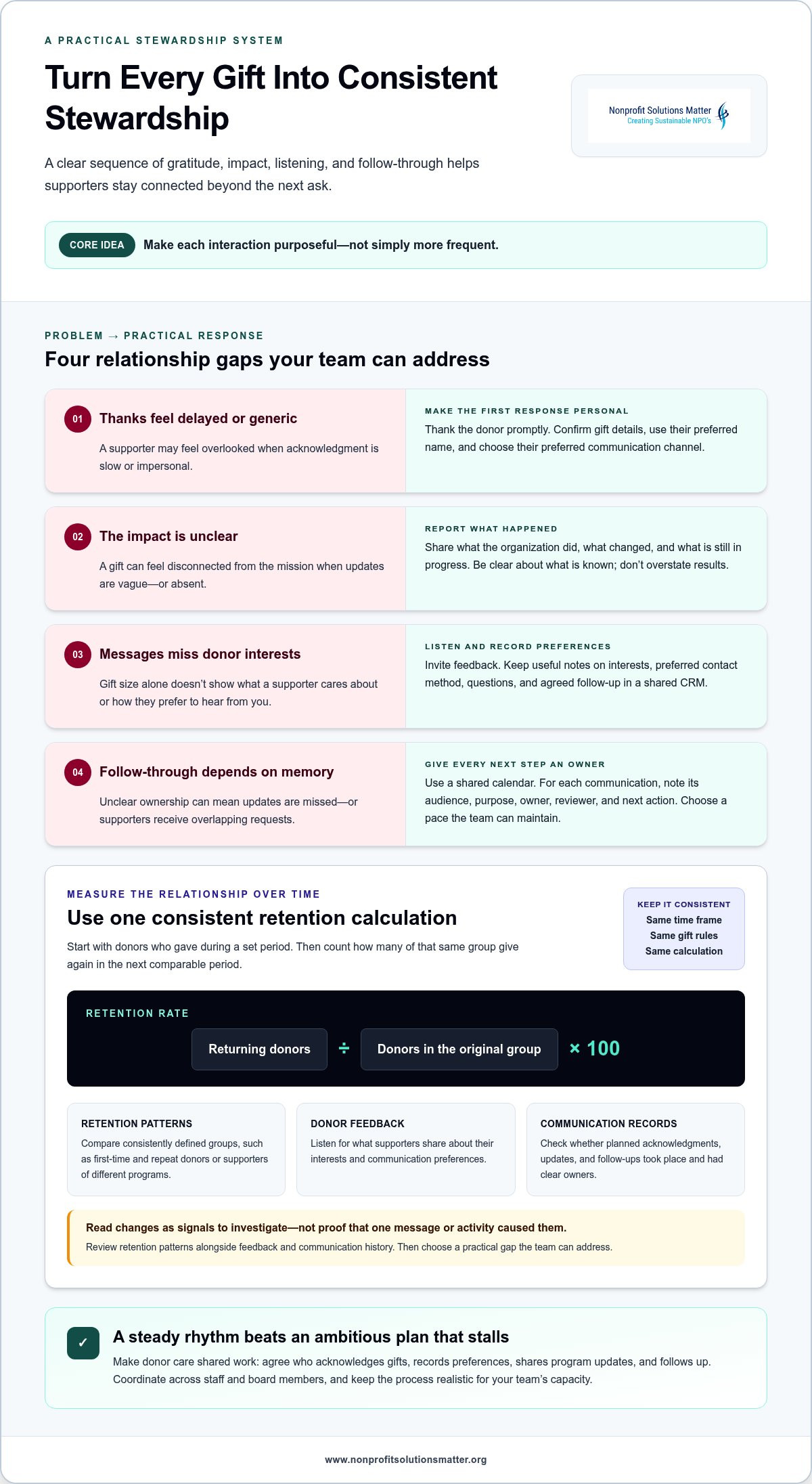
- Acknowledge: Send a timely, personal thank-you that recognizes the donor’s support. Confirm the gift details and use the donor’s preferred name and communication channel.
- Report impact: Share a concrete update about the work their gift helped advance. Explain what the organization did, what changed, and what is still in progress. Be clear about what’s known, and avoid overstating results.
- Invite feedback: Offer a simple way to share interests or communication preferences, and make space to listen. Record useful preferences so the next interaction reflects what the donor shared.
- Plan follow-up: Schedule a relevant update or invitation, not just another request. Assign an owner and record the next step in your shared system.
Segment communications by relationship, interests, and engagement history, not gift size alone. A donor who has shown interest in a particular program may value a related project update, while a longtime supporter may appreciate a deeper account of organizational progress. Let recorded preferences guide the message. Don’t assume that one gift reveals someone’s broader interests.
How can a small team personalize donor communication?
Use your CRM as a shared record of preferences, past interactions, and communication history. Keep entries accurate and useful. After a meaningful conversation, record the donor’s stated interests, preferred contact method, questions, and any agreed follow-up. Assign someone to maintain these records and resolve duplicate or outdated entries.
Then build a stewardship calendar around existing capacity. For each communication, identify the audience, purpose, owner, reviewer, and next action. Coordinate messages across staff and board members so a supporter doesn’t receive overlapping requests while waiting for an update. Choose a pace the team can maintain. A simple calendar followed consistently is more useful than an ambitious one that stalls.
Relevant communication turns donor information into care, helping supporters see how their interests connect with the mission.
How to measure retention and strengthen your donor stewardship system
Start with a consistent definition: identify the donors who gave during a set period, then track how many of those same donors give again in the next comparable period. Divide the returning donors by the donors in the original group to calculate the retention rate. Use the same time frame, gift rules, and calculation each time so your organization can interpret changes reliably. Pair the result with context, including donor feedback, communication history, and whether planned stewardship took place.
Look for patterns across groups that are useful to your team, such as first-time and repeat donors, or supporters connected to different programs. Check that each group is defined consistently before comparing results. A change in one group’s retention is a signal to investigate, not proof that a specific message or activity caused it. Giving USA’s donor engagement techniques can offer additional perspective on relationship-centered practices.
When should a nonprofit review its donor retention approach?
Set a recurring review that fits your reporting and planning rhythm. At each review, consider three sources together: retention patterns, donor feedback, and communication records. Check whether acknowledgments and updates went out as planned, whether donor preferences are recorded, and whether follow-up has a clear owner. If the evidence points to several possible gaps, choose one priority the team can address, such as improving follow-up after a gift or updating incomplete donor preferences.
Then use a simple improvement cycle: review records, identify a gap, assign an action, and revisit what changed. This keeps donor retention strategies connected to everyday practice instead of treating the metric as a standalone result. If the review reveals broader questions about accountability, data, or resource development systems, a resource development audit can help clarify where those systems need attention. Sustainable progress comes from consistent learning, not from reacting to every short-term fluctuation.
Build donor relationships that endure
Lasting donor support grows from consistent care, not isolated messages. Acknowledge contributions, share relevant updates, and make follow-up a shared responsibility. Then review retention alongside donor feedback and engagement patterns to see where your stewardship system can become more responsive.
These donor retention strategies work best when they fit your organization’s capacity and connect to a wider resource development plan. If you’ve identified gaps in ownership, communication, or follow-through, a focused conversation can help you determine a practical next step. Nonprofit Solutions Matter, Inc. supports nonprofits with resource development audits, board engagement and governance training, executive coaching, and technical assistance such as CRM optimization. Founder Sharon D. Jones brings more than 30 years of resource development experience and has helped raise more than $950 million across her career.
With a manageable system and steady attention to donor relationships, your team can build stronger connections that support the mission over time.
Next Steps
Frequently Asked Questions
What are the most effective donor retention strategies for a small nonprofit?
The most effective donor retention strategies for a small nonprofit are consistent, manageable practices that show supporters their contributions matter. Thank donors promptly, share clear updates about the work, and plan follow-up that reflects their interests. Assign responsibility across the team, too, so stewardship doesn’t depend on one person remembering every task.
How often should a nonprofit communicate with donors?
Choose a communication rhythm your organization can sustain, rather than following a fixed schedule that may not fit your donors or capacity. Share updates when there’s meaningful progress to report, acknowledge contributions, and coordinate messages so supporters aren’t repeatedly approached with requests. Record donor preferences and engagement, then adjust the cadence based on what you learn.
How can nonprofits measure donor retention?
Measure donor retention by calculating the share of donors who gave in one period and gave again in the next comparable period. Use the same definition and time frame each time. Review the overall pattern and useful groups, such as first-time and repeat donors, alongside communication records and donor feedback. This context helps identify questions to investigate without assuming what caused a change.
Can donor stewardship improve retention without a large budget?
Yes. Thoughtful stewardship relies on attention and follow-through more than expensive materials. Send personal thank-you messages, provide concise updates using information your team already gathers, and invite supporters to share their interests. Team members and board members can also help communicate progress. A simple shared calendar and clear ownership make these practices easier to maintain.

Article by
Sharon D Jones
Sharon D. Jones, M.Div., is a globally respected fundraising strategist, nonprofit leadership expert, and capacity-building architect with over three decades of experience. As the Founder and CEO of Nonprofit Solutions Matter, Inc., her proprietary growth frameworks have successfully mobilized nearly $957 million in philanthropic capital for local, national, and international organizations.
General Disclaimer & Disclosure
The information provided on this website is for general informational and educational purposes only. While we strive to keep content accurate and up to date, we make no representations or warranties of any kind, express or implied, about the completeness, accuracy, reliability, or suitability of the information contained herein.
Professional Advice
The content on this site does not constitute professional advice (e.g., legal, financial, medical, or tax). You should consult with a qualified professional before making any decisions based on the information provided on this website. Any action you take upon the information found on this site is strictly at your own risk.
Affiliate & Third-Party Links
Some articles on this site may contain affiliate links. If you click on an affiliate link and make a purchase, we may receive a small commission at no additional cost to you. We only recommend products or services we believe add value to our readers. We are not responsible for the content, privacy policies, or practices of any third-party websites linked within our articles.


