
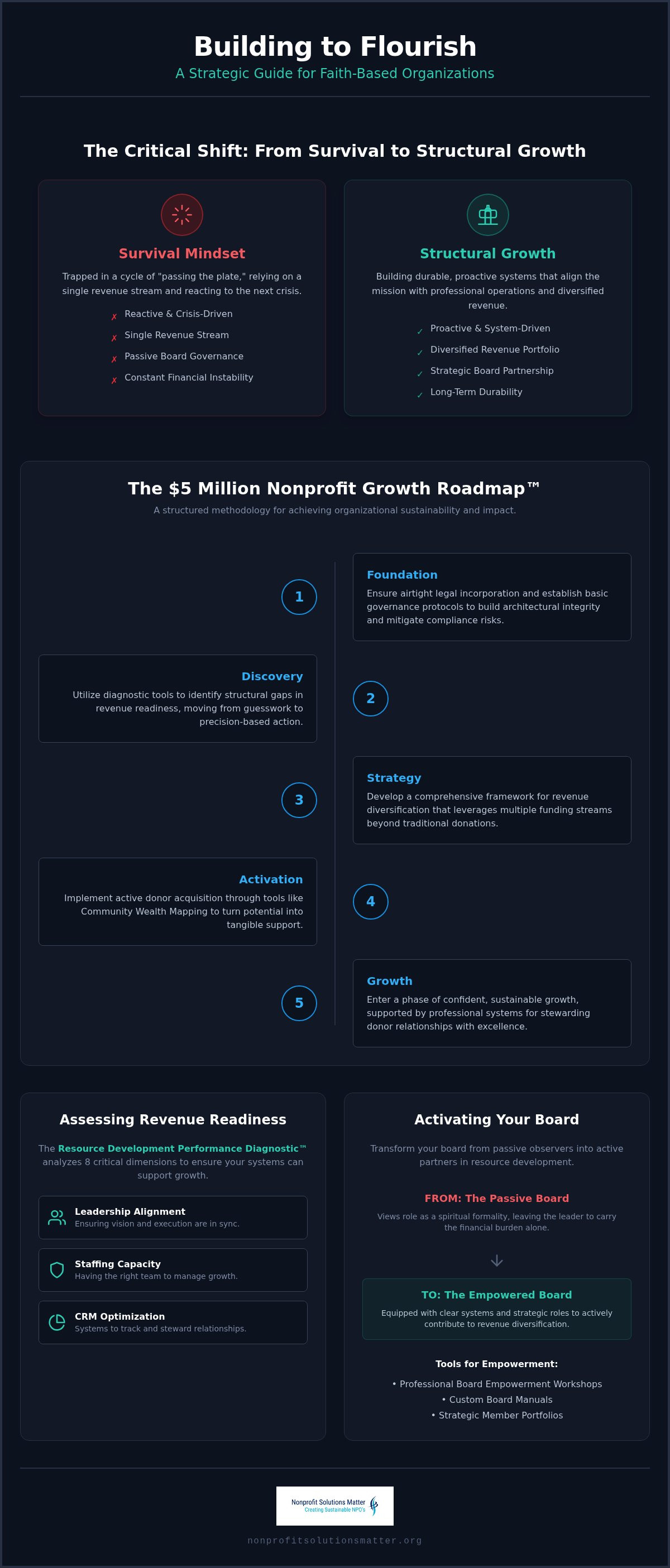
What if the spiritual conviction that fuels your mission is actually being used as a substitute for the structural systems required to sustain it? Many leaders find themselves trapped in a cycle of "passing the plate," relying on a single revenue stream while a passive board views governance as a formality rather than a strategic partnership. It's a heavy burden to lead from a place of constant financial crisis. Effective capacity building for faith-based organizations requires a shift from this survival mindset toward a more durable architectural integrity.
This article promises to show you how to transition from reactive operations to structural permanence through intentional resource development and professionalized governance. We'll examine frameworks for revenue diversification, strategies for board engagement, and systems to steward donor relationships with excellence. You will gain the tools to build an organization that isn't just surviving, but flourishing.
Key Takeaways
- Shift from a survival mindset to structural growth by aligning your mission with professionalized operational systems and donor stewardship.
- Implement The $5 Million Nonprofit Growth Roadmap™ to establish the governance protocols and legal foundations necessary for long-term durability.
- Enhance capacity building for faith-based organizations by moving your board from passive oversight to a strategic role in resource development.
- Build resilience through revenue diversification and book a 30-minute free consultation at https://bit.ly/3ky5ge0 to start your sustainability audit.
What is Capacity Building for Faith-Based Organizations?
Capacity building for faith-based organizations is the deliberate process of strengthening an organization's internal systems, leadership, and infrastructure. It's about building for durability. While secular groups focus primarily on operational metrics, faith-driven leaders must navigate a unique path that balances professional excellence with their sacred spiritual mission. This specialized approach ensures that the work continues long after the initial spark of inspiration has passed.
Most organizations begin in a survival state. In this phase, leadership is often reactionary and decisions are driven by the next immediate crisis. It's an exhausting cycle. True sustainability, however, is proactive and system-driven. It replaces the frantic energy of "passing the plate" with a structured architecture. The first step in this transition is a Resource Development Audit. This diagnostic tool assesses your organizational health, identifying exactly where your systems are strong and where they require reinforcement to support future growth.
Historical initiatives, such as the White House Office of Faith-Based and Neighborhood Partnerships, highlight the vital role FBOs play in society. Yet, many of these groups struggle because they lack the professional scaffolding needed to manage complex community needs. Moving toward a sustainable model requires a shift in how we view the mechanics of the ministry.
The Shift from Stewardship to Strategic Resource Development
Resource development is a comprehensive framework for revenue diversification that leverages multiple funding streams beyond traditional donations to ensure long-term stability. It's not just about asking for help; it's about building a portfolio of support. FBOs can adopt professional governance while maintaining their mission-driven empathy. This allows your board to move from being a spiritual formality to becoming an active, strategic partner. For a deeper look at this evolution, explore Board Governance Training for Nonprofits: Moving from Survival to Sustainability. To begin your own journey, book a 30-minute free consultation at 3ky5ge0.
The 5-Stage Framework for FBO Sustainability
Capacity building for faith-based organizations is best achieved through a structured methodology rather than haphazard growth. The $5 Million Nonprofit Growth Roadmap™ serves as a strategic guide for emerging and mid-size ministries. It begins with the Foundation stage. Here, we ensure legal incorporation and basic governance protocols are airtight. Without this architectural integrity, the organization remains vulnerable to external pressures and compliance risks.
Once the foundation is secure, we move into the Discovery stage. This phase utilizes The Resource Development Performance Diagnostic™ to identify exactly where structural gaps exist in your revenue readiness. By auditing your current state, you move away from guesswork and toward precision. The subsequent Strategy and Activation stages involve transitioning from planning to active donor acquisition through Community Wealth Mapping. This tool helps you visualize and tap into the latent resources within your network, turning abstract potential into tangible support.
Implementing The Resource Development Performance Diagnostic™
Revenue readiness isn't a single metric. It's a combination of eight critical dimensions, including leadership alignment, staffing capacity, and CRM optimization. If your systems can't track and steward donor relationships with professional excellence, your growth will eventually plateau. By analyzing these data-driven insights, you can confidently enter the Growth stage of the roadmap.
Building a sustainable ministry requires moving beyond a mindset of immediate crisis. You can apply to work with Sharon to implement these frameworks within your own organization. If you aren't yet sure where your primary gaps lie, consider booking a 30-minute free consultation to evaluate your current trajectory.
Engaging Your Board in Revenue Diversification
A common hurdle in capacity building for faith-based organizations is the "passive board" phenomenon. Many board members view their role as a spiritual formality or a purely advisory position. This leaves the executive leader carrying the entire burden of financial health. To break this cycle, you must move your board members from governance-only roles into active partners in resource development. It's a shift that requires both a change in mindset and a change in mechanics.
Professional Board Empowerment workshops provide the technical framework necessary for this shift. It's not enough to simply motivate your board; you must equip them with clear systems. This includes creating custom board manuals and strategic portfolios for each member. When every individual understands their specific contribution to revenue diversification, the organization moves toward a state of structural permanence. Each member becomes an advocate with a defined purpose.
Navigating these board transitions can be complex. Executive coaching offers the steady hand needed to lead through these shifts without losing mission alignment. Professionalizing your board is a cornerstone of capacity building for faith-based organizations, as it transforms them from observers into architects of your future. It ensures that as the board becomes more professionalized, the organization's moral purpose remains the central focus.
Building a Culture of Sustainability
Revenue diversification does more than just balance the budget. It reduces organizational anxiety. When you aren't reliant on a single stream of income, your team can focus on the mission with greater clarity and impact. This shift creates a foundation where growth is a planned outcome rather than a lucky break. You can find deeper guidance on this transition in our post, Engaging Nonprofit Board Members: Sustainability Roadmap.
The journey from survival to sustainability starts with a single step. To begin your organization's transformation, book a 30-minute free consultation today.
Constructing Your Legacy of Structural Permanence
Transitioning from a survival mindset to a sustainable architecture is the most significant gift you can give your mission. We've explored how capacity building for faith-based organizations relies on professionalized resource development and an empowered, strategic board. By implementing structured frameworks like The $5 Million Nonprofit Growth Roadmap™, you move beyond the "passing the plate" mentality. Sharon D. Jones, M.Div. and a Certified Nonprofit Executive, has helped organizations raise over $950 million by applying these exact principles. Our sliding-scale pricing ensures that even under-resourced ministries can access this high-level expertise.
Book your 30-minute free strategy call to move from survival to sustainability Your work is too important to leave to chance. Take the first step toward a future built on durability and systemic health today.
Frequently Asked Questions
What is capacity building for faith-based organizations?
Capacity building for faith-based organizations is the intentional process of strengthening internal systems, leadership, and infrastructure to ensure long-term durability. It moves a ministry beyond survival mode by professionalizing operations while keeping the spiritual mission central. This architectural approach creates a steady foundation. It allows leaders to focus on mission impact rather than immediate financial crises or operational gaps.
How does resource development differ from traditional collection models in a ministry context?
Resource development is a comprehensive strategy for revenue diversification that moves beyond a simple "passing the plate" mentality. Traditional models often rely on a single, unpredictable stream of donations. In contrast, this professionalized framework builds multiple revenue sources and professionalized donor stewardship. It creates a predictable engine for growth. This shift ensures that your mission remains resilient during economic shifts.
Why is board governance critical for the long-term sustainability of a faith-based nonprofit?
Board governance serves as the structural backbone of organizational durability. A passive board often views their role as a spiritual formality, which places an unsustainable burden on executive leadership. Effective governance transforms these individuals into strategic partners who actively participate in capacity building for faith-based organizations. This shared accountability ensures the ministry has the oversight required to navigate leadership transitions successfully.
How can a resource development audit identify the root causes of revenue stagnation?
A resource development audit is a diagnostic tool that examines eight critical dimensions of organizational health. It identifies structural gaps in leadership, CRM systems, and donor pipelines. By uncovering these systemic weaknesses, you can stop guessing why revenue has plateaued. This approach allows you to build a specific roadmap for growth. Start this process by booking a 30-minute free consultation at 3ky5ge0.
Article by
Sharon D Jones
Sharon D. Jones, M.Div., is a globally respected fundraising strategist, nonprofit leadership expert, and capacity-building architect with over three decades of experience. As the Founder and CEO of Nonprofit Solutions Matter, Inc., her proprietary growth frameworks have successfully mobilized nearly $957 million in philanthropic capital for local, national, and international organizations.
General Disclaimer & Disclosure
The information provided on this website is for general informational and educational purposes only. While we strive to keep content accurate and up to date, we make no representations or warranties of any kind, express or implied, about the completeness, accuracy, reliability, or suitability of the information contained herein.
Professional Advice
The content on this site does not constitute professional advice (e.g., legal, financial, medical, or tax). You should consult with a qualified professional before making any decisions based on the information provided on this website. Any action you take upon the information found on this site is strictly at your own risk.
Affiliate & Third-Party Links
Some articles on this site may contain affiliate links. If you click on an affiliate link and make a purchase, we may receive a small commission at no additional cost to you. We only recommend products or services we believe add value to our readers. We are not responsible for the content, privacy policies, or practices of any third-party websites linked within our articles.


