
Filling seats on a governing body is often treated as a simple administrative task, but a truly sustainable organization requires something far more intentional. If you feel the weight of founder burnout or the frustration of a passive board that stalls your growth, you aren't alone. Many leaders find themselves trapped in a cycle of survival because their leadership lacks the diverse professional networks needed for true revenue diversification. It's time to shift the perspective from simply finding volunteers to understanding how to build a nonprofit board that acts as a strategic engine for your mission.
You can architect a high-impact board that moves your organization toward long-term stability through strategic resource development. We'll examine the roadmap for creating structured board portfolios that empower your members and provide the freedom you need to focus on high-level impact. This guide provides the systems and frameworks necessary to transform your governance into a foundation of structural permanence and growth.
Key Takeaways
- Shift your focus from a "working board" to a "governing board" to ensure your organization has the architectural foundation required for long-term health.
- Discover how to build a nonprofit board by utilizing a Board Matrix to identify critical gaps in legal, financial, and community wealth mapping expertise.
- Activate your members through the $5 Million Nonprofit Growth Roadmap™ to move beyond passive attendance and into active resource development partnerships.
- Create structural permanence by implementing a revenue diversification strategy that leverages the diverse professional networks of your board members.
The Foundation of Sustainability: Why Board Architecture Matters
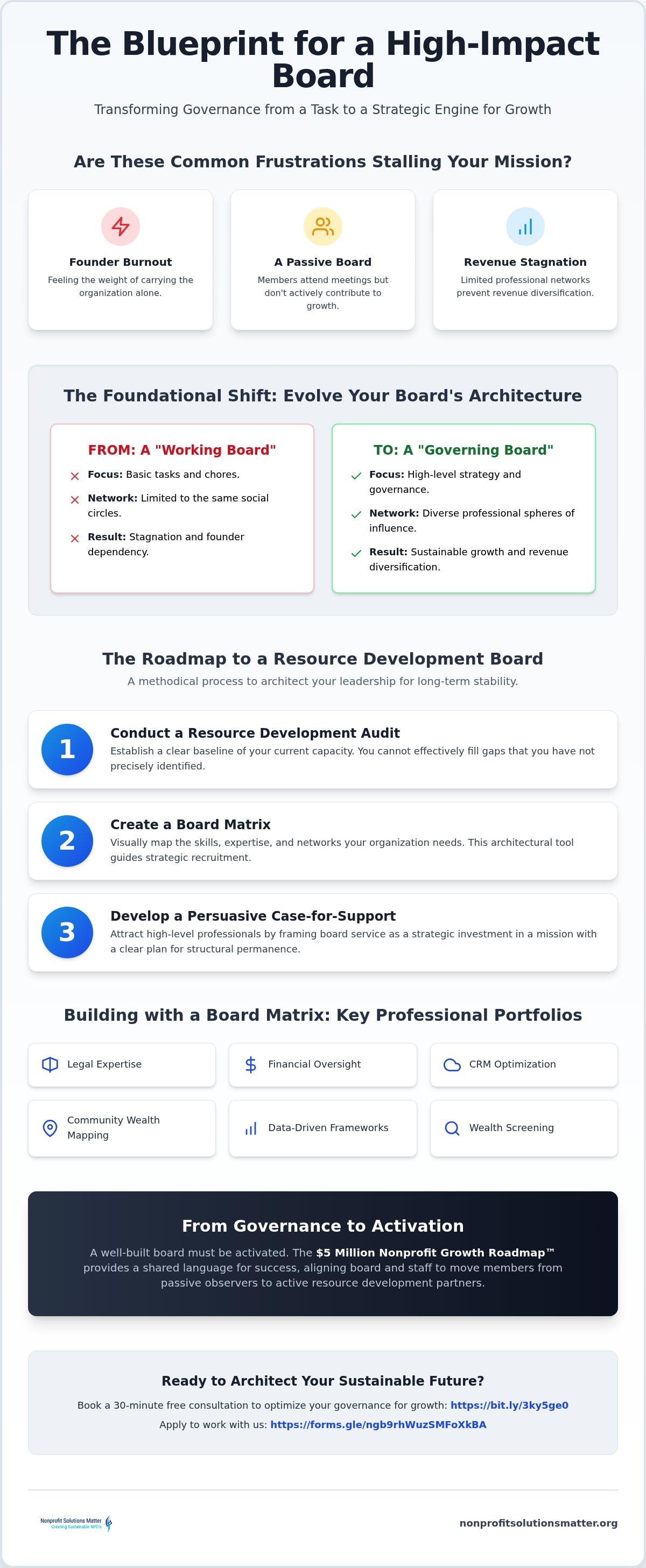
Think of your board as the architectural skeleton of your nonprofit. If the bones are weak, the entire structure eventually collapses under the pressure of growth. This architectural approach ensures your organization remains durable as you navigate the complexities of global impact. Understanding how to build a nonprofit board starts with recognizing that your needs change over time. In the early days, you likely relied on a "working board" filled with people who helped with chores and basic tasks. As you mature, you must evolve into a "governing board" that prioritizes strategy over execution.
Avoid the temptation to fill seats with friends or family just because it's convenient. This is the fastest route to revenue stagnation. When everyone on your board shares the same social circle, your ability to reach new supporters disappears. You need a Board of Directors that intentionally bridges gaps in your influence. This diversity is what transforms a group of supporters into a high-impact resource development engine that can sustain your mission for decades.
Distinguishing Between Governing and Advisory Boards
A governing board carries the legal weight of the organization, ensuring compliance and long-term viability. Advisory boards provide specialized advice without the legal strings attached. Utilizing both allows for maximum revenue diversification by tapping into different circles of influence. A modern board member must be a "Strategic Architect" who views governance as a tool for systemic health rather than just a monthly meeting.
If you're ready to move from survival to structural permanence, let's look at your current leadership structure together. You can book a 30-minute free consultation to discuss how to optimize your governance for growth. We'll identify the systemic gaps holding you back and create a path toward a truly sustainable future.
A 5-Stage Roadmap to Building Your Resource Development Board
Moving from a group of friends to a professional governing body requires a methodical shift. If you're wondering how to build a nonprofit board that actually produces results, you must treat recruitment like an architectural project. It begins with a clear-eyed look at your current foundation. You can't build a durable structure on an unexamined site.
Stage 1 involves conducting a resource development audit to baseline your current capacity. You can't fill gaps you haven't identified. Next, Stage 2 focuses on creating a Board Matrix. This tool maps necessary skills such as legal expertise, financial oversight, CRM optimization, and community wealth mapping. Finally, Stage 3 requires developing a persuasive case-for-support. High-level professional partners aren't looking for a basic volunteer opportunity; they're looking for a strategic investment in a mission that has a clear plan for structural permanence.
Identifying Skill Gaps and Professional Portfolios
Accountability flourishes when you move away from general participation and toward specific strategic portfolios. Each board member should own a professional domain that aligns with your organization's systemic health. This includes recruiting members with expertise in data-driven frameworks and wealth screening to ensure your outreach is precise and effective. By assigning these portfolios, you create a shared language of success that moves the needle on revenue diversification.
Assigning clear roles prevents the "passive board" syndrome that leads to founder burnout. If you need help mapping these portfolios to your specific mission, you can schedule a 30-minute free consultation to start architecting your future board today. We'll help you identify the exact leadership profiles needed to move your organization from survival to long-term sustainability.
From Governance to Activation: Empowering Your Board for Growth
Architecture is only as good as the life that inhabits it. Once you've learned how to build a nonprofit board with the right professional profiles, the next step is activation. Passive attendance is the enemy of sustainability. To move your members from being observers to being active resource development partners, you must provide them with a shared language for success. We implement the $5 Million Nonprofit Growth Roadmap™ as a foundational tool to align board and staff. This framework provides a clear, methodical path that removes the guesswork from organizational growth.
Managing a board of high-level professionals requires a different set of leadership skills from the CEO. This is where executive coaching becomes a vital investment. It's common for leaders to feel intimidated by their own board's expertise or to fall back into the "founder burnout" trap of doing everything themselves. Coaching provides the strategic distance needed to lead effectively. It ensures you can facilitate high-level governing support while staying focused on your mission's global impact.
Leveraging Board Empowerment Workshops
Activation requires more than just a meeting; it requires a system. Custom board manuals and targeted ask-skills training convert governance-only boards into active partners in revenue diversification. When members have a clear portfolio and the training to execute it, they become the strategic engine your organization needs. You can learn more about these methods through our Board Governance Training pillar. If you're ready to move from survival to structural permanence, book a 30-minute free strategy call to discuss activating your board today.
Architecting Your Sustainable Future
Building a resilient organization requires more than just passion; it demands a deliberate architectural strategy. By transitioning from a founding "working" board to a professional governing body, you create the stability needed for long-term growth. This transformation leads to a state of structural permanence. Our founder has raised over $950 million across six continents to move organizations from survival to sustainability. Understanding how to build a nonprofit board through skill-based recruitment and strategic portfolios ensures your leadership is equipped for complex revenue diversification. Our customized Board Empowerment workshops are designed to bridge the gap between passive attendance and active partnership. Ready to turn your passive board into an active resource development partner?
Book a 30-minute free strategy call today You can also apply to work directly with Sharon D. Jones to begin architecting your organization's future. It's time to build a foundation that lasts.
Frequently Asked Questions
What are the legal requirements for a nonprofit board?
Legal requirements vary by state. Most mandate a minimum of three members serving as President, Secretary, and Treasurer. The IRS expects a board large enough to provide independent oversight; therefore, a majority of voting members must be independent. This architectural foundation ensures your organization meets federal standards while maintaining the structural integrity needed for long-term sustainability.
How many board members should a nonprofit have for optimal resource development?
Three members meet the legal minimum. However, optimal resource development often requires a broader range of expertise. Data from May 2026 indicates that organizations with engaged boards are 17% more likely to experience year-over-year growth. A larger board allows for specialized portfolios. Don't exceed your capacity to provide meaningful executive leadership and support.
How do I find board members who are willing to help with revenue diversification?
Success starts with moving beyond social circles. Use a Board Matrix to identify professional gaps. Look for individuals with backgrounds in financial strategy, CRM optimization, or community wealth mapping. When you understand how to build a nonprofit board based on professional alignment, you attract partners. These partners are naturally equipped to drive revenue diversification and organizational growth.
What is the difference between a governing board and an advisory board?
A governing board carries the legal and fiduciary weight of the organization. They ensure compliance and systemic health. Advisory boards provide specialized knowledge and professional connections without the legal obligations of a director. Integrating both allows you to expand your reach for revenue diversification while keeping your primary governing body focused on high-level strategy.
If you're ready to transform your board into a strategic asset, we can help. Book a 30-minute free consultation to discuss your roadmap to sustainability.
Article by
Sharon D Jones
Sharon D. Jones, M.Div., is a globally respected fundraising strategist, nonprofit leadership expert, and capacity-building architect with over three decades of experience. As the Founder and CEO of Nonprofit Solutions Matter, Inc., her proprietary growth frameworks have successfully mobilized nearly $957 million in philanthropic capital for local, national, and international organizations.
General Disclaimer & Disclosure
The information provided on this website is for general informational and educational purposes only. While we strive to keep content accurate and up to date, we make no representations or warranties of any kind, express or implied, about the completeness, accuracy, reliability, or suitability of the information contained herein.
Professional Advice
The content on this site does not constitute professional advice (e.g., legal, financial, medical, or tax). You should consult with a qualified professional before making any decisions based on the information provided on this website. Any action you take upon the information found on this site is strictly at your own risk.
Affiliate & Third-Party Links
Some articles on this site may contain affiliate links. If you click on an affiliate link and make a purchase, we may receive a small commission at no additional cost to you. We only recommend products or services we believe add value to our readers. We are not responsible for the content, privacy policies, or practices of any third-party websites linked within our articles.


