
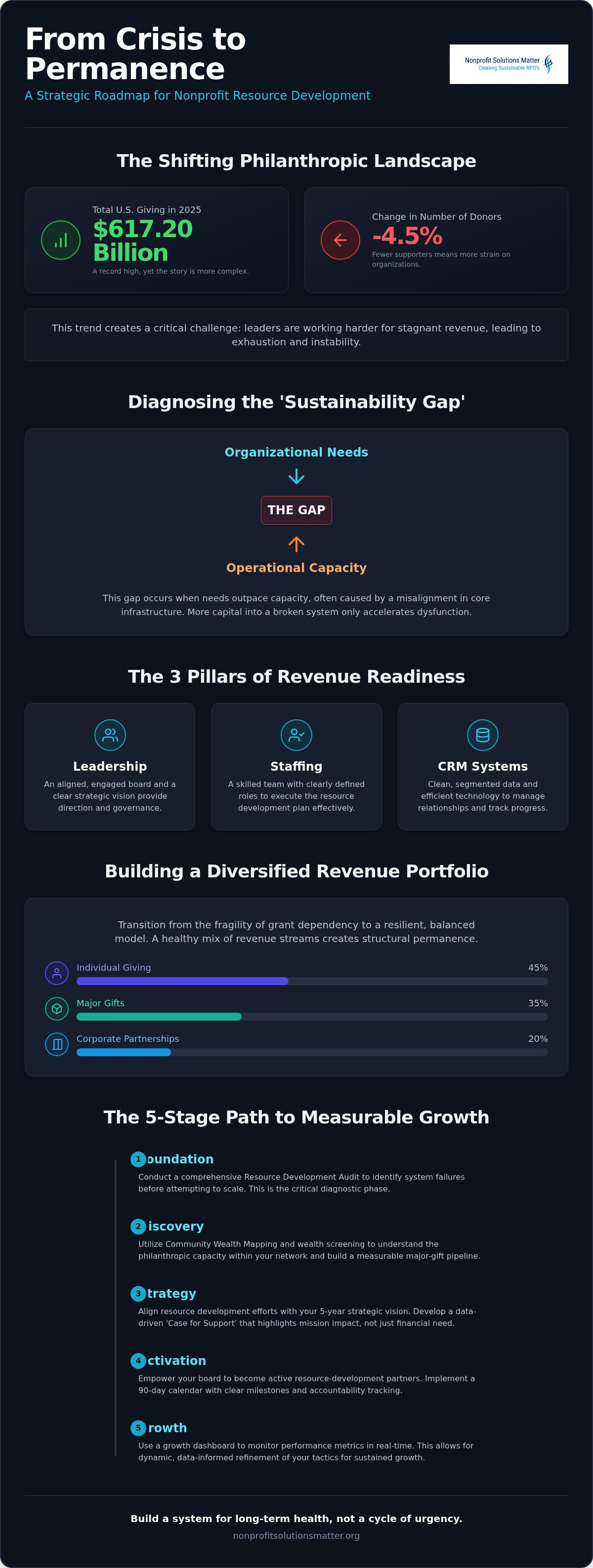
The most resilient organizations don't survive on luck; they thrive on intentional systems. While U.S. giving hit a record $617.20 billion in 2025, the actual number of donors fell by 4.5%. This shift means many leaders are facing revenue stagnation while working harder for fewer results. You've likely felt the exhaustion of relying on a single funding source or managing a disengaged board. Building a fundraising plan from scratch allows you to move away from immediate crisis and toward structural permanence by designing a framework for long-term health.
This guide provides the roadmap to transition your organization into a period of sustainable stability. We'll outline a 90-day implementation calendar and strategies for revenue diversification that transform your board members into your most effective strategic partners. By focusing on resource development rather than a cycle of urgency, you'll create a foundation built for the next decade of impact.
Key Takeaways
- Transition from a mindset of immediate crisis to one of structural permanence by establishing a resource development architecture that's built for durability.
- Learn the methodical process for building a fundraising plan from scratch, ensuring your revenue diversification efforts align with your five-year strategic vision.
- Discover how to reduce grant dependency by cultivating a healthy mix of individual giving, major gifts, and corporate partnerships.
- Activate your board as high-level strategic partners through the $5 Million Nonprofit Growth Roadmap™; book a free 30-minute strategy call at https://bit.ly/3ky5ge0 to begin.
Beyond Crisis Mode: Why Your Resource Development Plan Requires a Structural Foundation
True sustainability begins with a shift in perspective. Many leaders view resource development as a series of isolated events or urgent appeals, but it's actually a systemic architecture. Effective resource management requires aligning your internal capabilities with your external goals. When building a fundraising plan from scratch, the most common mistake is assuming that simply "raising more money" will solve your organization's problems. If your infrastructure is broken, more capital only accelerates the dysfunction.
This misalignment creates a "Sustainability Gap," where organizational needs outpace operational capacity. To bridge this gap, you must look beyond the immediate bank balance. Conducting a Resource Development Audit is the critical first step. It acts as a diagnostic tool to identify where your systems are failing before you attempt to scale.
The Sustainability Gap: Diagnosing Infrastructure Before You Ask
We use The Fundraising Performance Diagnostic™ framework to evaluate the three pillars of your organization: leadership, staffing, and CRM systems. Revenue Readiness is the precise alignment of governance, strategy, and activation. Without this alignment, building a fundraising plan from scratch often leads to structural gaps like donor pipeline leaks or disengaged board members. If you're feeling the weight of revenue stagnation, it's time to examine the foundation. You can book a free 30-minute strategy call to discuss your specific infrastructure needs at 3ky5ge0.
The Strategic Architect’s Guide to Building a Revenue Diversification Roadmap
A sustainable roadmap isn't a reaction to a budget deficit; it's a proactive design for growth. Building a fundraising plan from scratch starts with a needs assessment that aligns every effort with your organization's five-year strategic vision. This ensures that every dollar sought serves a specific, long-term purpose. You must move beyond the fragility of grant-dependency by embracing revenue diversification. This involves constructing a balanced portfolio that includes individual giving, corporate partnerships, and major gifts. Using a strategic resource development guide helps you align these goals with your internal capacity.
Building a fundraising plan from scratch requires more than enthusiasm; it demands a data-driven donor acquisition program built on clean, segmented data. Rather than appealing to a donor's pity, develop a 'Case for Support' that highlights mission-aligned impact. This shifts the conversation from financial need to architectural integrity and systemic health.
Mapping Community Wealth and Prospect Capacity
Community Wealth Mapping allows you to identify philanthropic capacity within your existing network. By utilizing wealth screening, you can rank prospects based on their affinity for your mission and their actual capacity to give. Data cleaning turns a static donor list into a measurable major-gift pipeline, ensuring your outreach is precise and effective. If you're ready to identify these hidden opportunities, you might benefit from a free 30-minute strategy call to review your current donor data.
Activating the Engine: From Strategic Vision to Measurable Resource Growth
Transitioning from a structural roadmap to actual revenue growth requires more than just spreadsheets; it requires a shift in organizational culture. When building a fundraising plan from scratch, you must move your board beyond a governance-only role. Through targeted empowerment workshops, these individuals become active resource-development partners who understand how to leverage their networks effectively. This human element provides the vital energy needed to sustain your new architecture.
To maintain steady momentum, we implement a 90-day implementation calendar that features specific milestones and rigorous accountability tracking. Executive coaching is often the bridge between a theoretical plan and a high-performing reality, providing the leadership support necessary to navigate complex institutional changes. It's the difference between a document that sits on a shelf and a living system that generates results.
Institutionalizing Growth with The $5 Million Nonprofit Growth Roadmap™
This implementation guide provides a clear path through five distinct stages: Foundation, Discovery, Strategy, Activation, and Growth. By utilizing a growth dashboard, leaders can monitor performance metrics and refine their revenue diversification tactics in real-time. This dynamic approach allows for agility while maintaining a focus on long-term systemic health. Building a fundraising plan from scratch is a sophisticated process that benefits from an experienced hand. You can book a 30-minute strategy call today to begin customizing this roadmap for your unique mission and goals.
Architecting Your Organization’s Future
True sustainability is the result of a deliberate, systemic architecture. Building a fundraising plan from scratch requires you to diagnose your infrastructure, diversify revenue, and empower your board. This methodical approach moves you from the exhaustion of survival mode to a state of structural permanence. You're not just raising funds; you're engineering a future for your mission.
As a Certified Nonprofit Executive (CNE) and Consultant (CNC), Sharon D. Jones has raised over $950 million globally. In 2024, our clients achieved more than $15 million in revenue growth by applying these proven frameworks. Your vision deserves a foundation this strong. You don't have to navigate this transition alone. Ready to move from survival to sustainability?
Frequently Asked Questions
What is the difference between fundraising and resource development?
Resource development is a comprehensive, systemic approach to organizational health that differs from traditional methods by focusing on long-term sustainability rather than transactional asks. It integrates your strategic vision with your financial needs. When you're building a fundraising plan from scratch, focusing on development ensures you're creating a durable revenue engine. This shift moves your nonprofit away from constant crisis toward a future of systemic permanence.
How long does it take to see results from a new resource development plan?
Most organizations see initial progress within the first 90 days, though a full structural transformation typically takes six to twelve months to mature. This timeline allows for the necessary data cleaning and board training required for permanent growth. By following a phased implementation calendar, you can track incremental successes while your new revenue diversification streams build the momentum needed for long-term stability.
Can a small nonprofit with limited staff build a revenue diversification strategy?
Yes, small nonprofits can build a sophisticated revenue diversification strategy by focusing on high-leverage systems rather than large staff counts. Building a fundraising plan from scratch isn't about how many people you have; it's about the quality of your donor data and the clarity of your roadmap. Even a lean team can manage a major-gift pipeline by utilizing tools like wealth screening and Community Wealth Mapping.
Article by
Sharon D Jones
Sharon D. Jones, M.Div., is a globally respected fundraising strategist, nonprofit leadership expert, and capacity-building architect with over three decades of experience. As the Founder and CEO of Nonprofit Solutions Matter, Inc., her proprietary growth frameworks have successfully mobilized nearly $957 million in philanthropic capital for local, national, and international organizations.
General Disclaimer & Disclosure
The information provided on this website is for general informational and educational purposes only. While we strive to keep content accurate and up to date, we make no representations or warranties of any kind, express or implied, about the completeness, accuracy, reliability, or suitability of the information contained herein.
Professional Advice
The content on this site does not constitute professional advice (e.g., legal, financial, medical, or tax). You should consult with a qualified professional before making any decisions based on the information provided on this website. Any action you take upon the information found on this site is strictly at your own risk.
Affiliate & Third-Party Links
Some articles on this site may contain affiliate links. If you click on an affiliate link and make a purchase, we may receive a small commission at no additional cost to you. We only recommend products or services we believe add value to our readers. We are not responsible for the content, privacy policies, or practices of any third-party websites linked within our articles.


