
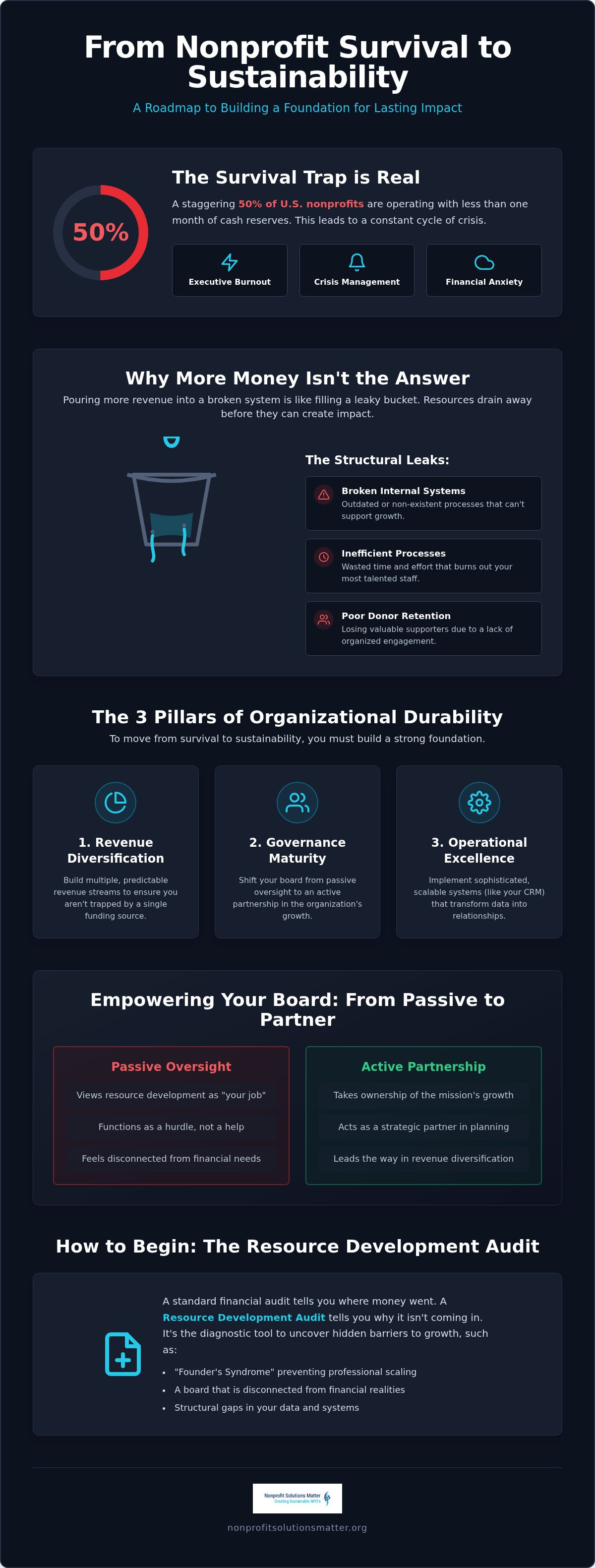
Did you know that 50% of U.S. nonprofits are currently operating with less than one month of cash reserves? It's a staggering reality that keeps many executive directors trapped in a cycle of burnout and constant crisis management. You’re likely exhausted from the hamster wheel where revenue diversification feels like a distant dream and your board treats resource development as your job alone. We understand that pressure, and we know it isn't sustainable for you or your mission.
This article provides the roadmap to move from nonprofit survival to sustainability by building a structural foundation that lasts. You’ll discover the framework required to transition from financial anxiety to long-term, scalable impact. We’ll explore how to create predictable revenue models and activate a board that finally opens doors for your organization, allowing you to lead with vision rather than just managing the next emergency.
Key Takeaways
- Understand the structural shift required to move from nonprofit survival to sustainability by aligning your mission with long-term resources.
- Learn why simply bringing in more money won't fix a broken system and how CRM optimization stops your hardest-won resources from slipping through the cracks.
- Discover the "Active Board" model that turns your directors into strategic partners who aren't afraid to lead the way in revenue diversification.
- Get a clear roadmap for using a Resource Development Audit to diagnose organizational gaps and then book a strategy call to start your transition.
The Threshold of Sustainability: Defining the Survival-to-Growth Gap
Survival mode is a reactive state. It's driven by immediate financial pressure where every decision feels like an emergency. Whether you're leading a local faith-based group or an international NGO, you're likely exhausted from chasing the next grant just to meet payroll. Transitioning from nonprofit survival to sustainability isn't just about getting more money; it's about fixing the "funding leak" caused by fragile systems.
Leaders often mistake low bank balances for the root problem. It's usually a symptom. In 2026, a nonprofit organization must navigate new complexities like the Universal Charitable Deduction and shifting donor behaviors. A sophisticated approach to organizational health is no longer optional. It's the only way to avoid the stagnation that kills impact.
The Three Pillars of Organizational Durability
To build a foundation that lasts, you need three core elements. First, revenue diversification ensures you aren't trapped by a single funding source. Second, governance maturity shifts your board from passive oversight to active partnership. Finally, operational excellence implements systems that scale. We recommend starting with a Resource Development Audit to see where your pillars are crumbling.
Why Mission-Driven Organizations Stagnate
Many groups fall into the "Founder’s Trap," where individual passion prevents professional scaling. You might neglect infrastructure to prioritize program delivery, but that creates a ceiling you can't break. Sustainability is the ability to maintain impact regardless of external volatility. If you're ready to break this cycle and move toward structural permanence, book a strategy call with us today.
The Anatomy of Stagnation: Why Raising More Money Isn’t the Cure
Many leaders believe that if they just had a bigger budget, their problems would vanish. But more money often acts like water poured into a leaky bucket. If your internal systems are broken, new revenue simply drains away through inefficient processes and poor donor retention. This cycle creates "crisis mode," an environment of constant financial anxiety that burns out your most talented staff. To move from nonprofit survival to sustainability, you must first plug these structural leaks by shifting your focus from immediate cash to long-term health.
The High Cost of Poor Data Infrastructure
Your CRM is the heart of your revenue diversification efforts. When donor data is disorganized, it's impossible to perform effective wealth screening or prospect research. You're essentially flying blind, missing opportunities to connect with high-capacity donors who already believe in your mission. Modernizing your development department through technical assistance isn't just an overhead expense. It’s a strategic investment that transforms transactional data entry into a sophisticated relationship management system, ensuring no donor is forgotten.
Identifying Structural Gaps Through Assessment
A standard financial audit tells you where the money went, but a Resource Development Audit tells you why it isn't coming in. This diagnostic tool uncovers the hidden barriers to growth, such as "Founder’s Syndrome" or a board that feels disconnected from the mission's financial needs. Strategic planning must be a living document that guides daily action rather than a shelf-filler. If you're ready to evaluate your internal systems and stop the stagnation, it's time for a change. Strengthening these systems is the only way to ensure your journey from nonprofit survival to sustainability is permanent.
Empowering the Board: From Passive Oversight to Strategic Partners
Many executive directors view their boards as a hurdle rather than a help. It's a common frustration that keeps organizations stuck in a cycle of stagnation. To move from nonprofit survival to sustainability, you need to dismantle the myth that boards only exist for high-level oversight. In the "Active Board" model we use at Nonprofit Solutions Matter, Inc., directors are strategic partners who take full ownership of the mission's growth. This shift requires clear communication and a shared understanding that resource development is a collective responsibility, not just a staff task.
Turning Passive Members into Resource Partners
Setting expectations is the first step toward activation. We often advocate for a "Give, Get, or Get Off" philosophy to ensure every member contributes meaningfully to the organization's health. Training your board to be brand ambassadors allows them to open doors that staff simply can't reach. By investing in Board Engagement & Governance Training , you build a pipeline of future leaders who are equipped for revenue diversification rather than just attending meetings.
Specialized Governance for Faith-Based and International NGOs
Global organizations face unique hurdles that traditional models often ignore. You might deal with diverse cultural expectations or theological nuances that influence how leadership is perceived. Managing international board dynamics requires a deliberate approach to mission-alignment across different geographic regions. Whether you're navigating complex global structures or local faith communities, specialized governance is vital for nonprofit survival to sustainability. Book a strategy call today to start transforming your board into a strategic engine for growth.
Roadmap to Sustainability: 5 Steps to Structural Permanence
Moving from theory to practice requires a methodical approach. You can't just jump into new programs without checking if your foundation can hold the weight. Achieving nonprofit survival to sustainability is a five-step process designed to build structural permanence:
- Conduct a Resource Development Audit to find your gaps.
- Align your board through targeted governance training.
- Diversify revenue with a tailored action plan.
- Optimize infrastructure using CRM tools and prospect research.
- Institutionalize leadership through executive coaching.
Phase 1: The Diagnostic Foundation
Before you scale, you have to assess. Adding new programs to a shaky structure only accelerates burnout. We use wealth screening to identify "hidden" potential within your current donor list, often finding major gift prospects you didn't know you had. This phase is about defining success metrics that go beyond your annual budget, focusing instead on long-term systemic health and architectural integrity. You need to know exactly where your leaks are before you can fix them.
Phase 2: Executing the Transition
Once the diagnostic is done, it's time to build. The Nonprofit Starter Pack provides the essential tools for foundational growth, while leadership retainers and coaching ensure you have the support to navigate this structural shift. Scaling impact isn't about working harder; it's about implementing consistent, systemic improvements that allow your organization to thrive independently of any single leader or donor. This methodical progression creates a sense of security and momentum for your entire team.
Navigating the Transition with Nonprofit Solutions Matter, Inc.
Sharon D. Jones leads our team at Nonprofit Solutions Matter, Inc. as a "Strategic Architect," using over 30 years of cross-sector experience to design durable organizational structures. We don't just offer temporary fixes or trendy advice. Our methodology has helped raise over $550 million for nonprofits, proving that a systemic approach works much better than simply chasing individual checks. Because we're a 501(c)(3) ourselves, we don't just consult from a distance; we act as high-level partners who truly understand the internal pressures you're facing every day.
Why Expertise Matters in Capacity Building
There's a massive difference between basic "fundraising help" and a comprehensive sustainability strategy. Basic help might get you through the month, but a true strategy ensures you're still thriving a decade from now. We provide customized solutions for everyone from local community organizations to global NGOs. Whether you need technical assistance with CRM optimization or intensive leadership development, our focus is on moving you from nonprofit survival to sustainability through structural health. We believe that your impact should be scalable and permanent rather than fleeting.
Your First Step Toward a Sustainable Future
The journey away from the hamster wheel begins with a diagnostic. Initiating a Resource Development Audit allows us to identify the specific gaps in your revenue diversification and technical infrastructure. During our Board Engagement workshops, you'll gain practical tools to turn passive oversight into active partnership. It's time to stop the manual crisis management and start leading with a steady, experienced hand. Take a moment to move from survival to sustainability with a professional audit today.
If you're ready to build a foundation that lasts, book a strategy call with us now to discuss your organization's unique needs.
Building Your Sustainable Future
The journey from nonprofit survival to sustainability is a shift from reactive crisis to intentional growth. You've learned that lasting success isn't just about more money; it's about structural integrity. By optimizing your data systems and activating your board as strategic partners, you create a foundation that endures. We've spent 30 years helping leaders navigate these shifts. As a fellow 501(c)(3) that has helped raise over $550 million, we don't just teach these systems; we live them. You don't have to stay on the hamster wheel any longer.
You have the passion to change the world. Now, let's build the systems that allow your mission to thrive for decades. Your future of scalable impact starts with one deliberate step toward structural permanence.
Frequently Asked Questions
What is the main difference between nonprofit survival and sustainability?
Survival mode is a reactive state where decisions are driven by immediate financial pressure and short-term needs. Sustainability, however, is a proactive structural state where your mission and resources are perfectly aligned. It’s the difference between barely making payroll each month and having the financial reserves and systems in place to weather any external economic shift with confidence.
How long does it take to move a nonprofit from survival to sustainability?
Most organizations experience a significant structural shift within 12 to 24 months of implementing a strategic framework. The process begins with stabilizing your internal systems and training your board to take ownership of revenue diversification. As these changes take root, you’ll move from nonprofit survival to sustainability by replacing erratic, crisis-driven income with predictable and diversified revenue streams.
Can a small nonprofit with a passive board really become sustainable?
Yes, but it requires a fundamental redefinition of the board's role within the organization. Small nonprofits often struggle because their directors haven't been given the tools or expectations to lead. By implementing an active board model, you can transform passive oversight into a strategic partnership. This shift allows even the smallest teams to build a foundation that supports scalable, long-term impact.
What is included in a Resource Development Audit?
A Resource Development Audit is a comprehensive diagnostic that evaluates your revenue streams, data infrastructure, and board engagement levels. We look for "funding leaks" where resources are lost to inefficiency and use wealth screening to find untapped potential in your donor list. It’s the primary tool for moving from nonprofit survival to sustainability because it provides a data-driven roadmap for your transition.
How does CRM optimization contribute to nonprofit sustainability?
CRM optimization prevents the loss of institutional memory and ensures your team isn't wasting time on manual data entry. When your donor data is organized and accessible, you can perform sophisticated prospect research and relationship management. This technical foundation allows you to automate routine tasks, freeing up your leadership to focus on high-level strategy and building deeper connections with major resource partners.
Why is board governance training essential for revenue diversification success?
Board members often want to help but don't know how to open doors without feeling like they're "asking for money." Governance training gives them the professional tools and confidence to act as brand ambassadors. When your board understands how to strategically navigate their networks, they become an engine for growth rather than a group that simply waits for staff to provide financial updates.
Does Nonprofit Solutions Matter, Inc. work with international NGOs?
Yes, Nonprofit Solutions Matter, Inc. has extensive experience supporting international NGOs and faith-based groups across diverse geographic regions. We understand that global work involves unique cultural nuances and complex governance requirements. Our team designs strategies that respect local contexts while ensuring the central organization remains structurally sound and compliant, providing the architectural guidance needed for global resilience.
What is the ROI of hiring a capacity-building consultant?
The ROI of capacity building is found in organizational durability and the end of the "starvation cycle." Instead of constantly reacting to financial gaps, your leadership can finally focus on high-level strategy and mission delivery. Investing in professional systems stops the high cost of staff burnout and donor churn, transforming your organization into a self-sustaining entity that no longer relies on a single leader's heroics.
If you're ready to stop the cycle of crisis management and start building for the future, book a strategy call with us today to discuss your organization's specific needs.
Article by
Sharon D Jones
Sharon D. Jones, M.Div., is a globally respected fundraising strategist, nonprofit leadership expert, and capacity-building architect with over three decades of experience. As the Founder and CEO of Nonprofit Solutions Matter, Inc., her proprietary growth frameworks have successfully mobilized nearly $957 million in philanthropic capital for local, national, and international organizations.
General Disclaimer & Disclosure
The information provided on this website is for general informational and educational purposes only. While we strive to keep content accurate and up to date, we make no representations or warranties of any kind, express or implied, about the completeness, accuracy, reliability, or suitability of the information contained herein.
Professional Advice
The content on this site does not constitute professional advice (e.g., legal, financial, medical, or tax). You should consult with a qualified professional before making any decisions based on the information provided on this website. Any action you take upon the information found on this site is strictly at your own risk.
Affiliate & Third-Party Links
Some articles on this site may contain affiliate links. If you click on an affiliate link and make a purchase, we may receive a small commission at no additional cost to you. We only recommend products or services we believe add value to our readers. We are not responsible for the content, privacy policies, or practices of any third-party websites linked within our articles.


