
If you feel like your organization is running on a treadmill just to stay in the same place, simply raising more money isn't the solution. You've likely felt the weight of stagnant growth or a board that seems more like a group of spectators than active partners. It's exhausting to operate in perpetual survival mode, especially when you're relying on just a handful of major donors to keep the lights on. This is where a professional nonprofit fundraising audit transforms your trajectory.
You'll learn how a resource development audit identifies the hidden structural gaps holding you back and provides the architectural blueprint for sustainability. We'll explore how modernizing your revenue diversification systems and engaging your leadership can finally shift your focus from immediate crisis toward a future of structural permanence and growth.
Key Takeaways
- Don't settle for immediate survival; move toward long-term sustainability by embracing strategic revenue diversification.
- Use a nonprofit fundraising audit to pinpoint structural gaps in your systems and create a professional blueprint for permanent growth.
- Understand why a resource development assessment is different from a standard financial audit so you'll choose the right level of support.
- Learn how to modernize your systems and turn a disengaged board into a high-performing leadership team; book a strategy call to start your organization's transformation.
What is a Nonprofit Fundraising Audit and Why Does it Matter?
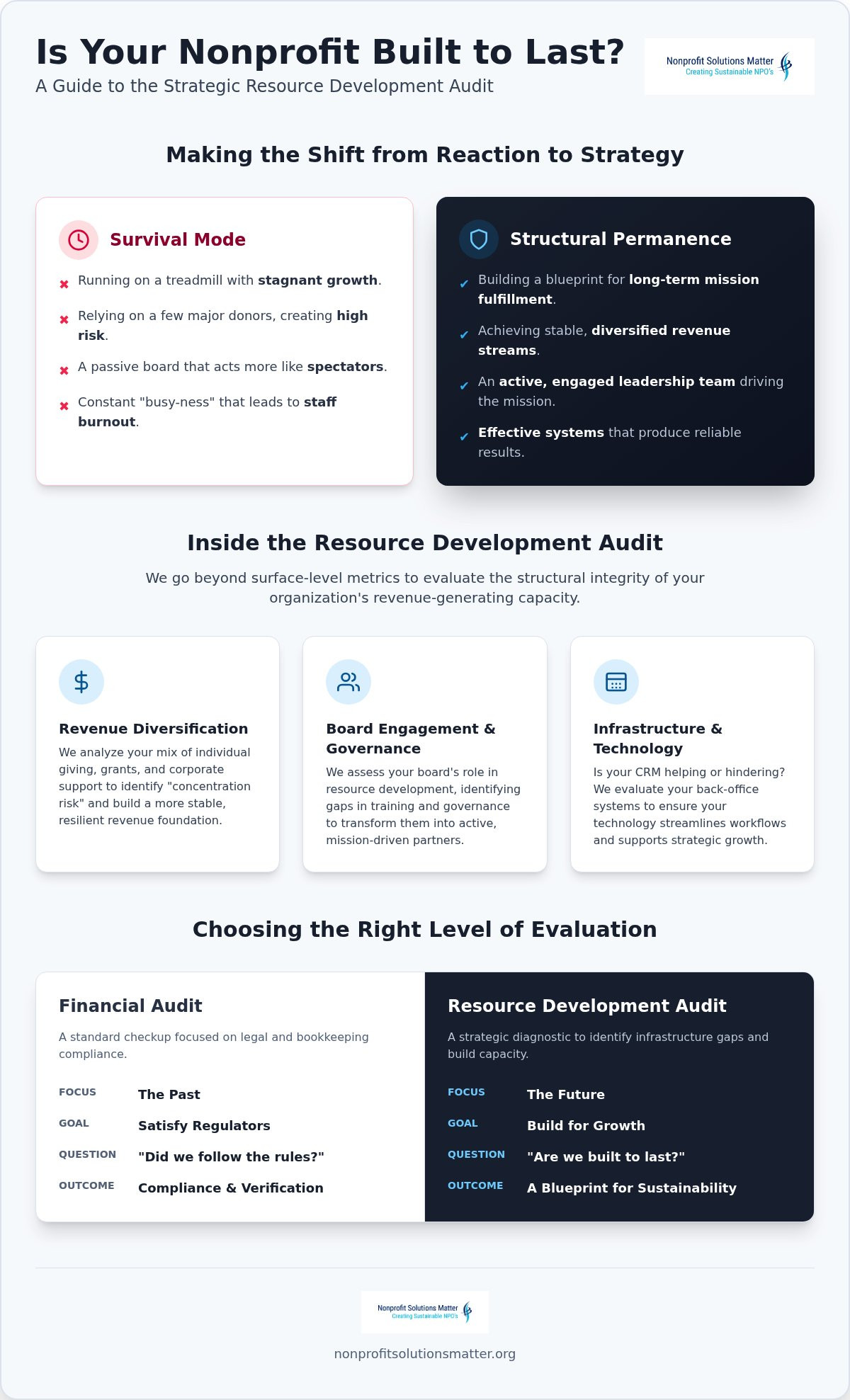
A nonprofit fundraising audit isn't just a standard financial checkup; it's a comprehensive evaluation of your organization's entire revenue-generating capacity. While many leaders view evaluations as a box to check, this process is actually an investment in your architectural integrity. A resource development audit is a strategic diagnostic tool used to identify infrastructure gaps that prevent your mission from scaling. It provides the clarity needed to move from "survival mode," where fundraising is reactive and frantic, toward "sustainability," where strategic resource development leads the way. Think of it like a professional charity assessment that evaluates the health of your systems rather than just the balance in your bank account.
The Difference Between Activity and Achievement
Many executive directors mistake extreme activity for high achievement. Your team might be working exhausting hours, yet donor growth remains stubbornly flat. This level of "busy-ness" often masks a lack of strategic direction, which inevitably leads to staff burnout and high turnover. A professional audit shifts your focus from simply doing more work to performing more effective work. It ensures that every effort put into revenue diversification is backed by a logical system that produces reliable results.
Identifying the Sustainability Gap
The sustainability gap represents the distance between your current revenue and the actual funds required for long-term mission fulfillment. If you feel like your nonprofit has hit a growth ceiling, structural weaknesses are likely the cause. These gaps prevent even the most inspired organizations from reaching their full potential. By identifying these systemic cracks, you can build a foundation that supports permanent growth and durability. If you are ready to bridge this gap, book a strategy call to explore how we can help you build a more resilient future.
Inside the Resource Development Audit: Evaluating Structural Integrity
Our Resource Development Audit framework goes beyond surface-level metrics to examine the "why" behind your data. While a standard fundraising audit might identify low retention, a comprehensive nonprofit fundraising audit investigates the people, processes, and platforms causing the leak. We provide technical assistance to modernize legacy systems, ensuring your infrastructure supports your mission rather than hindering it. It's about moving from fragile guesswork to a foundation of structural permanence.
Reviewing Revenue Diversification and Donor Lifecycles
We analyze your balance between individual giving, grants, and corporate partnerships to identify "concentration risk." If too much revenue comes from too few sources, your organization is vulnerable. By evaluating donor retention and acquisition health, we help you build a more stable revenue mix. If you're concerned about your current funding balance, you can start your evaluation today.
Assessing Board Engagement and Governance
A deep nonprofit fundraising audit also evaluates your board members as vital partners in resource development. We identify gaps in training and governance that keep leaders passive. Our goal is to transform your board into an active, mission-driven body capable of opening doors and securing long-term support. This shift is essential for moving toward true sustainability and durability.
Infrastructure and Technical Readiness
Is your CRM working for you or against you? We assess your back-office systems, from CRM optimization to wealth screening and prospect research. These tools are critical for identifying major gift potential and streamlining your development team's workflow. If your systems feel outdated, book a strategy call to discuss modernizing your technical roadmap.
Audit vs. Assessment: Navigating the Levels of Evaluation
Choosing the right depth of evaluation is key to moving from a survival mindset to long term stability. While both assessments and audits provide value, they serve different masters. A financial audit looks backward to satisfy regulators, but a strategic nonprofit fundraising audit looks forward to build your organization's architectural integrity. Understanding where you sit in this spectrum ensures you don't over invest in compliance while under investing in your actual growth capacity. While a financial audit ensures compliance with the past, a fundraising audit builds a blueprint for the future.
Financial Audit vs. Strategic Fundraising Audit
A financial audit is primarily a legal and bookkeeping exercise focused on overhead and 501(c)(3) compliance. For organizations in Pennsylvania, an audit is required once you reach $750,000 or more in gross revenue. This differs from states like New York, where the threshold is $1,000,000, or California at $2,000,000. In contrast, a strategic nonprofit fundraising audit evaluates your resource development systems, board engagement, and donor acquisition health. You need the former to stay legal, but you need the latter to stay sustainable and durable.
The 'Nonprofit Starter Pack' vs. Enterprise Audits
Your lifecycle stage determines the level of professional support you need. Smaller faith based groups or community nonprofits often find their footing with our Nonprofit Starter Pack, which focuses on foundational revenue diversification. However, international NGOs or large scale missions require a more complex enterprise level audit to manage multi national donor lifecycles and advanced CRM optimization. Matching the evaluation to your current scale prevents wasted effort. If you're unsure which path fits your team, book a strategy call to discuss your roadmap.
Preparing for Your Audit: A Leadership Roadmap
Preparing for a nonprofit fundraising audit is less about "cleaning the house" and more about opening the windows for a fresh perspective. As a leadership team, your goal is transparency. You aren't being judged; you're being guided. This collaborative journey requires full buy-in from the top down before a consultant even steps through the door. When you approach the process with curiosity rather than fear, the audit becomes a bridge from today's pressure to tomorrow's stability.
Step 1: Gathering the Essential Data
Start by compiling three years of revenue data, donor lists, and grant history. You'll also need board meeting minutes and current strategic planning documents. Don't forget to ensure your CRM is accessible for a technical review and optimization. Organizing these assets early allows your consultant to focus on strategic revenue diversification rather than hunting for files.
Step 2: Aligning Leadership and the Board
Clearly communicate the "why" to your board to reduce any underlying anxiety. Explain that this is a professional investment in your organization's architectural integrity. Set clear expectations for upcoming interviews and workshops. When everyone understands what success looks like post-audit, they'll participate more authentically in the process.
Step 3: Selecting the Right Strategic Partner
Selecting the right partner for your nonprofit fundraising audit is about finding a mentor with a global perspective. Experience and empathy are just as important as a solid track record. You need a partner who understands both US and international NGO landscapes to ensure your roadmap is globally relevant. Since we operate as a 501(c)(3) ourselves, we bring an insider's view that traditional consultants often lack.
Partnering with Strategic Architects: The Nonprofit Solutions Matter, Inc. Approach
At Nonprofit Solutions Matter, Inc., we don't just deliver a document; we act as your Strategic Architect to build a foundation that lasts. Our unique approach to the nonprofit fundraising audit is informed by over 30 years of practical experience and a track record of raising more than $550 million for mission-driven causes. We understand the internal pressures of leadership because we operate from the same mission-driven heart. We help you move past the exhaustion of survival by teaching you How to Develop a Comprehensive Resource Development Plan that turns your vision into a measurable roadmap for success.
Beyond the Report: Implementation and Coaching
A report that gathers dust on a shelf is a wasted investment. Nonprofit Solutions Matter, Inc. focuses on providing actionable technical assistance that bridges the gap between theory and reality. Through tailored executive coaching, we help your team institutionalize the audit's findings so they become a permanent part of your operations. This ensures that your revenue diversification efforts aren't just temporary fixes but are instead woven into a living strategic plan. We stay by your side as a high-level partner to ensure the transition from survival to sustainability is both smooth and effective.
A Legacy of Sustainability
Sharon D. Jones's extensive background across diverse sectors ensures that every nonprofit fundraising audit we conduct is grounded in reality. We utilize sophisticated tools like wealth screening and CRM optimization to ensure your donor acquisition is precise and sustainable. Our goal is to leave your organization with the structural permanence required to thrive for decades. If you're ready to build a legacy of durability and health, Schedule your Resource Development Audit today by booking a strategy call with our experienced team.
Building a Blueprint for Permanent Growth
The transition from survival to sustainability isn't found in a single lucky gift; it's built through the architectural integrity of your systems. By utilizing a nonprofit fundraising audit, you've learned how to identify structural gaps and engage your board to create a future defined by durability. These steps move your organization away from the exhaustion of reactive cycles toward a streamlined state of revenue diversification and mission impact.
Nonprofit Solutions Matter, Inc. brings 30+ years of sector experience and $550 million raised to every partnership we form. We don't just hand over a report; we provide the technical assistance and coaching needed to make your growth permanent. It's time to stop managing crises and start leading a sustainable movement. Your mission deserves a foundation that is as inspired as the work you do every day.
We are ready to help you unlock your organization's full potential. Let's start building together.
Frequently Asked Questions
How often should a nonprofit conduct a fundraising audit?
Most organizations benefit from a deep dive every three to five years or during a major leadership transition. This frequency ensures your revenue diversification strategies stay aligned with your mission's growth. Regular checkups prevent you from slipping back into survival mode and keep your infrastructure durable enough to handle unexpected shifts in the sector.
What is the typical cost of a professional resource development audit?
While industry averages for full financial audits often range from $15,000 to $50,000, the cost of a strategic audit varies based on your organization's complexity and size. We don't offer a one size fits all price because every mission has unique needs. It's best to discuss your specific goals during a discovery call to get an accurate estimate.
Can we conduct a fundraising audit internally with volunteers?
You can try, but internal reviews often lack the objectivity needed for a true structural transformation. A professional nonprofit fundraising audit provides an unbiased, outside perspective that volunteers or staff might miss due to their proximity to daily tasks. External experts bring a global view and specialized knowledge that effectively identifies deep seated systemic gaps.
How long does the audit process usually take from start to finish?
A comprehensive audit typically takes between eight to twelve weeks from the initial data gathering to the final presentation. This timeframe allows for deep technical reviews, board interviews, and the creation of an actionable roadmap. Rushing the process often means overlooking the subtle infrastructure cracks that prevent your organization from reaching long term sustainability.
What is the difference between a fundraising audit and a development assessment?
An assessment is often a high level scan of your current activities, while a nonprofit fundraising audit is a deep diagnostic dive into your entire infrastructure. Think of an assessment as a quick health check and an audit as a full structural survey. The audit provides the detailed architectural blueprint you need to build a permanent, scalable program.
Will an audit help us engage a board that is currently passive?
Yes, an audit is one of the most effective tools for turning a passive board into active partners. It provides a professional, data backed justification for their involvement and clarifies their specific roles in revenue diversification. By presenting clear gaps and logical solutions, you give your board a strategic framework they can confidently support and lead.
What documents do we need to have ready for a fundraising consultant?
You'll need three years of revenue data, donor retention reports, and your current strategic plan. It's also helpful to have board meeting minutes, grant calendars, and access to your CRM for a technical review. Being transparent with these documents allows your consultant to build a more accurate and effective sustainability roadmap for your team's future growth.
How does wealth screening fit into the audit process?
Wealth screening acts as a powerful lens during the audit to identify untapped major gift potential within your existing database. It helps us see where your acquisition efforts should be focused for the highest return. By integrating this data, we can build a more precise strategy for long term revenue diversification and systemic health.
Ready to move your organization toward a more sustainable future? Book a strategy call today to discuss how we can help you build a durable roadmap for success.

Article by
Sharon D Jones
Sharon D. Jones, M.Div., is a globally respected fundraising strategist, nonprofit leadership expert, and capacity-building architect with over three decades of experience. As the Founder and CEO of Nonprofit Solutions Matter, Inc., her proprietary growth frameworks have successfully mobilized nearly $957 million in philanthropic capital for local, national, and international organizations.
General Disclaimer & Disclosure
The information provided on this website is for general informational and educational purposes only. While we strive to keep content accurate and up to date, we make no representations or warranties of any kind, express or implied, about the completeness, accuracy, reliability, or suitability of the information contained herein.
Professional Advice
The content on this site does not constitute professional advice (e.g., legal, financial, medical, or tax). You should consult with a qualified professional before making any decisions based on the information provided on this website. Any action you take upon the information found on this site is strictly at your own risk.
Affiliate & Third-Party Links
Some articles on this site may contain affiliate links. If you click on an affiliate link and make a purchase, we may receive a small commission at no additional cost to you. We only recommend products or services we believe add value to our readers. We are not responsible for the content, privacy policies, or practices of any third-party websites linked within our articles.


