
What if the very leadership skills that helped you launch your nonprofit are now the primary barriers to its long-term growth? When searching for a nonprofit leadership training program, many executive directors are actually looking for an escape from the survival mindset where they act as the sole engine of the organization. You likely feel the pressure of founder’s syndrome, high staff turnover, or a board that remains disengaged. It's exhausting to manage every bottleneck while watching revenue stagnate.
You deserve a structure that supports your vision rather than one that relies on your constant presence. This guide explores why traditional training often fails to create lasting change and how you can transition to a sustainable growth architecture. We'll dismantle three pervasive myths that keep organizations small. You'll discover a roadmap to move from crisis management to systemic health, turning your board into a powerful resource development partner.
Key Takeaways
- Transition from an operational manager to a strategic architect by focusing on systems that prevent organizational bottlenecks.
- Discover why a comprehensive nonprofit leadership training program is more effective than one-time workshops for institutionalizing growth.
- Master the technical aspects of revenue diversification to ensure your mission isn't held back by limited funding streams.
- Learn how to transform your board from a group of volunteers into active resource development partners for lasting sustainability.
Myth #1: Nonprofit Leadership is Simply About Managing People
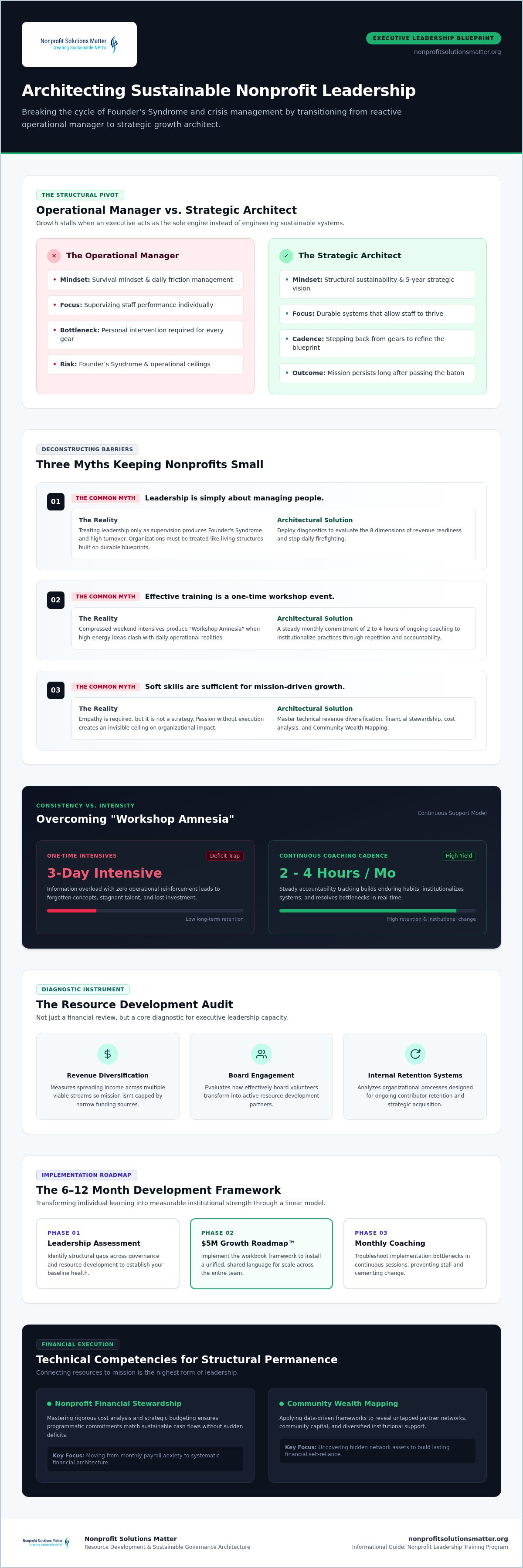
Many leaders assume their primary role is to supervise staff. This is the mark of an Operational Manager, someone who reacts to daily friction and manages individual performance. A Strategic Architect, however, focuses on the systems that allow those individuals to succeed. If you only manage people without architecting durable systems, you inadvertently create "Founder’s Syndrome." This occurs when the organization becomes so reliant on your personal intervention that growth hits a ceiling. A high-quality nonprofit leadership training program should teach you how to step back from the gears and look at the blueprint.
Instead of reactive firefighting, a sustainability mindset requires you to treat your organization like a living structure. One of the most effective leadership tools at your disposal is a Resource Development Audit. This is not just a financial check; it is a diagnostic for your leadership capacity. It reveals critical data points such as:
- Revenue diversification across multiple streams.
- Board engagement in resource development.
- Internal systems for donor retention and acquisition.
Transitioning from Survival to Structural Sustainability
To move beyond a survival mindset, you must evaluate the eight dimensions of revenue readiness found in the Fundraising Performance Diagnostic™. This tool helps you stop obsessing over next month’s payroll and start planning a 5-year strategic vision. Understanding various leadership development frameworks can help you see that growth isn't about working harder, but about building better systems. Structural sustainability is the ability of an organization to thrive beyond its current leadership. By focusing on systemic health, you ensure your mission persists long after you've passed the baton.
Myth #2: Effective Training is a One-Time Workshop Event
Many executives hope a weekend retreat will fix staff turnover or board apathy. It won't. This "Workshop Amnesia" occurs when high-energy ideas meet the brick wall of daily operations. Real change requires a nonprofit leadership training program built on consistency rather than intensity. When learning is compressed into a single event, the brain rarely retains the complex systems needed for long-term sustainability. You need a steady cadence to move from theory to practice.
Research into the leadership development deficit highlights that without ongoing reinforcement, talent cultivation stalls. Executive Coaching plays a vital role here by institutionalizing new practices through repetition. A monthly commitment of just 2-4 hours is far more effective than a three-day intensive. This approach allows you to build a performance architecture through continuous accountability tracking. It ensures new habits actually stick in the real world. This steady cadence is the hallmark of a truly effective nonprofit leadership training program.
The 6-12 Month Leadership Development Framework
- Step 1: Conduct a leadership assessment to identify structural gaps in your governance and resource development.
- Step 2: Implement the $5 Million Nonprofit Growth Roadmap™ Workbook to create a shared language for growth.
- Step 3: Utilize monthly coaching sessions to troubleshoot implementation bottlenecks as they arise.
Success isn't found in a binder on a shelf; it's found in the small, daily shifts that coaching facilitates. Lasting transformation requires moving beyond the workshop cycle toward a model of continuous support and accountability. By focusing on long-term development, you ensure that the skills learned translate into measurable organizational growth and a more resilient mission. This structural approach turns individual learning into institutional strength.
Myth #3: Soft Skills are Sufficient for Mission-Driven Growth
Empathy is a requirement, but it isn't a strategy. Many executives believe that a strong heart and a clear vision are enough to carry an organization forward. This belief often creates an invisible ceiling on your impact. To achieve structural permanence, you must master the technical architecture of revenue diversification. A comprehensive nonprofit leadership training program bridges the gap between mission-driven passion and financial execution. It's time to stop viewing the request for support as a separate, uncomfortable task. In reality, connecting resources to your mission is the highest form of leadership.
Modern growth requires a deep understanding of nonprofit financial stewardship, which includes cost analysis and strategic budgeting. You need data-driven frameworks like Community Wealth Mapping to identify untapped potential within your network. Without these technical competencies, even the most inspired mission will eventually stall. Leadership is about more than just managing staff; it's about architecting the financial health of the entire system.
Integrating Resource Development and Governance
True sustainability happens when you move from traditional methods to a sophisticated resource development strategy. This shift requires your board to transition from passive observers to active resource development partners. Your nonprofit leadership training program should prioritize board engagement and governance training to align these two groups. When the board understands their role in the growth architecture, they become a powerful engine for expansion rather than a bottleneck.
Success in this area relies on utilizing tools like wealth screening and prospect research. These resources empower your board with actionable data, transforming executive decision-making from guesswork into a precise science. When your leadership team understands the mechanics of revenue readiness, the organization moves from a state of fragility to one of durable growth. This integration ensures that every decision aligns with the long-term vision of the organization.
Architecting a Legacy of Sustainability
Moving from a survival mindset to growth requires a shift in how you view your role and your organization's architecture. Leadership is about building durable systems, not just supervising staff. Real change happens through consistent, monthly development rather than one-off retreats. By mastering technical resource development and revenue diversification, you empower your board to become a strategic engine. A modern nonprofit leadership training program provides the accountability needed to institutionalize these shifts. You don't have to navigate this alone. We're here to help you build an organization that thrives and continues strengthening the world.
Next Steps:
- Nonprofit Executive Coaching: Moving from Survival to Sustainability in 2026
- Board Governance Training for Nonprofits: Moving from Survival to Sustainability
- Strong organizations don't happen by accident, they're built. Tell us what you're building.
Frequently Asked Questions
What is included in a comprehensive nonprofit leadership training program?
A high-impact nonprofit leadership training program integrates governance, strategic planning, and technical resource development. It should utilize data-driven tools like the Fundraising Performance Diagnostic™ to assess revenue readiness and the $5 Million Nonprofit Growth Roadmap™ Workbook for implementation. Beyond interpersonal skills, it covers technical areas such as wealth screening and donor data segmentation. This ensures leaders are equipped to build durable systems rather than just managing daily tasks.
How much time should an Executive Director commit to leadership coaching?
Coaching engagements typically require a commitment of 2 to 4 hours per month. This manageable cadence allows for deep, confidential strategy sessions without overwhelming your operational schedule. In addition to these meetings, you'll spend time on specific action items identified during your sessions. This structure ensures that leadership growth remains a consistent priority while you continue to manage the daily needs of your mission.
Can leadership training help with a disengaged nonprofit board?
Yes, targeted training is often the most effective way to activate a passive board. Through board engagement and governance training, members learn to transition from simple oversight to becoming active resource development partners. By providing them with clear strategic portfolios and specific skills for revenue diversification, you remove the ambiguity that often causes disengagement. This process turns your board into a powerful engine for organizational sustainability.
Is there financial assistance for small nonprofits seeking leadership development?
Financial accessibility is a core value for mission-driven growth. Many organizations offer sliding-scale pricing based on your annual operating budget, age, and mission focus. Additionally, some providers offer pro-bono consulting and coaching hours specifically for under-resourced or grassroots groups. It's always best to inquire about these options during your initial consultation to ensure a nonprofit leadership training program remains within your reach.
Article by
Sharon D Jones
Sharon D. Jones, M.Div., is a globally respected fundraising strategist, nonprofit leadership expert, and capacity-building architect with over three decades of experience. As the Founder and CEO of Nonprofit Solutions Matter, Inc., her proprietary growth frameworks have successfully mobilized nearly $957 million in philanthropic capital for local, national, and international organizations.
General Disclaimer & Disclosure
The information provided on this website is for general informational and educational purposes only. While we strive to keep content accurate and up to date, we make no representations or warranties of any kind, express or implied, about the completeness, accuracy, reliability, or suitability of the information contained herein.
Professional Advice
The content on this site does not constitute professional advice (e.g., legal, financial, medical, or tax). You should consult with a qualified professional before making any decisions based on the information provided on this website. Any action you take upon the information found on this site is strictly at your own risk.
Affiliate & Third-Party Links
Some articles on this site may contain affiliate links. If you click on an affiliate link and make a purchase, we may receive a small commission at no additional cost to you. We only recommend products or services we believe add value to our readers. We are not responsible for the content, privacy policies, or practices of any third-party websites linked within our articles.


