
What if your board meetings felt like a strategic engine room rather than a monthly chore? You've likely felt the weight of leadership burnout when you're the only one driving resource development. It's exhausting to manage a passive oversight body while worrying about a single, fragile revenue stream. Investing in the specialized board governance training nonprofit leaders rely on is the first step toward shifting this dynamic from immediate crisis to structural permanence.
We understand that you need more than just compliance; you need a partnership built on architectural integrity. This article provides a clear roadmap to transform your board into a high-impact ally that takes true ownership of your mission. You'll discover how to implement revenue diversification and engagement systems that ensure your organization thrives. We'll explore the mechanics of systemic health and the logical steps required to build a sustainable future.
Key Takeaways
- Differentiate between basic compliance and systemic health to bridge the sustainability gap within your leadership structure.
- Implement a comprehensive board governance training nonprofit leaders use to evaluate eight dimensions of organizational readiness through a specialized diagnostic.
- Transform static donor lists into measurable pipelines for revenue diversification by applying the principles of Community Wealth Mapping.
- Shift your board from a passive oversight body to an active partner for resource development; book a 30-minute free consultation at https://bit.ly/3ky5ge0.
The Sustainability Gap: Why Compliance-Only Board Governance Training Falls Short
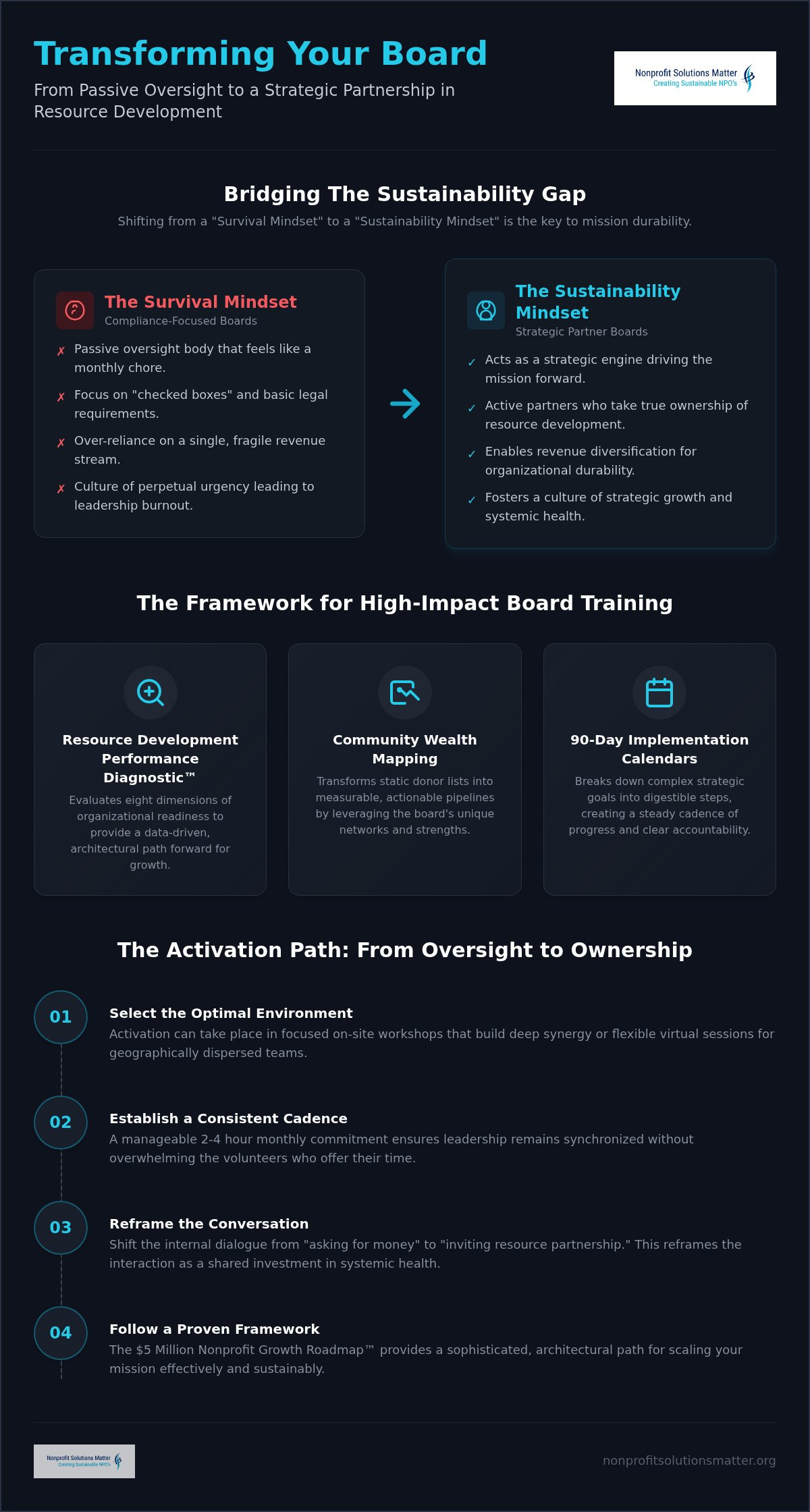
Many organizations operate in a state of perpetual urgency. They treat board development as a legal requirement rather than a strategic lever. The "Sustainability Gap" represents the distance between basic compliance and systemic health. While following foundational corporate governance principles ensures you meet legal standards, it doesn't guarantee organizational durability or mission growth.
Traditional board governance training nonprofit leaders often encounter fails because it focuses on "checked boxes" rather than cultural shifts. This creates a "Survival Mindset" where passive boards merely show up for meetings to review reports. We need a "Sustainability Mindset" instead. This shift transforms board members into active partners who take true ownership of the vision. Rebuilding this infrastructure requires a Strategic Architect to move the organization away from fragile, ad-hoc solutions toward clear, reliable systems.
Moving Beyond Oversight to Strategic Resource Development
Board members must understand the mechanics of revenue diversification to prevent reliance on single, fragile income streams. When a board remains in a passive oversight role, they miss critical opportunities to leverage their networks for growth. Disengagement doesn't just stall your progress; it threatens the very durability of your mission. Board governance is the structural engine for mission delivery. If you're ready to bridge this gap, you can book a 30-minute free consultation to discuss your specific needs. We'll help you move from a mindset of immediate crisis toward one of structural permanence.
Essential Components of High-Impact Board Governance Training
Moving from oversight to action requires structured frameworks. High-impact board governance training nonprofit organizations need must go beyond theoretical roles. We utilize a Resource Development Performance Diagnostic™ to evaluate eight dimensions of organizational readiness. This data-driven approach ensures that the board’s efforts align with the architectural integrity of the mission. While some seek a board governance certification to understand basic duties, true sustainability requires mastering the mechanics of growth.
One of the most transformative tools is Community Wealth Mapping. This process doesn't just turn donor lists into pipelines; it makes them measurable and actionable. Each board member should maintain a strategic portfolio that highlights their unique connections and strengths. We replace vague expectations with specific, personal-ask skills. Accountability is maintained through 90-day implementation calendars. These calendars break down complex goals into digestible steps, creating a steady cadence of progress.
Strategies for Effective Revenue Diversification and Growth
Training should empower members to identify geographic and sector-based network mapping opportunities. Effective board governance training nonprofit boards receive must include strategies for revenue diversification and growth. We shift the internal dialogue from "asking for money" to "inviting resource partnership." This reframe changes the psychological dynamic of the interaction. It moves the conversation from a transaction to a shared investment in systemic health. You can explore this further in our comprehensive resource development audit guide. If you're ready to revitalize your leadership, you can schedule a 30-minute free consultation to evaluate your current board engagement levels.
Activating Your Board: From Passive Oversight to Strategic Partnership
Activation begins by selecting the optimal environment for transformation. On-site workshops foster deep relational synergy and focused attention, while virtual sessions provide essential flexibility for geographically dispersed teams. The format matters less than the objective: moving beyond passive oversight. We guide your team as they transition into active resource development partners who share the weight of organizational growth. This alignment requires a consistent, methodical pace. A 2–4 hour monthly commitment ensures that leadership remains synchronized without overwhelming the individuals who volunteer their time.
Our methodology is anchored by the $5 Million Nonprofit Growth Roadmap™. This framework offers a sophisticated, architectural path for scaling your mission effectively. It replaces the frantic energy often found in advocacy spaces with a calm, grounded strategy for expansion. By integrating nonprofit board governance best practices, we help you build a foundation that supports long-term mission delivery. This isn't about theoretical concepts; it's about practical application that produces durable results.
Leveraging the Board Empowerment Workshop for Long-Term Impact
During a full-day Board Empowerment workshop, your team develops a custom board manual and a comprehensive strategy session. We institutionalize this progress through technical systems like CRM optimization and data-driven wealth screening. These tools ensure that your revenue diversification efforts are based on clear evidence rather than guesswork. To begin this journey, apply to work with Sharon D. Jones for the specialized board governance training nonprofit organizations need to thrive. You may also schedule a 30-minute free consultation to evaluate your current trajectory and identify systemic gaps.
Architecting a Future of Organizational Permanence
Bridging the gap between basic compliance and systemic health is the essential first step toward organizational durability. By implementing high-impact board governance training nonprofit leaders can successfully transform passive oversight into an active partnership for resource development. It's a shift that matters. Our proven 5-stage Growth Roadmap framework has helped raise over $950 million for clients worldwide. We bring specialized expertise to BIPOC-led and faith-based organizations, ensuring your internal infrastructure supports your unique calling. Moving from a mindset of immediate crisis toward structural permanence is a strategic necessity for the communities you serve. We're here to help you build a foundation that lasts for generations.
Book a 30-minute free strategy call today Your mission deserves a board that takes true ownership of its future success.
Frequently Asked Questions
How much time should board members commit to governance training each month?
Board members should commit to a 2 to 4 hour monthly window for leadership development and coaching. This specific duration allows for meaningful alignment without overwhelming those who volunteer their expertise. It creates a steady, methodical pace that moves the organization toward structural permanence. Consistency is the key to building architectural integrity within your leadership team.
Can board governance training help with revenue diversification?
Specialized board governance training nonprofit organizations receive directly impacts revenue diversification by equipping members with strategic networking skills. We teach your board to identify geographic and sector-based mapping opportunities through Community Wealth Mapping. This process turns passive donor lists into measurable pipelines. It shifts the internal dialogue from simple oversight to an active partnership in securing the organization’s financial future.
What is the difference between governance and resource development?
Governance provides the structural engine for mission delivery, focusing on legal compliance and systemic health. Resource development is the strategic process of identifying and securing the assets needed to fuel that mission. While they are distinct functions, a sustainable organization integrates them. A board that understands this connection can move from a survival mindset to one of long-term mission sustainability.
How do we start the process of board transformation?
The process begins with identifying systemic gaps through a Resource Development Performance Diagnostic™. You can start by booking a 30-minute free consultation at https://bit.ly/3ky5ge0 to evaluate your current board engagement. For those ready for a deeper commitment, you can apply to work with Sharon D. Jones at https://forms.gle/ngb9rhWuzSMFoXkBA. This initial step sets the stage for a customized Board Empowerment workshop.
Article by
Sharon D Jones
Sharon D. Jones, M.Div., is a globally respected fundraising strategist, nonprofit leadership expert, and capacity-building architect with over three decades of experience. As the Founder and CEO of Nonprofit Solutions Matter, Inc., her proprietary growth frameworks have successfully mobilized nearly $957 million in philanthropic capital for local, national, and international organizations.
General Disclaimer & Disclosure
The information provided on this website is for general informational and educational purposes only. While we strive to keep content accurate and up to date, we make no representations or warranties of any kind, express or implied, about the completeness, accuracy, reliability, or suitability of the information contained herein.
Professional Advice
The content on this site does not constitute professional advice (e.g., legal, financial, medical, or tax). You should consult with a qualified professional before making any decisions based on the information provided on this website. Any action you take upon the information found on this site is strictly at your own risk.
Affiliate & Third-Party Links
Some articles on this site may contain affiliate links. If you click on an affiliate link and make a purchase, we may receive a small commission at no additional cost to you. We only recommend products or services we believe add value to our readers. We are not responsible for the content, privacy policies, or practices of any third-party websites linked within our articles.


