
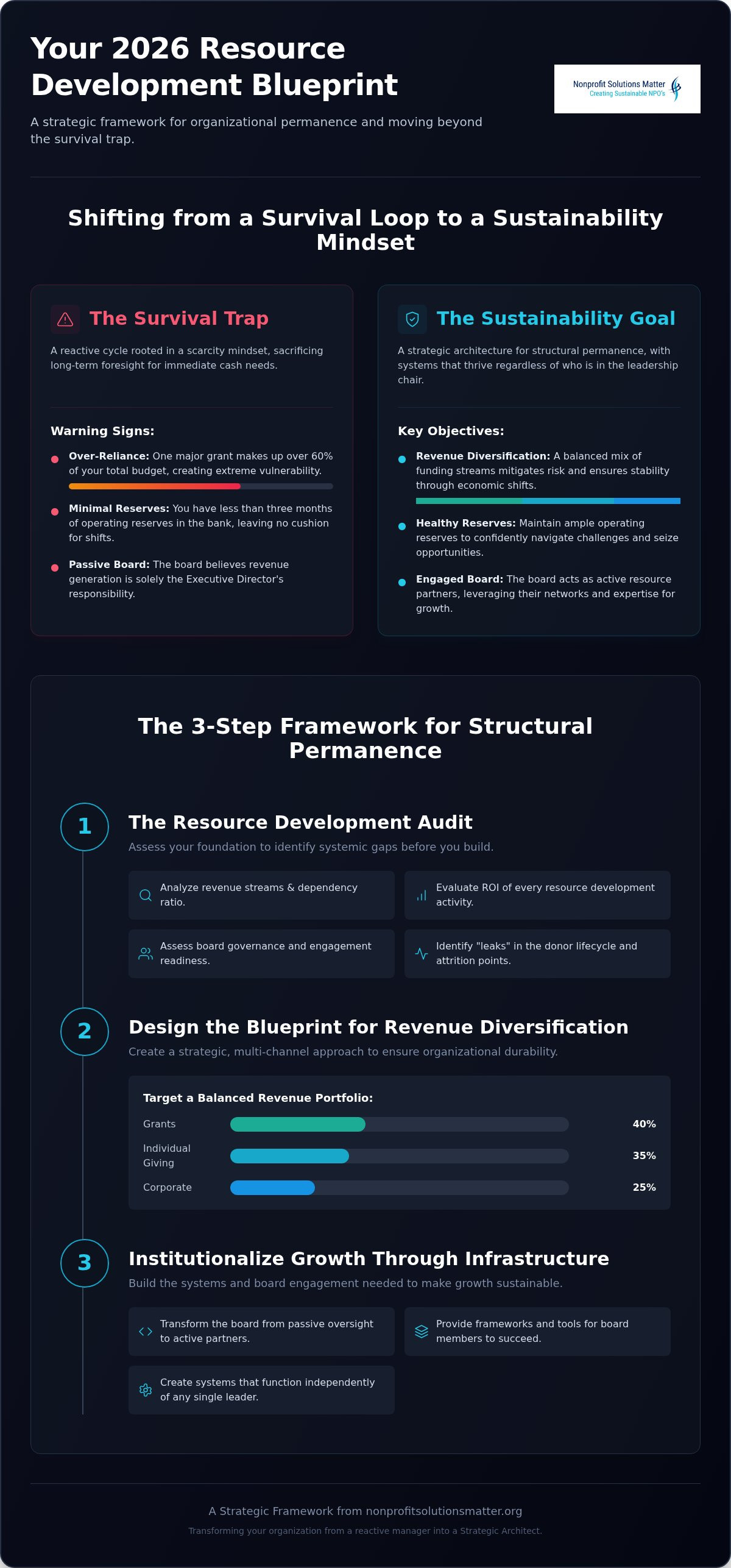
A resource development plan isn't just a list of activities; it is a strategic architecture for organizational permanence. If you're wondering how to develop a resource development plan that moves you past the "survival mode" trap, you aren't alone. Many leaders feel the heavy pressure of sacrificing long-term foresight for immediate cash needs. It’s a common challenge, but it doesn't have to be your permanent reality. You deserve a system that provides stability rather than constant anxiety.
This guide will show you how to transition from reactive outreach to a sophisticated blueprint for growth. We’ll explore how to achieve revenue diversification to withstand economic shifts and turn a disengaged board into active partners in your mission. By the end, you’ll have a clear framework to replace internal crisis with structural permanence for 2026 and beyond.
Key Takeaways
- Start with a Resource Development Audit to identify the structural gaps that might be holding your organization back from true sustainability.
- Discover how to develop a resource development plan that creates a balanced revenue diversification mix across grants, individual giving, and corporate partnerships.
- Shift your board's perspective from passive oversight to active engagement by providing the frameworks they need to become effective resource partners.
- Move beyond the "survival mode" cycle by establishing a clear implementation timeline and using quarterly reviews to keep your 2026 growth on track.
Beyond the Resource Development Merry-Go-Round: Defining Sustainable Growth
Tactical outreach often feels like a treadmill. You run hard to hit an annual goal, only to start over at zero on January 1st. This approach creates a "Sustainability Gap" where money comes in, but organizational infrastructure remains fragile. Strategic resource development is different. It’s the architectural work of building a foundation that supports your mission for decades. Understanding Resource mobilization theory reveals that true growth comes from systemic health, not just isolated outreach events. By using a Resource Development Audit to identify these gaps, you can learn how to develop a resource development plan that transforms you from a reactive manager into a Strategic Architect.
The Survival vs. Sustainability Mindset
Survival mode is rooted in a scarcity mindset. It’s a cycle where planning is sacrificed for immediate cash needs. Are you stuck? Check for these signs:
- Your board thinks revenue generation is only the Executive Director's job.
- One major grant makes up over 60% of your total budget.
- You have less than three months of operating reserves in the bank.
Sustainability requires shifting toward structural permanence. It’s about creating systems that thrive regardless of who is in the leadership chair. This transition ensures your mission isn't tied to a single person or a single revenue event.
Why 2026 Demands a New Approach
The coming year brings unique challenges. We're seeing a rise in trust-based philanthropy and a significant shift in donor demographics. Economic volatility makes traditional reliance on a single stream dangerous. Revenue diversification is no longer optional; it’s an essential risk-mitigation strategy. Learning how to develop a resource development plan for this new era ensures your organization doesn't just survive economic shifts but leads through them. If you’re ready to bridge the gap between your current reality and your long-term vision, book a strategy call with us today to start your transformation.
Step 1: The Resource Development Audit—Assessing Your Foundation
Before you can map out your future, you need a clear-eyed look at your present. A Resource Development Audit is more than just a financial review; it’s a deep-dive into the systemic health of your organization. As you determine how to develop a resource development plan, starting with an audit prevents you from building on a cracked foundation. It helps you identify "leaks" in your donor lifecycle, such as high attrition rates where supporters give once but never return. An objective third-party often uncovers these blind spots that internal teams naturally miss because they are too close to the daily operations.
Analyzing Revenue Streams and Diversification
To achieve true stability, you must calculate your dependency ratio. If a single grant or donor accounts for a massive portion of your budget, your organization is at risk. Evaluate the ROI of every current activity. For instance, an annual gala might generate high gross revenue but net very little after expenses and hundreds of staff hours are factored in. Identifying untapped potential in major gifts or corporate partnerships is a critical step in a robust nonprofit resource development plan.
Evaluating Board Governance and Readiness
Your board should be your greatest asset, not a bottleneck. Assess whether your members are active ambassadors or just passive attendees. Many organizations struggle with "Founder's Syndrome," where decision-making is too centralized, stalling growth. A board engagement audit determines if your leadership is ready to step into their role as resource partners. Truly knowing how to develop a resource development plan means ensuring your board is equipped for the journey. If you're feeling stuck, you can book a strategy call with us today to explore how an audit can reveal your path forward.
Step 2: Designing the Blueprint for Revenue Diversification
Once you’ve audited your foundation, it’s time to draft the blueprint. Revenue Diversification is the strategic distribution of funding sources to ensure organizational durability. This means moving beyond a "one-size-fits-all" approach to a multi-channel strategy. Map your donor lifecycle from initial prospect to long-term partner, ensuring every touchpoint builds trust. When you understand how to develop a resource development plan, you prioritize a revenue mix that balances grants, individual giving, corporate partnerships, and social enterprise. This ensures that if one stream falters, the others hold the weight.
Setting Strategic vs. Tactical Goals
Don’t confuse tactical activities with strategic progress. A tactical goal is "raise $100,000," while a strategic goal is "increase major gift retention by 20%." The latter builds the infrastructure for future years. Your plan must account for your team’s capacity; don’t commit to a social enterprise model if you don’t have the staff to run it. Align every developmental goal with your organization’s long-term strategic vision to ensure every dollar raised moves the mission forward.
The Role of Major Gifts and Wealth Screening
Major gifts provide the stability needed for growth. Learning how to develop a resource development plan involves integrating Wealth Screening & Prospect Research to identify high-capacity donors already in your database. This shifts your outreach from transactional to transformational. Craft a Case for Support that speaks to the legacy high-net-worth individuals want to leave. If you’re ready to build a more durable future, book a strategy call with us today and let's start designing your custom blueprint.
Step 3: Institutionalizing Growth Through Infrastructure and Board Engagement
A plan is only as strong as the systems supporting it. To truly understand how to develop a resource development plan, you have to look at infrastructure as the skeleton of your organization. This is how you "institutionalize" success, ensuring it doesn't walk out the door if your Executive Director leaves. By building robust systems and engaging your board, you ensure the organization's durability remains intact even during leadership transitions. Developing a technical assistance plan for staff training is a key part of this, moving you from a person-dependent model to a system-dependent one.
Turning the Board into a Resource Engine
Move your board from passive observers to active resource partners. Implement a clear "Give or Get" policy to set expectations from day one. It’s not about making them "askers" immediately; it’s about training them to tell your story effectively in their own circles. A functional Development Committee shouldn't just meet to talk; it should drive the implementation of your revenue diversification strategies through clear accountabilities and monthly progress checks.
Data Integrity and CRM Optimization
Your CRM is the heartbeat of your growth. A messy database is the biggest enemy of any development plan because you can't manage what you can't measure. When you're figuring out how to develop a resource development plan that lasts, focus on tracking metrics that drive sustainability, like Donor Lifetime Value (LTV) and Cost Per Dollar Raised (CPDR). Use automation to handle repetitive tasks so your staff can focus on building real relationships. This prevents burnout and keeps your data clean and actionable for your 2026 goals.
Book your Board Engagement & Governance Training
Executing Your 2026 Plan: Moving from Survival to Sustainability
Execution is where your vision meets the pavement. Avoid the common mistake of a "hard reset" every January; instead, treat your progress as a continuous arc toward durability. When you’ve learned how to develop a resource development plan, you know that an implementation timeline with clear accountabilities is your best tool. Quarterly reviews keep you grounded, allowing you to adjust your tactics based on real-time data so you stay on track for your 2026 goals. This methodical approach ensures your strategy remains a living document rather than a forgotten file.
The ROI of Professional Capacity Building
Investing in your team isn't an expense; it's a strategy for growth. While some might hesitate at the cost of consulting, the ROI of professional capacity building is found in long-term revenue gains and a more resilient model. Executive coaching helps leaders bridge the "Sustainability Gap" by providing the confidence and frameworks needed to scale. You'll know your plan is working when revenue diversification becomes a reality and your board takes true ownership of their roles. These indicators signal that your organization has moved from a state of crisis to one of structural permanence.
Next Steps: Starting Your Resource Development Journey
Your path to structural permanence begins with a Resource Development Audit to identify your unique opportunities. Whether you need a Nonprofit Starter Pack for a new venture or sophisticated Wealth Screening & Prospect Research for an established mission, Nonprofit Solutions Matter, Inc. is ready to help. Move past the mindset of just "getting by" and embrace a future built on professional solutions. To take the next step in your organizational evolution, book a strategy call with us today and let's build your roadmap for 2026.
Building Your Legacy of Structural Permanence
We've moved through the mechanics of audits and the architecture of revenue diversification. Now, the focus shifts to your commitment to this long-term transformation. With over 30 years of experience and more than $550 million raised for our partners, we understand the unique pressures NGOs and faith-based groups face. Mastering how to develop a resource development plan is the bridge between your current survival mode and a future of structural permanence. It's about ensuring your impact is felt for generations.
Schedule your Resource Development Audit with Nonprofit Solutions Matter, Inc. today.
Your mission deserves the security of professional systems. Let's turn your vision into a sustainable reality that doesn't depend on luck or a single donor. You have the passion; we have the strategic solutions to make it last.
Frequently Asked Questions
What is the difference between a fundraising plan and a resource development plan?
A fundraising plan usually focuses on tactical, annual activities like events or direct mail. In contrast, a resource development plan is a strategic blueprint for long-term sustainability. It focuses on building the organizational infrastructure and diverse revenue streams needed for structural permanence. This approach moves you from meeting immediate cash needs to ensuring your mission thrives for decades.
How often should a nonprofit conduct a resource development audit?
You should conduct a Resource Development Audit every two to three years to ensure your strategy remains aligned with your growth. It’s also vital to perform one during major leadership transitions or when your organization hits a growth plateau. Regular audits ensure your foundation remains strong and help you identify new "leaks" in your donor lifecycle.
Can a small nonprofit with limited staff develop a resource development plan?
Small teams can definitely create these plans, and it is actually more critical for them to have a clear roadmap. When learning how to develop a resource development plan with limited staff, focus on high-ROI activities and automation. Start with a Nonprofit Starter Pack to build your systems correctly from the beginning, ensuring you don't burn out.
How do I get my board to help with resource development if they are resistant?
Shift the conversation from "asking for money" to "sharing the mission" to reduce their anxiety. Most board members are resistant because they lack the tools or confidence to engage. Provide Board Engagement & Governance Training to help them understand their role as resource partners. Once they have a clear "Give or Get" policy, their resistance usually fades.
What are the most important metrics to include in a development plan?
Focus on metrics that indicate systemic health rather than just the total amount raised. Track Donor Retention Rates, Donor Lifetime Value (LTV), and Cost Per Dollar Raised (CPDR). These numbers tell you if your revenue diversification efforts are actually profitable. Monitoring these key indicators allows you to make data-driven adjustments during your quarterly reviews to maintain your growth.
Is wealth screening ethical for small community organizations?
Yes, it is a highly ethical way to ensure you are being a good steward of your limited time and resources. Wealth Screening & Prospect Research simply identifies which supporters already in your database have the capacity to make a transformational impact. This allows you to focus your energy on the relationships that can most effectively move your mission forward.
How do we move from grant-dependency to a diversified revenue model?
Transitioning requires a deliberate multi-year strategy that builds new revenue channels incrementally. Start by setting a target "Revenue Mix" that includes individual giving, corporate partnerships, and social enterprise. Use your resource development plan to slowly decrease your reliance on a single grant. This diversification acts as a safety net, protecting your organization from the volatility of grant cycles.
What should be the first step if our current plan is failing?
If your current efforts aren't yielding results, stop and perform an audit to find the root cause. You need to identify whether the failure is in your strategy, your infrastructure, or your board engagement levels. Pinpointing the exact systemic gap allows you to reset with a more accurate blueprint. If you're ready to break through this plateau, book a strategy call with us today.
Article by
Sharon D Jones
Sharon D. Jones, M.Div., is a globally respected fundraising strategist, nonprofit leadership expert, and capacity-building architect with over three decades of experience. As the Founder and CEO of Nonprofit Solutions Matter, Inc., her proprietary growth frameworks have successfully mobilized nearly $957 million in philanthropic capital for local, national, and international organizations.
General Disclaimer & Disclosure
The information provided on this website is for general informational and educational purposes only. While we strive to keep content accurate and up to date, we make no representations or warranties of any kind, express or implied, about the completeness, accuracy, reliability, or suitability of the information contained herein.
Professional Advice
The content on this site does not constitute professional advice (e.g., legal, financial, medical, or tax). You should consult with a qualified professional before making any decisions based on the information provided on this website. Any action you take upon the information found on this site is strictly at your own risk.
Affiliate & Third-Party Links
Some articles on this site may contain affiliate links. If you click on an affiliate link and make a purchase, we may receive a small commission at no additional cost to you. We only recommend products or services we believe add value to our readers. We are not responsible for the content, privacy policies, or practices of any third-party websites linked within our articles.


