
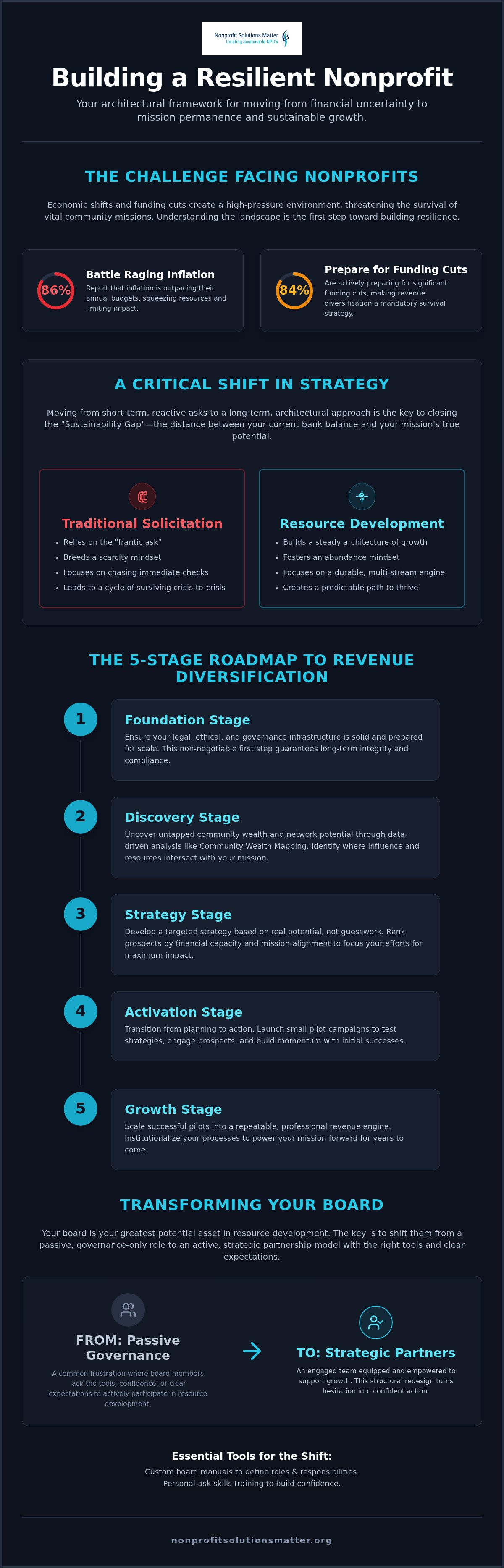
Did you know that 86% of nonprofits are currently battling inflation that's moving faster than their annual budgets? Across the nation, where economic shifts impact organizations quickly, ignoring nonprofit revenue diversification isn't just risky; it's a threat to your mission's survival. At Nonprofit Solutions Matter, Inc., we understand you likely feel the weight of revenue stagnation and the frustration of a board that stays quiet when it's time to talk about growth. It's a heavy burden to carry when your heart is in the work, but the numbers don't always add up.
We agree that your impact shouldn't be limited by a fragile bank account. This guide offers a clear architectural framework to move your organization from constant crisis to structural permanence. We will show you how to build a predictable revenue engine and turn your board into true partners in resource development, ensuring your organization thrives well beyond 2026.
Key Takeaways
- Bridge the "Sustainability Gap" by identifying the distance between your current funding and your true potential to scale your mission's impact in Panama.
- Implement a professional framework for nonprofit revenue diversification to move beyond the risk of relying on a single grant or major donor.
- Master the transition from a passive, governance-only board to a team of engaged strategic partners who actively support resource development.
- Uncover hidden growth opportunities within your community using a structured roadmap that prioritizes legal integrity and systemic health.
Closing the Sustainability Gap: Why Revenue Diversification is Critical in 2026
The Sustainability Gap is the silent distance between your current bank balance and the actual cost of your mission's potential. For many leaders in Panama, this gap feels wider than ever. Relying on a single large grant or one major donor isn't a strategy; it's a structural risk. When that one source shifts, your entire organization shakes. With 84% of nonprofits currently preparing for funding cuts and corporations now facing a 1% taxable income floor for deductions under the 2025 tax laws, nonprofit revenue diversification has moved from a "nice-to-have" goal to a mandatory survival requirement. Achieving nonprofit revenue diversification isn't just about finding more money; it's about finding better, more reliable money.
We need to shift our language to shift our results. Moving away from traditional solicitation toward resource development signals that you're no longer just chasing checks. You're building an architectural foundation. A Resource Development Audit can help you diagnose exactly where your systems are leaking and where your sustainability gap is most vulnerable. This approach ensures that your mission is supported by a durable, multi-stream engine rather than a single, fragile thread.
Resource Development vs. Traditional Solicitation: A Strategic Shift
Traditional approaches often rely on the "frantic ask," a cycle of desperation that breeds a scarcity mindset. Resource development replaces this with a steady architecture of growth. It's the difference between hunting for a meal and planting an orchard. This transition requires leadership to embrace an abundance mindset, looking at community assets and network potential rather than just immediate crises. When you institutionalize this approach, you create a predictable engine that supports long-term mission scaling. It's time to stop surviving and start building for permanence.
If you are ready to bridge your sustainability gap and build a more resilient future, the best next step is to book a strategy call with our team today.
The 5-Stage Roadmap to Professional Revenue Diversification
Achieving nonprofit revenue diversification requires more than a simple shift in mindset; it demands a structured, deliberate path. This isn't a 90-day fix. It's a multi-year journey toward architectural integrity and systemic health. We view this progression through a five-stage lens that ensures every dollar developed is supported by a stable foundation rather than a temporary trend.
The Foundation stage serves as your first priority. You must ensure your legal and ethical infrastructure is prepared for scale. In Panama, this involves confirming your legal incorporation and ensuring your governance meets specific regulatory standards. This groundwork is essential for long-term nonprofit revenue diversification. Once the base is set, the Discovery and Strategy stages allow you to uncover untapped community wealth and network potential. You then move into the Activation and Growth stages. Here, you transition from small pilot campaigns to a repeatable, professional revenue engine that powers your mission forward.
Implementing Community Wealth Mapping for Strategic Growth
Community Wealth Mapping is the geographic and network analysis of philanthropic capacity within your reach. It allows you to visualize where influence and resources intersect with your specific mission. To implement this effectively, follow these steps:
- Identify local network influencers and sector-aligned corporate partners.
- Map the specific connections between your board and these high-capacity prospects.
- Use data to rank prospects by both financial capacity and mission-alignment.
This data-driven approach ensures you aren't guessing. You're building a targeted strategy based on real potential rather than hope. If you're ready to see how these stages apply to your specific context, a Resource Development Audit can help you map your unique path to sustainability.
Strengthening Your Infrastructure: Turning Your Board into Strategic Partners
We often hear the same frustration from executive directors in Panama: "My board just doesn't want to do resource development." It's a common hurdle, but it's rarely about a lack of passion. Most board members simply don't have the tools or the clear expectations they need to succeed. To achieve true nonprofit revenue diversification, you must move your board from a passive, governance-only mindset to an active partnership model. This shift requires more than just a pep talk. It needs a structural redesign.
Success begins with providing professional support. This includes creating custom board manuals that define their roles and offering personal-ask skills training to build their confidence. When your board members understand how to leverage their networks effectively, they stop being a hurdle and start being a catalyst for growth. A professional Resource Development Audit is the best way to identify the exact structural gaps that are keeping your board from engaging fully with your mission.
The Role of a Resource Development Audit in Identifying Structural Gaps
Our proprietary Fundraising Performance Diagnostic™ assesses eight critical dimensions of revenue readiness to see where your organization stands. This process often reveals that the problem isn't the people, but the systems. We look closely at CRM optimization and donor data cleaning. If your data is messy, your board can't be strategic. By cleaning up these internal processes, you can step away from the stress of daily operations. You can finally adopt the "Strategic Architect" persona your nonprofit needs for long-term health and successful nonprofit revenue diversification.
If you're ready to transform your board into a strategic engine, book a strategy call with us today to discuss your next steps.
Building Your Organization’s Future Beyond 2026
You now have the architectural framework to bridge your sustainability gap. By shifting from a cycle of frantic asks to a disciplined resource development model, you're choosing permanence over survival. We've explored how a professional roadmap and an engaged board can transform your financial reality in Panama's evolving market. With over $950 million raised for mission-driven causes and leadership backed by Certified Nonprofit Executive expertise, we know that nonprofit revenue diversification is the only way to ensure your impact lasts for decades. You don't have to navigate this transition alone. Our proven 5-stage Growth Roadmap was designed to give leaders like you the structural stability you deserve.
Frequently Asked Questions
What is the difference between traditional solicitation and resource development?
Resource development is a strategic, systemic approach to growth that moves beyond the transactional nature of traditional methods. It focuses on building a durable architecture for your mission. Instead of chasing immediate checks, you're creating a permanent engine. This shift ensures your organization remains stable even when external funding environments change or specific donors move on.
How many revenue streams should a sustainable nonprofit have?
A sustainable nonprofit should aim for three to five distinct revenue streams to ensure long-term stability. Relying on a single source creates a structural risk that can't be ignored. Effective nonprofit revenue diversification might include a mix of individual giving, corporate partnerships, and earned income. This balance protects your Panama-based mission from local economic shifts or sudden policy changes.
Can a small nonprofit with limited staff realistically diversify its revenue?
Small teams can certainly achieve nonprofit revenue diversification by focusing on high-leverage activities rather than trying to do everything at once. Success starts with activating your board as resource partners and cleaning your donor data. By following a structured roadmap, you can build a repeatable engine that grows your capacity without exhausting your limited staff or volunteer resources.
What is a Resource Development Audit and why is it necessary?
A Resource Development Audit is a professional diagnostic tool that identifies the "sustainability gap" within your organization. It evaluates your readiness for growth across dimensions like board engagement and technical infrastructure. This audit is necessary because it provides a data-driven starting point. It ensures you invest your resources into strategies that will actually yield a measurable, long-term impact.
If you're ready to find your sustainability gap and build a more resilient future, the best next step is to book a strategy call with our team today.
Article by
Sharon D Jones
Sharon D. Jones, M.Div., is a globally respected fundraising strategist, nonprofit leadership expert, and capacity-building architect with over three decades of experience. As the Founder and CEO of Nonprofit Solutions Matter, Inc., her proprietary growth frameworks have successfully mobilized nearly $957 million in philanthropic capital for local, national, and international organizations.
General Disclaimer & Disclosure
The information provided on this website is for general informational and educational purposes only. While we strive to keep content accurate and up to date, we make no representations or warranties of any kind, express or implied, about the completeness, accuracy, reliability, or suitability of the information contained herein.
Professional Advice
The content on this site does not constitute professional advice (e.g., legal, financial, medical, or tax). You should consult with a qualified professional before making any decisions based on the information provided on this website. Any action you take upon the information found on this site is strictly at your own risk.
Affiliate & Third-Party Links
Some articles on this site may contain affiliate links. If you click on an affiliate link and make a purchase, we may receive a small commission at no additional cost to you. We only recommend products or services we believe add value to our readers. We are not responsible for the content, privacy policies, or practices of any third-party websites linked within our articles.


