
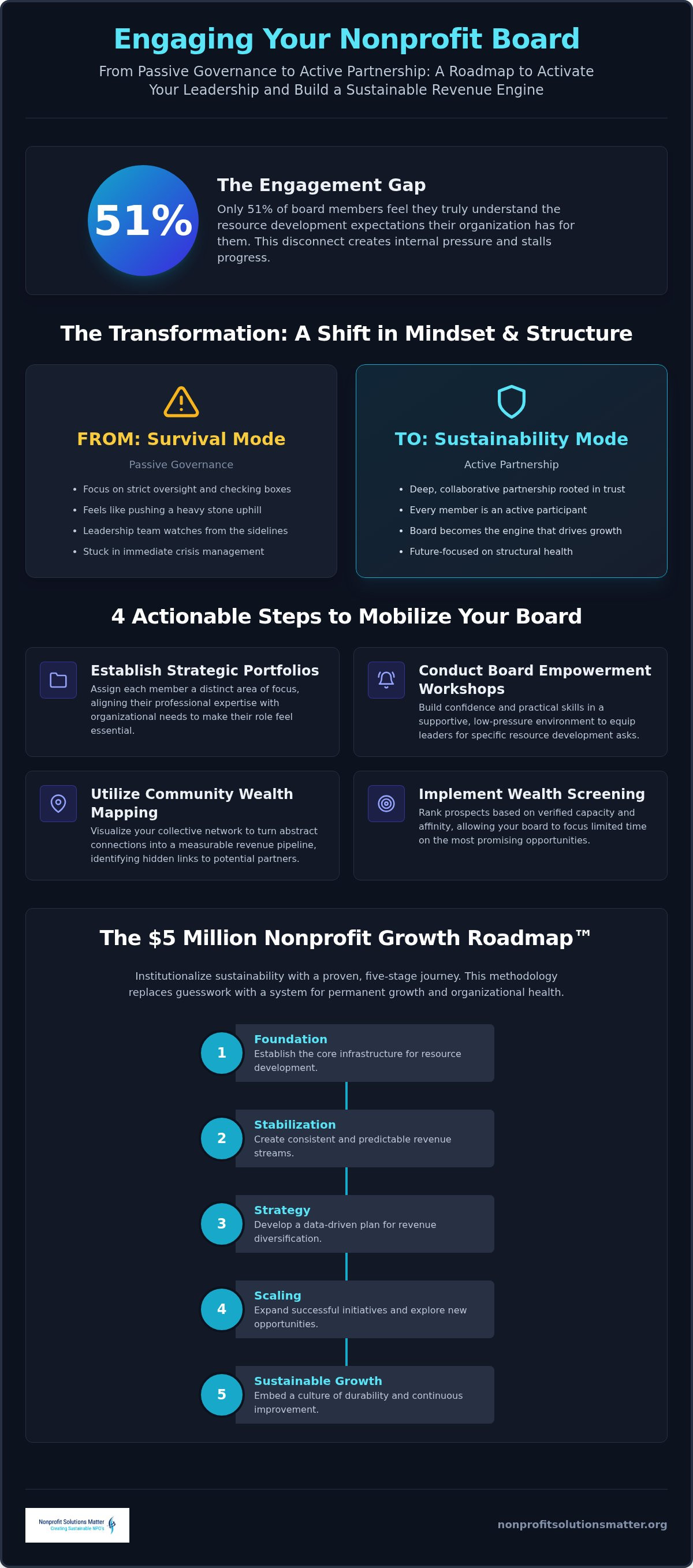
Only 51% of board members feel they truly understand the resource development expectations their organization has for them. If you've been wondering how to engage nonprofit board members effectively, you aren't alone. It often feels like you're pushing a heavy stone uphill while your leadership team watches from the sidelines. Managing a group that only shows up for meetings without taking action creates significant internal pressure and stalls your progress. You deserve a partner in this mission. This guide reveals how to transform your board from a passive governance body into a high-impact partner. We'll outline a sustainability roadmap that activates every member through structured resource development and revenue diversification. This strategic approach moves your organization away from immediate crisis toward a future of structural health and permanent growth.
Key Takeaways
- Transition from passive governance to active partnership by moving your leadership team out of "Survival Mode" and into a sustainable, future-focused model.
- Discover the structural framework for how to engage nonprofit board members through Strategic Portfolios that align individual talents with resource development needs.
- Equip your leadership team with the confidence to drive revenue diversification through Board Empowerment workshops.
- Implement the $5 Million Nonprofit Growth Roadmap™ to build a permanent revenue engine; book a 30-minute free consultation to start your strategic audit.
From Passive Governance to Active Partnership: The Engagement Framework
True board engagement isn't about perfect attendance or checking off boxes during a meeting. It's a deep, collaborative partnership rooted in trust and future-oriented deliberations. While the legal duties of boards of directors provide a baseline, high-impact leadership requires more. Many organizations struggle with how to engage nonprofit board members when they're stuck in Survival Mode. We want to move you into Sustainability Mode. In this state, every member is an active participant in revenue diversification.
Engagement often fails because the underlying architecture is weak. You can't expect a board to perform without a clear system. This is why a Resource Development Audit is essential. It provides the architectural integrity needed to support your mission's moral purpose. When these elements align, your board stops being a burden and starts being the engine that drives your growth.
Identifying the Structural Gaps in Your Board
Understanding how to engage nonprofit board members starts with a clear-eyed look at your current reality. We use our proprietary Resource Development Performance Diagnostic™ to analyze eight specific dimensions of revenue readiness. This tool helps distinguish between a governance-only board, which focuses strictly on oversight, and a true resource development partner. If your leadership team feels disconnected from the mission's financial health, it's likely a structural issue, not a personal one.
Ready to bridge these gaps? You can book a 30-minute free consultation to discuss your board's specific needs. If you're ready for a deeper transformation, feel free to apply to work with Sharon directly.
5 Actionable Steps to Mobilize Your Board for Resource Development
Mobilizing a board requires moving beyond high-level theory into tactical execution. To master how to engage nonprofit board members, you must replace vague requests with specific, data-backed directives. This transition shifts the focus from passive oversight to active contribution, ensuring every leader understands their unique value to the mission's growth.
- Establish Strategic Portfolios: Assign every member a distinct area of focus. This ensures their professional expertise aligns with organizational needs, making their role feel essential rather than optional.
- Conduct Board Empowerment Workshops: Many leaders hesitate because they feel ill-equipped for specific asks. These workshops build confidence and practical skills in a supportive, low-pressure environment.
- Utilize Community Wealth Mapping: This process visualizes your collective network. It turns abstract connections into a measurable revenue pipeline by identifying hidden links between your mission and potential partners.
- Implement Wealth Screening: Rank prospects based on their verified capacity and affinity. This allows your board to focus their limited time on the most promising opportunities rather than guessing where to start.
Activating Network Potential Through Data
Effective engagement requires a deep understanding of the motivations for board service. People join your leadership team because they want their time to result in a tangible impact. When you understand how to engage nonprofit board members by aligning their personal networks with data, you turn passion into a sustainable engine. Instead of simply asking "who do you know," use data-driven prospect research to guide their efforts. Equip your team with a persuasive case-for-support that directly links their passion to the long-term goal of revenue diversification.
Providing these structural tools removes the friction that often leads to leadership burnout. If you're ready to see how these strategic steps apply to your specific team, you can schedule a 30-minute free consultation to begin your leadership activation.
Institutionalizing Sustainability Through Strategic Infrastructure
Sustainability isn't a destination. It's an architectural standard. To truly master how to engage nonprofit board members, you must move beyond temporary excitement and build a permanent infrastructure. We guide organizations through the $5 Million Nonprofit Growth Roadmap™. This proprietary five-stage journey transitions your team from a shaky Foundation to sustainable, scalable Growth. It replaces guesswork with a proven methodology that prioritizes systemic health over short-term fixes. By aligning your board with this roadmap, you create a culture of durability.
Maintaining this momentum requires more than good intentions. We recommend a 90-day implementation calendar paired with real-time growth dashboards. These tools ensure accountability remains high. They turn abstract goals into concrete, manageable milestones. When every member sees the data, the path forward becomes undeniable. Sustainable engagement is a continuous cycle. It requires ongoing education and clear performance metrics to thrive. It's about building a system that outlasts any individual leader.
The Role of Professional Coaching in Board Success
Internal pressures often create a disconnect between staff and leadership. One-on-one coaching for CEOs and Directors helps bridge this gap effectively. It provides a confidential space for strategic dialogue, which is vital for navigating governance challenges or managing "Founder’s Syndrome." This professional support allows you to adopt best leadership practices without the noise of daily operations. It transforms the way you approach how to engage nonprofit board members by refining your own executive presence.
If you're ready to institutionalize these systems, apply to work with Sharon for personalized board transformation. You can also book a 30-minute free consultation to discuss your specific 90-day roadmap and resource development goals.
Building a Sustainable Legacy Through Leadership
Transforming your leadership team from a passive body into a high-impact partner requires more than inspiration; it demands a structural shift. By moving away from survival tactics toward the architectural integrity of the $5 Million Nonprofit Growth Roadmap™, you ensure your organization's durability. We've explored how to engage nonprofit board members through Strategic Portfolios and data-driven Community Wealth Mapping. These systems turn abstract networks into measurable revenue pipelines. Sharon D. Jones has used these proprietary frameworks to help global nonprofits raise over $950 million. Whether you lead a small, BIPOC-led, or faith-based organization, your mission deserves a sustainable engine driven by active partnerships.
Book your free 30-minute strategy call today. You don't have to navigate this transition alone. A steady, experienced hand is ready to guide your leadership toward structural permanence and long-term growth.
Frequently Asked Questions
How much time should board members commit to resource development each month?
Board members should commit approximately two to four hours per month to active resource development efforts. This time investment goes beyond attending meetings. It includes tasks like Community Wealth Mapping, donor stewardship, or professional networking. When you define how to engage nonprofit board members through these specific monthly actions, you create a sustainable rhythm that prevents leadership burnout and drives consistent revenue growth.
What is the difference between a governance board and a resource development board?
A governance board focuses primarily on compliance, legal oversight, and fiduciary duties. In contrast, a resource development board acts as a high-impact partner in revenue diversification. While every board has legal responsibilities, an engaged board moves beyond passive oversight to actively open doors, leverage networks, and secure the financial resources necessary for long-term mission sustainability and structural health.
How do I handle a board member who is passionate about the mission but refuses to assist with revenue diversification?
Start by identifying their unique strengths through a Strategic Portfolio. Not every member needs to make a direct "ask" for money. Some may excel at prospect research, while others are better suited for stewardship or technical oversight. When you learn how to engage nonprofit board members by aligning their passion with specific, non-solicitation tasks, they often become your most valuable advocates.
Can a small nonprofit with a volunteer board implement a $5 million growth roadmap?
Yes, the $5 Million Nonprofit Growth Roadmap™ is designed as a staged journey specifically for organizations of all sizes. It starts with a solid foundation and moves through discovery and activation before reaching the growth phase. Even with a volunteer team, following this structured framework allows you to build the necessary infrastructure to scale your impact. Book a 30-minute free consultation to start.
Article by
Sharon D Jones
Sharon D. Jones, M.Div., is a globally respected fundraising strategist, nonprofit leadership expert, and capacity-building architect with over three decades of experience. As the Founder and CEO of Nonprofit Solutions Matter, Inc., her proprietary growth frameworks have successfully mobilized nearly $957 million in philanthropic capital for local, national, and international organizations.
General Disclaimer & Disclosure
The information provided on this website is for general informational and educational purposes only. While we strive to keep content accurate and up to date, we make no representations or warranties of any kind, express or implied, about the completeness, accuracy, reliability, or suitability of the information contained herein.
Professional Advice
The content on this site does not constitute professional advice (e.g., legal, financial, medical, or tax). You should consult with a qualified professional before making any decisions based on the information provided on this website. Any action you take upon the information found on this site is strictly at your own risk.
Affiliate & Third-Party Links
Some articles on this site may contain affiliate links. If you click on an affiliate link and make a purchase, we may receive a small commission at no additional cost to you. We only recommend products or services we believe add value to our readers. We are not responsible for the content, privacy policies, or practices of any third-party websites linked within our articles.


