
What if the paperwork you're filing today is actually the ceiling that limits your growth three years from now? It's a common fear among visionary founders. You want to focus on your mission, yet you're likely feeling overwhelmed by administrative requirements and the pressure to get your articles of incorporation for nonprofit exactly right. It's frustrating to feel like a legal technicality might delay your IRS approval or stall your momentum before you even begin.
This document is more than just a filing; it's the first stage of the $5 Million Nonprofit Growth Roadmap. In this 2026 guide, you'll learn how to build a legal foundation that moves your organization from survival to long-term sustainability. We'll provide a clear, actionable path that covers both state and federal needs, ensuring your structure supports future revenue diversification. By the end, you'll have the confidence to move forward with a checklist designed for permanent growth and structural integrity.
Key Takeaways
- See why a generic template for your articles of incorporation for nonprofit might hold you back and how to draft a document that serves as a permanent blueprint for your mission.
- Get the practical steps you need to pick a strategic name and appoint a registered agent so your organization is legally sound and ready to scale.
- Understand how your legal structure sets the stage for successful resource development and revenue diversification as your organization grows.
- Learn how to transition from a startup mindset to a sustainable model, then book a strategy call to ensure your foundation is built to last.
Why Your Articles of Incorporation Are the Blueprint for Sustainability
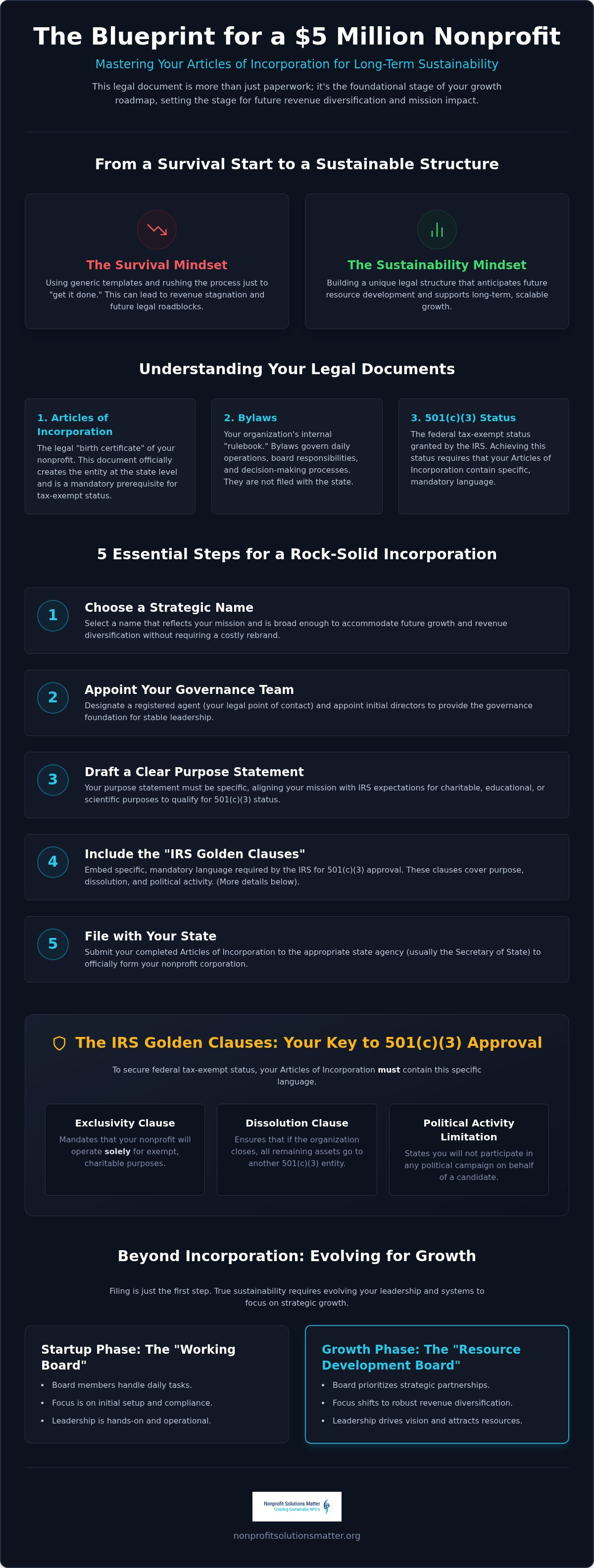
Think of your articles of incorporation for nonprofit as more than just another administrative box to check. It's effectively the legal "birth certificate" of your mission and the first stage of the $5 Million Nonprofit Growth Roadmap™. While many founders rush through this step with a survival mindset, simply filing to "get it done," this document is actually the structural foundation for everything you'll build. When you learn about the incorporation process, you see it's about creating a distinct legal entity capable of holding assets and protecting your vision for the long haul.
Generic templates are a common trap. They often lead to revenue stagnation because they don't account for the unique ways your organization might grow. If your language is too narrow, you could face an IRS rejection or find yourself unable to pursue specific revenue diversification strategies down the road. Building for 2026 and beyond requires a sustainability mindset. You need a structure that anticipates future resource development needs rather than one that just meets the bare minimum for today's crisis.
The Difference Between Articles, Bylaws, and Tax-Exempt Status
It's easy to get these terms mixed up. Your Articles create the entity at the state level; this is the mandatory prerequisite for applying for federal 501(c)(3) status. In contrast, your Bylaws serve as the internal "rulebook" for daily operations. During this initial phase, your Board of Directors must ensure these documents reflect a long-term vision. If you're ready to build a foundation that lasts, book a strategy call today to ensure your legal setup is geared for growth.
5 Essential Steps to Incorporate Your Nonprofit for Long-Term Success
Moving from a visionary idea to a legal reality requires a methodical approach. When you're drafting your articles of incorporation for nonprofit, you're not just filling out a form. You're setting the trajectory for your organization's future sustainability. It's easy to get lost in the legalese, but following these steps keeps your foundation solid and ready for growth.
Step 1 is selecting a strategic name. Don't just pick something that sounds good today. Think about where you want to be in a decade. Is the name broad enough to support future revenue diversification without requiring a costly rebrand? Next, you'll need to appoint a registered agent and your initial directors. These individuals provide the governance foundation necessary for stable leadership. You can find excellent nonprofit compliance resources from the Attorney General to help you navigate these state-level requirements and ensure your board is ready for the work ahead.
Your purpose statement must align your mission with IRS expectations. This isn't the place for vague aspirations. Instead, focus on the specific charitable goals that will drive your future growth. If you're feeling overwhelmed by these details, our Legal Incorporation Services can guide you through every requirement and ensure you're set up for success.
The IRS Golden Clauses: Drafting for 501(c)(3) Approval
To secure 501(c)(3) approval, you must include specific language known as the "Golden Clauses." The Exclusivity Clause mandates that your nonprofit operates solely for exempt purposes. The Dissolution Clause ensures that if the organization closes, all remaining assets go to another 501(c)(3) entity. Finally, the Political Activity Limitation ensures you won't participate in any political campaign on behalf of a candidate. Book a strategy call today to ensure your articles of incorporation for nonprofit include this vital language.
Moving from Legal Setup to Sustainable Revenue Diversification
Filing your articles of incorporation for nonprofit is a major milestone. It's the legal green light for the journey ahead. Think of it as the first stage of the $5 Million Nonprofit Growth Roadmap™. Once the paperwork is processed, your focus must shift from basic compliance to long-term sustainability. Now the real work begins. Your legal structure becomes the engine for Community Wealth Mapping and robust donor acquisition.
Moving past the startup phase means evolving your leadership. Many organizations begin with a "working board" where members handle daily tasks. To scale, you need to transition into a "resource development board" that prioritizes revenue diversification and strategic partnerships. You'll also need technical assistance to navigate the setup of your initial CRM and giving platforms. While business guides often explain how to start a nonprofit, the real challenge is building the systems that keep it running.
The Nonprofit Starter Pack: Your Sustainability Toolkit
We designed our Nonprofit Starter Pack with Voltie-like precision to help new founders avoid common pitfalls. A key part of this is the Resource Development Audit. It's a proactive tool that helps prevent "Founder’s Syndrome" by establishing clear systems and shared governance early on. View your successful legal setup as your first big win in a much larger strategy. It's time to move from the excitement of "starting" to the impact of "sustaining." If you're ready to build a mission that lasts, book a strategy call today to map out your next steps.
Build a Foundation That Fuels Your Future Impact
Drafting your articles of incorporation for nonprofit isn't just about crossing a legal finish line; it's about setting the stage for decades of systemic health. You now have the roadmap to move beyond generic templates and create a structure that supports complex resource development and revenue diversification. We've spent over 30 years helping organizations like yours navigate these shifts, contributing to over $950 million raised for global missions. As a registered 501(c)(3) ourselves, we understand the weight of your calling and the strategic architecture needed for long-term growth.
Your mission is too important to leave to chance. Take this first win and turn it into a legacy of sustainability. We are here to help you architect that future with confidence and clarity.
Frequently Asked Questions
What is the difference between Articles of Incorporation and Bylaws?
Your articles of incorporation for nonprofit are the public documents that legally create your entity with the state. They act as your "birth certificate." Bylaws, on the other hand, are an internal document that serves as your board's operating manual. While the articles tell the government who you are, the bylaws tell your team how to make decisions and manage daily governance.
Can I change my Articles of Incorporation after I have filed them with the state?
You can definitely update them. As your mission grows or your revenue diversification strategies shift, you might need to file an "Article of Amendment" with your Secretary of State. This is a common part of organizational evolution. Just be sure that any changes you make still include the specific IRS language required to maintain your 501(c)(3) tax-exempt status.
Do I need a lawyer to draft my nonprofit articles of incorporation?
There's no legal requirement to hire an attorney, but having an expert hand is a great investment. Many founders choose our Legal Incorporation Services to ensure they don't miss the technical clauses that the IRS looks for. Getting this right from day one prevents the frustration of a rejected application and creates a professional foundation for your future resource development goals.
How long does it typically take to get 501(c)(3) approval after incorporating?
The timeline depends on which path you take with the IRS. If you qualify for the streamlined Form 1023-EZ, you'll typically receive your determination letter in 2 to 4 weeks. The full Form 1023 usually takes between 3 to 6 months for processing. Don't worry about the wait; your tax-exempt status is generally retroactive to your incorporation date if you file within 27 months.
If you're ready to stop guessing and start building a mission that lasts, we're here to help you get every detail right.

Article by
Sharon D Jones
Sharon D. Jones, M.Div., is a globally respected fundraising strategist, nonprofit leadership expert, and capacity-building architect with over three decades of experience. As the Founder and CEO of Nonprofit Solutions Matter, Inc., her proprietary growth frameworks have successfully mobilized nearly $957 million in philanthropic capital for local, national, and international organizations.
General Disclaimer & Disclosure
The information provided on this website is for general informational and educational purposes only. While we strive to keep content accurate and up to date, we make no representations or warranties of any kind, express or implied, about the completeness, accuracy, reliability, or suitability of the information contained herein.
Professional Advice
The content on this site does not constitute professional advice (e.g., legal, financial, medical, or tax). You should consult with a qualified professional before making any decisions based on the information provided on this website. Any action you take upon the information found on this site is strictly at your own risk.
Affiliate & Third-Party Links
Some articles on this site may contain affiliate links. If you click on an affiliate link and make a purchase, we may receive a small commission at no additional cost to you. We only recommend products or services we believe add value to our readers. We are not responsible for the content, privacy policies, or practices of any third-party websites linked within our articles.


